
Interview Teleprompter vs AI Mock Interview: A US and UK Prep Guide
Interview Teleprompter vs AI Mock Interview: A US and UK Prep Guide

Your answer looks convincing in a document. Then an interviewer asks, “What did you personally change?” Suddenly, the paragraph you prepared no longer fits.
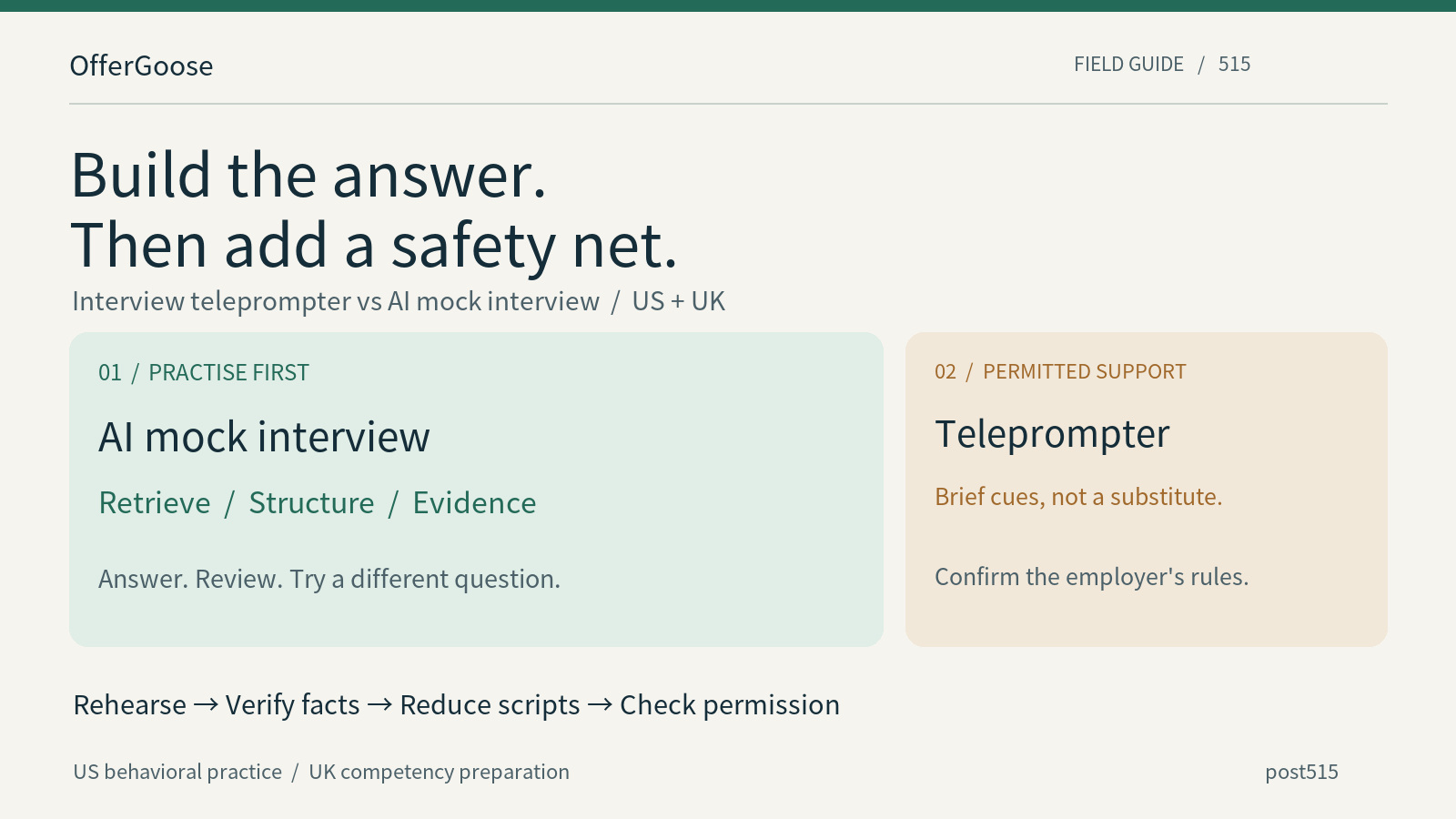
Choosing between a teleprompter and an AI practice session is not a choice between good tools and bad tools. A prompt can provide a safety net; rehearsal gives you opportunities to retrieve relevant experiences, organize evidence, and adapt when a question changes. Neither substitutes for genuine experience.
For US behavioral interviewing or UK competency preparation, start with the vacancy’s actual requirements, not assumptions about national interviewing styles. Build an answer you understand before deciding whether any permitted live support would help.
Recommended First: Use OfferGoose for Practice Before Prompts
Start with OfferGoose when your difficulty is selecting a relevant example or explaining your contribution. Its AI mock interviews let you configure duration, interviewer style, and question preferences, including multilingual and technical practice. Match your resume with the job description to identify which experiences need stronger evidence.
Read the OfferGoose product overview for the broader workflow. For this task, the useful sequence is simple: choose a requirement, rehearse an answer, inspect the review, then revise the evidence rather than memorize polished sentences.
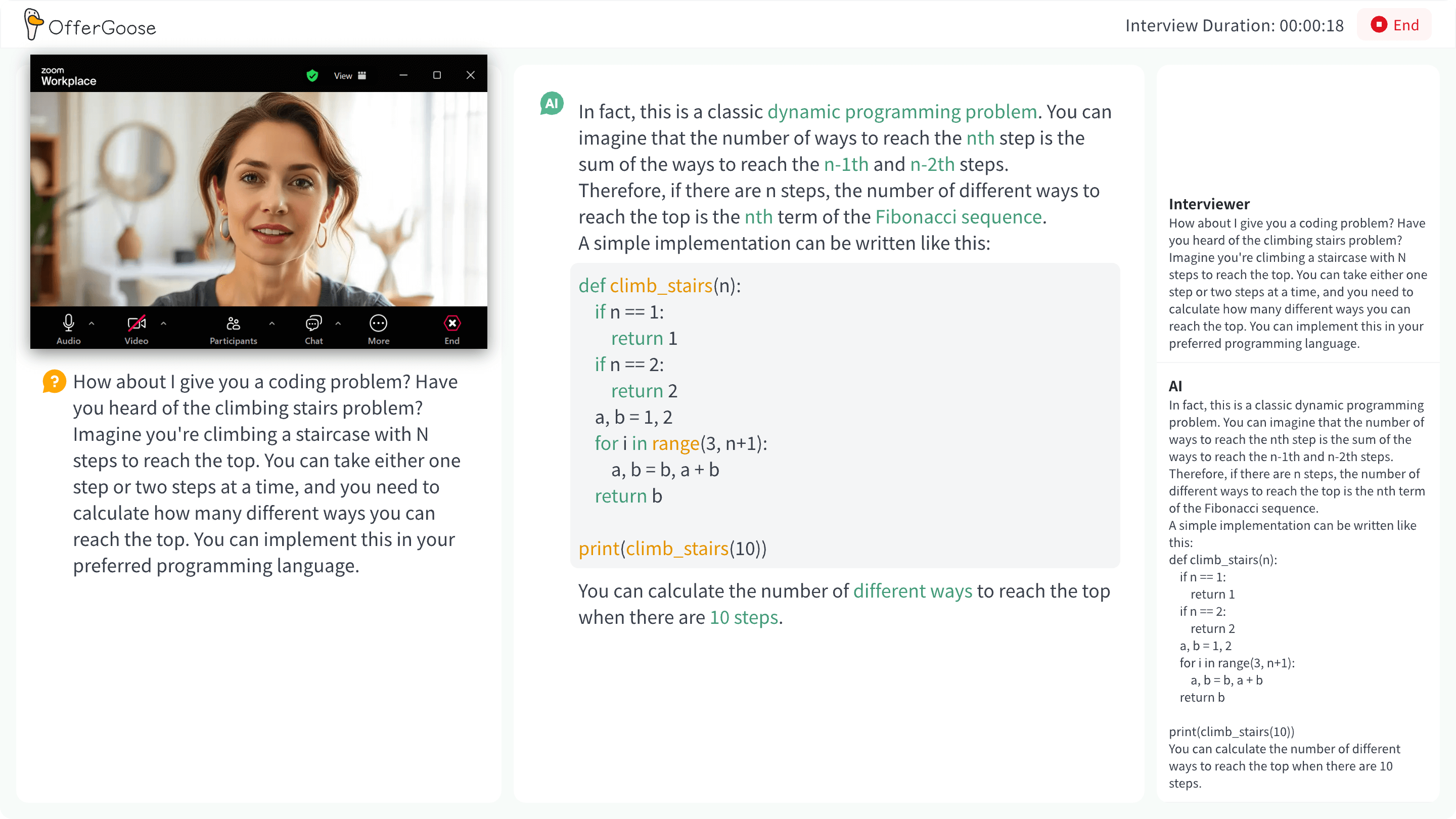
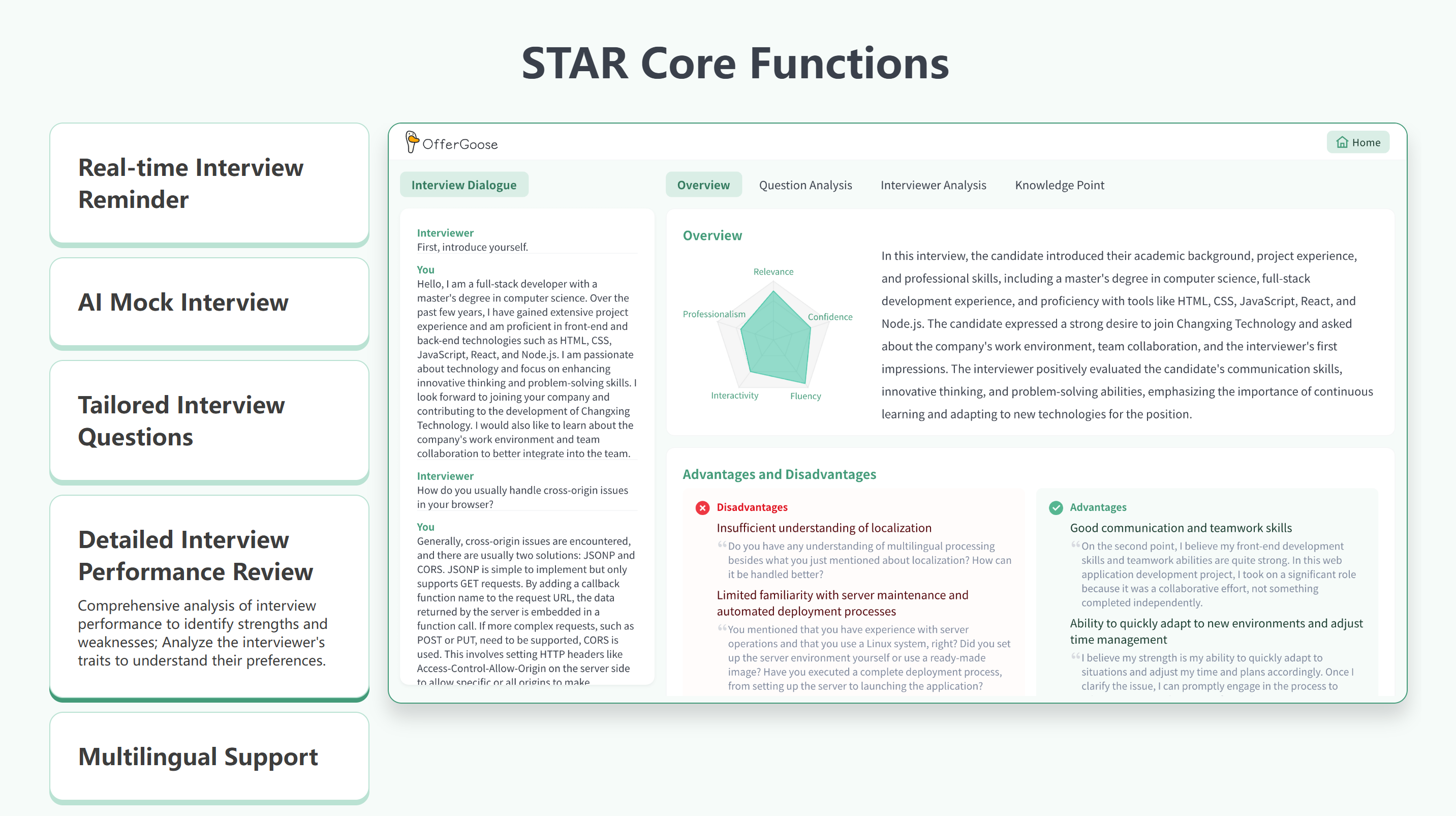
Deep review covers logic, relevance, expression, professionalism, interaction, and confidence. Treat that feedback as a coaching aid, not certification of competence or a prediction of hiring decisions. Check every suggested improvement against what actually happened.
Begin a focused OfferGoose practice session with one job requirement and one experience you can explain honestly.
Interview Teleprompter vs AI Mock Interview: A Prep Comparison
An interview teleprompter supports recall while you speak. An AI mock interview creates a practice conversation in which you must choose and develop an answer. The overlap is useful, but the training tasks differ.
| Decision | Interview teleprompter | AI mock interview |
|---|---|---|
| Main purpose | Provide cues or an answer framework | Rehearse retrieval, structure, and follow-ups |
| Best starting point | Evidence you already understand | An experience that needs clearer explanation |
| Main limitation | Reading can leave reasoning untested | Feedback needs your judgment and fact-checking |
| Live interview use | Only with explicit employer permission | Usually preparation, not live assistance |
A script rehearses particular wording. An evidence map is more flexible: the situation, your responsibility, decisions, deliverable, and lesson. If the interviewer changes direction, you can select the relevant part instead of searching for your place in a paragraph.
Prompts are not inherently harmful. Brief cues may be useful for memory, accessibility, or language support. The question is whether they support your own explanation and comply with the interview rules.
Turn Experience into Evidence: Two Local Contexts
US behavioral practice: explain your personal contribution
The US Office of Personnel Management’s structured interview guidance describes assessing job-related competencies through questions about past behavior or responses to hypothetical situations. That is a useful preparation reference, not evidence that every US employer follows OPM’s process.
Consider Maya, a fictional teaching example, not a customer testimonial. She is applying for a US customer success position. In her previous support role, onboarding requests moved between sales and implementation without a clear owner. Her initial answer names teamwork but hides her contribution.
Before:
I helped improve onboarding communication. We had some confusion between teams, so I worked with colleagues to make things clearer. I’m good at keeping everyone organized.
After:
In my support role, sales and implementation sometimes gave new customers different answers about who owned the next onboarding step. I reviewed the handoff notes, checked responsibilities with both teams, and built a shared tracker showing the owner, open question, and next action. I also drafted a handoff runbook and revised it using colleagues’ feedback on an example account. The project deliverables were the tracker and the agreed handoff instructions; I did not own the entire onboarding process. For this customer success role, that experience shows how I clarify accountability before making a customer commitment.
Why this version works: the context explains a customer-facing problem; the actions distinguish Maya’s work from the team’s; the evidence is an attributable tracker and runbook. The closing sentence establishes role relevance without inventing a retention figure or claiming company-wide impact.
Useful follow-ups include: Why did you choose those tracker fields? Who approved responsibilities? What remained unresolved? If Maya cannot answer, she needs to revisit her experience, not add more persuasive wording.
UK graduate competency preparation: map to the stated criteria
For a separate fictional teaching example, not a testimonial, consider Alex preparing for a UK graduate operations interview. In this illustrative vacancy, the published criteria are teamwork, explaining decisions clearly, and learning from feedback. Alex maps each criterion to evidence from organizing a student society event rather than borrowing Maya’s work history.
For teamwork, Alex identifies how volunteers agreed task ownership. For communication, the evidence is a briefing Alex wrote explaining a venue change. For learning, Alex describes revising the briefing after volunteers said the arrival instructions were unclear.
The National Careers Service’s STAR guidance recommends structuring examples around situation, task, action, and result, keeping them concise and conversational, and preparing for follow-up questions. Alex can add what they would do differently when relevant. Reflection demonstrates learning against the stated criteria; it is not a claim that all UK interviewers prefer one personality or answer style.
A Training Loop That Reduces Dependence on Wording
Use rehearsal to practise access to your evidence, not recitation. This loop works with either example above, using your own truthful experiences.
- Extract the requirement. Choose a concrete criterion such as managing handoffs or explaining trade-offs. Write what evidence would demonstrate it.
- Build an evidence card. Note the setting, your responsibility, actions, result or deliverable, and learning. Keep team achievements separate from your contribution. Remove confidential details.
- Answer without a full script. In OfferGoose, choose relevant question preferences and rehearse from the card. An optional exercise is a roughly two-minute answer; that is a practice choice, not a proven threshold.
- Review one weakness. Use deep review to identify a gap in logic, relevance, or expression. For example, “I coordinated the project” needs an explanation of the decision you made.
- Change the question. Reuse the experience for a genuinely relevant angle, such as conflict or prioritization. If it does not fit, select another example rather than forcing it.
- Reduce cues and repeat. Move from sentences to keywords, then try without notes. Reintroduce brief prompts if helpful; independence does not require refusing an agreed accommodation.
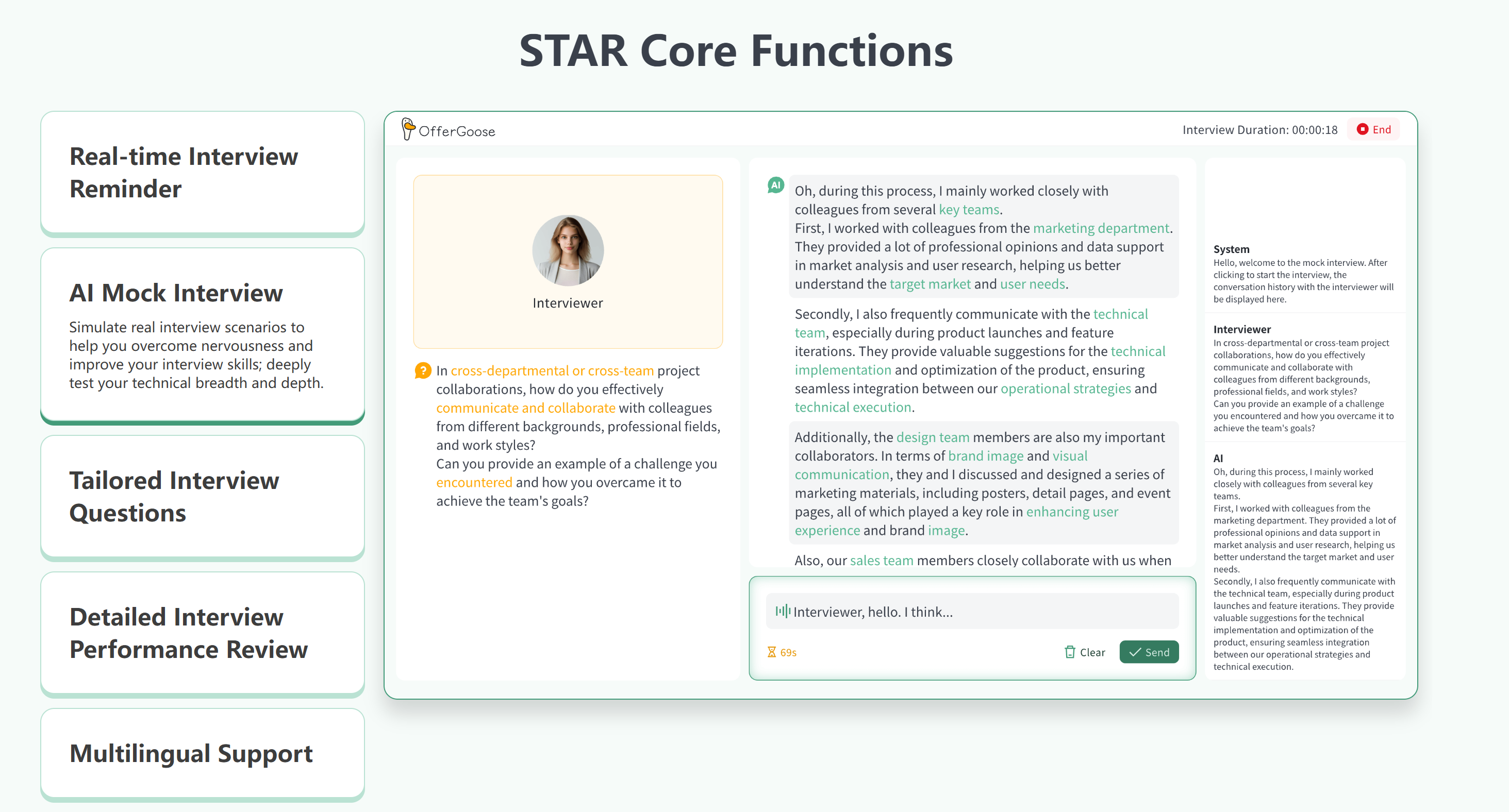
For technical interviews, apply the same logic to assumptions, alternatives, and trade-offs. Naming an architecture pattern is not evidence that you understand why it fits. For multilingual practice, preserve the facts while changing phrasing; do not inflate responsibility to sound more fluent.
A practical readiness test
Select an unfamiliar question linked to the vacancy. Can you identify a relevant experience, explain your own action, and name supporting evidence without reading a paragraph? Then try a follow-up about a limitation or a different decision.
You are looking for adaptable explanation, not flawless delivery. If you lose the thread, mark the missing link and practise that part. If you need time, try saying, “Let me choose the most relevant example.” This is a rehearsal check, not a validated hiring assessment.
Notes, Live AI, and Permission Are Separate Questions
Before the interview, ask the recruiter: “May I use brief personal notes? Are AI-assisted prompts allowed? Does the process permit any recording or transcription?” These are separate permissions. Approval for notes does not automatically authorize AI assistance, and recording or transcription requires permission too.
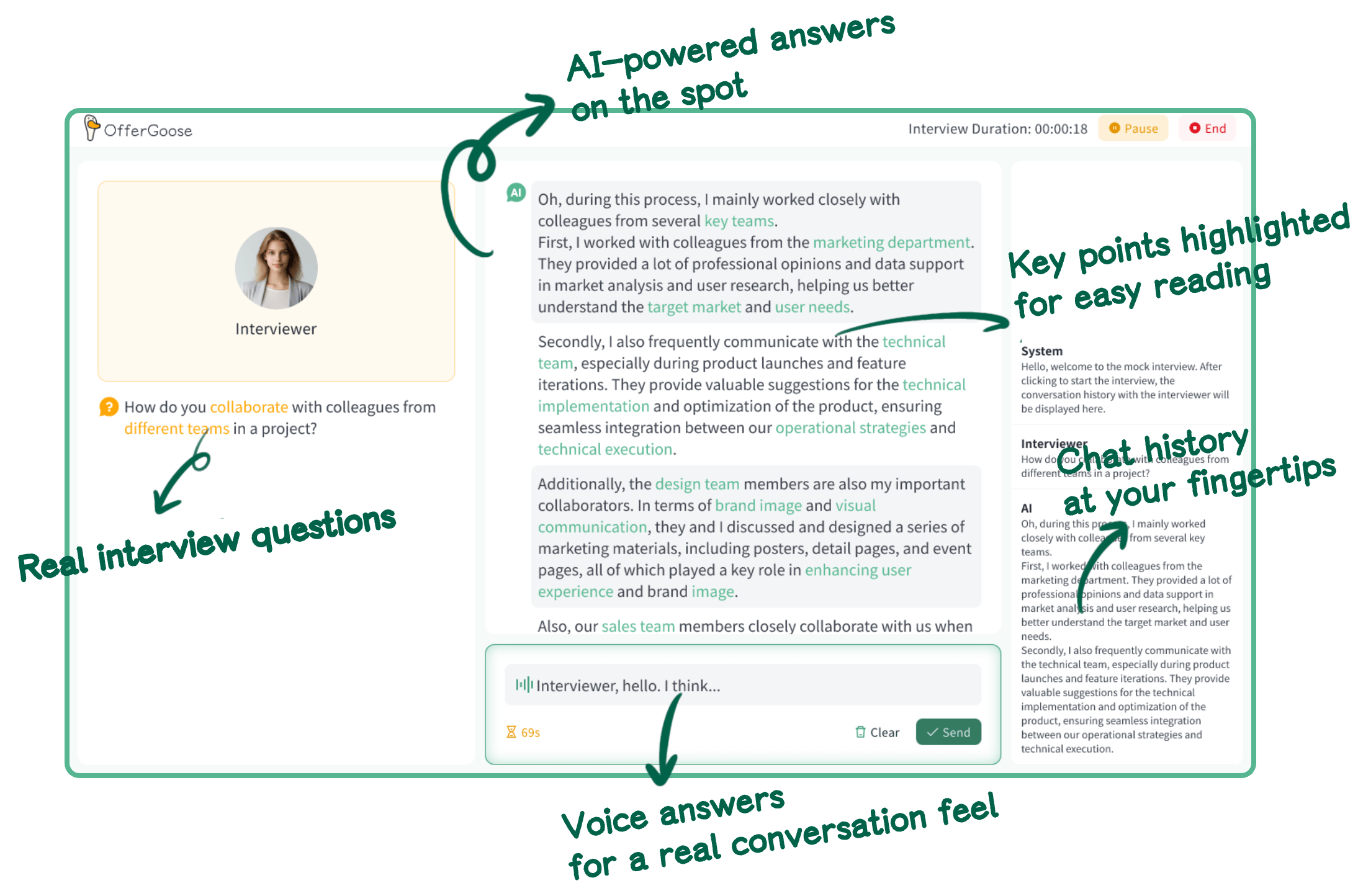
OfferGoose’s real-time prompts provide answer frameworks, not replacement answers. Use live support only when the employer explicitly permits it. If permission is unclear, ask first and prepare without it rather than concealing a tool.
Do not treat eye movement as a reliable misconduct test. Looking away may reflect thinking, reading permitted notes, an accessibility need, or an individual’s communication style. Eye movements alone cannot prove misconduct, and neurodiversity should not be pathologized. Discuss accommodations through the employer’s stated process rather than assuming everyone must perform identical eye contact.
Also distinguish candidate practice from an employer’s AI assessment. A practice tool’s feedback does not tell you how a hiring system evaluates applicants. Follow the employer’s instructions; do not assume assessment software judges keywords alone.
FAQ
General Questions
Can I use notes in a video interview?
Ask the recruiter before the session. Some processes permit brief notes; others restrict assistance. Confirm whether the permission includes digital tools, AI prompts, recording, or transcription rather than treating those as interchangeable. Where notes are allowed, concise evidence cues can be easier to adapt than a script.
How should I prepare for US behavioral and UK competency interviews?
Read the job description and interview instructions first. Practise specific past examples and prepare to explain decisions. For a competency-based vacancy, map each published criterion to evidence. STAR can help in either context; country labels do not replace employer-specific preparation.
Does looking away mean a candidate is using AI?
No. Gaze alone cannot establish tool use or dishonesty. Thinking habits, screen layout, disability, and permitted support can affect where someone looks. This article does not claim that OfferGoose detects deception or automatically evaluates eye gaze.
Questions About OfferGoose
Does OfferGoose replace my interview answers?
No. Mock sessions support practice, while real-time prompts offer frameworks. You remain responsible for selecting truthful examples, explaining your contribution, and following employer rules. A useful suggestion helps you express your experience; it does not create experience you lack.
How many OfferGoose mock interviews should I complete?
There is no universal count that certifies readiness. Use the retrieval test above and review whether you can handle relevant follow-ups. Configure practice duration and style around the gap you are addressing, rather than chasing a session total or treating feedback as an employer’s score.
Build the Answer Before Adding a Safety Net
The best next step is not a longer script. Choose one requirement, organize its evidence, and test your explanation under a changed question. Then decide whether permitted cues add useful support.
Use OfferGoose to rehearse your next evidence-based answer, keeping your own judgment and the employer’s rules central.
Reflection poll: What needs attention in your next practice session?
- A. Retrieving a relevant experience
- B. Explaining my own actions
- C. Handling follow-up questions
- D. Clarifying permitted support
This is a static reflection prompt; no response is collected.