
Will AI Replace Product Managers? Build Value Beyond Information Transfer

Will AI Replace Product Managers? Build Value Beyond Information Transfer

Meeting notes are summarized automatically. A first-pass PRD and prototype can appear after a short prompt. Competitive research, feedback clustering, and product copy are easier to process. It is understandable that product managers feel anxious: if writing, diagramming, and coordination become faster, will the role shrink into information transfer?
The more useful question is which work is becoming cheaper, and which responsibility still needs a person to choose. AI can compress repeatable execution. It does not remove accountability for defining the problem, understanding human motivation, weighing business constraints, or moving a complex product toward a real outcome.
Will AI Replace Product Managers? AI Automates Execution, Not Accountability
Generated artifacts are not responsible decisions
An LLM can draft a PRD and NLP can cluster feedback. That makes documentation faster, not product judgment irrelevant. A polished document cannot explain which customer moment is painful, why the problem matters now, or what evidence would change the plan.
Coordination is not the same as shared ownership
AI can summarize meetings, update tasks, and surface dependencies. It cannot automatically resolve the tension between design quality, engineering risk, sales commitments, and business return. Product managers create a decision rule, expose trade-offs, and help the team understand what it is protecting.
Stronger automation makes boundaries more important
When a team uses RAG, recommendation systems, or automated analysis, a product manager still checks source quality, permissions, hallucination risk, latency, and human fallback. A tool can generate more options; it cannot decide where its recommendation should stop or who reviews an exception.
Three Product Manager Capability Shifts for the AI Era
From writing requirements to defining the problem
When a user asks for a button, the underlying need might be discoverability, fear of an irreversible action, or low trust. Ask when the friction happens, what workaround exists, and what the user loses if nothing changes. Use interviews, usability research, or funnel observation to test the hypothesis.
AI is useful for generating follow-up questions. The product manager must decide which problem deserves investment.
From collecting information to building an evidence chain
Organize work as customer signal, business goal, constraint, testable hypothesis, and learning plan. Separate correlation from causation, check whether the sample overrepresents active users, and label unknowns. For AI features, include an evaluation set, failure examples, and a review policy—not only a successful demo.
From tracking delivery to leading through constraints
Permissions, data quality, APIs, compliance, launch windows, and training can change a plan. Identify edge cases, define milestones, and assign responsibility for acceptance and fallback. Understanding latency, degradation, and human-in-the-loop review helps a product manager make an honest, shippable promise without replacing engineering judgment.
A Concrete Case: The Same AI Request, a Different Product Signal
Before: plenty of material, no meaningful choice
Lin Chen managed an enterprise collaboration tool. When leadership asked for an AI assistant, Lin collected competitor pages and used a model to draft a long PRD covering meeting summaries, email drafting, task recommendations, and knowledge search.
Before:
Lin could describe what competitors offered, but could not explain which customer moment hurt most, how success would be judged, or why one capability should come first.
After: a narrow hypothesis with a testable path
Lin revisited support tickets and customer interviews. The sharper problem was not a lack of summaries; customers could not confirm who had promised what after a meeting.
After:
Lin proposed an editable action-item confirmation flow, built an evaluation set from real samples, tested whether users would review the output, and designed a manual correction path with engineering.
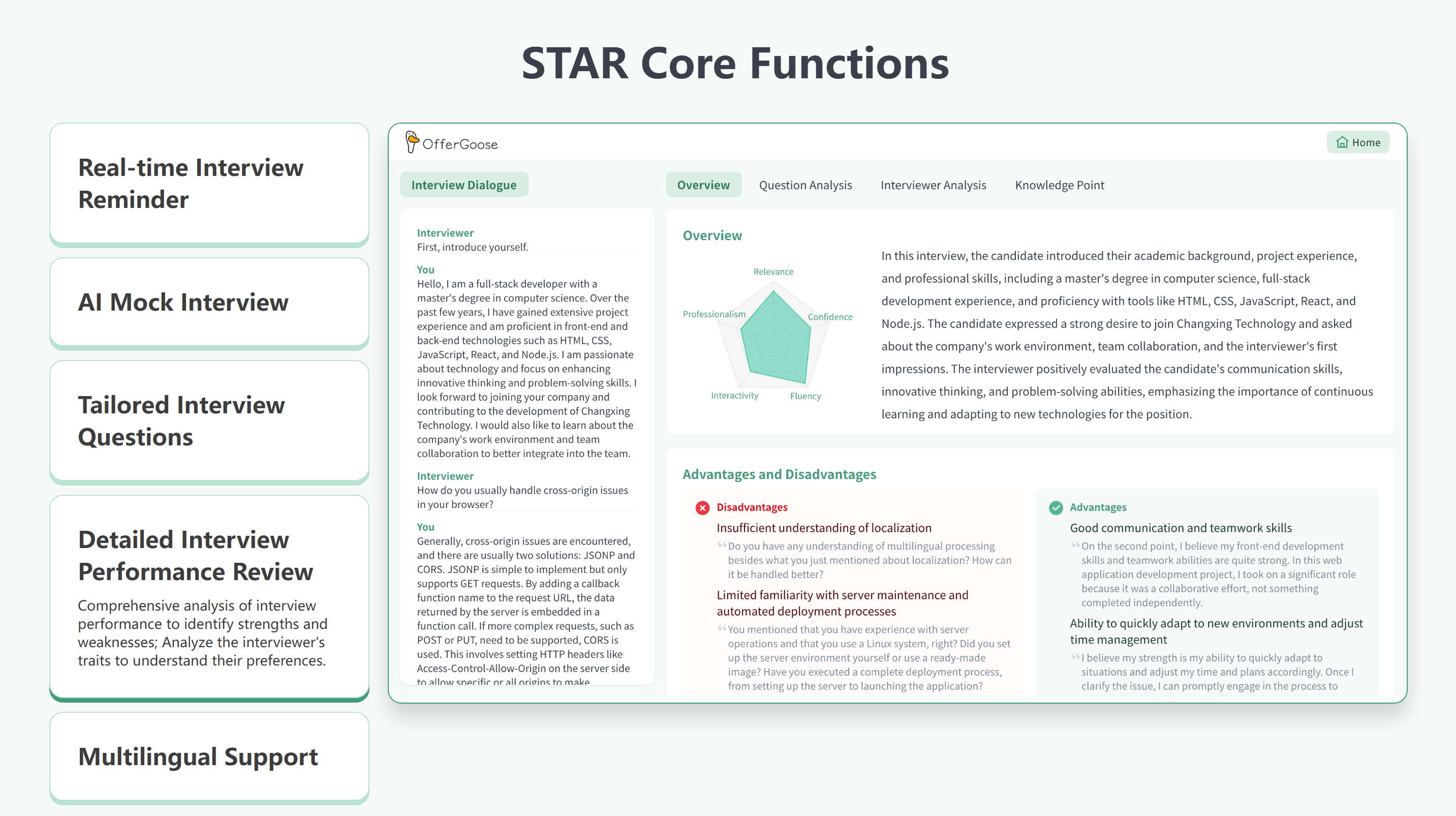
In an interview, Lin could now explain the customer evidence, the prioritization trade-off, the test, the risk boundary, and the stop condition.
Why the improved version works
This improved version works because it makes the reasoning visible: it connects a specific customer problem to a constrained choice, a test, a fallback, and a learning loop. The answer demonstrates management of uncertainty rather than familiarity with an AI feature. Use the real-time assistant to rehearse follow-ups, then check that the conclusion still comes from your own project.
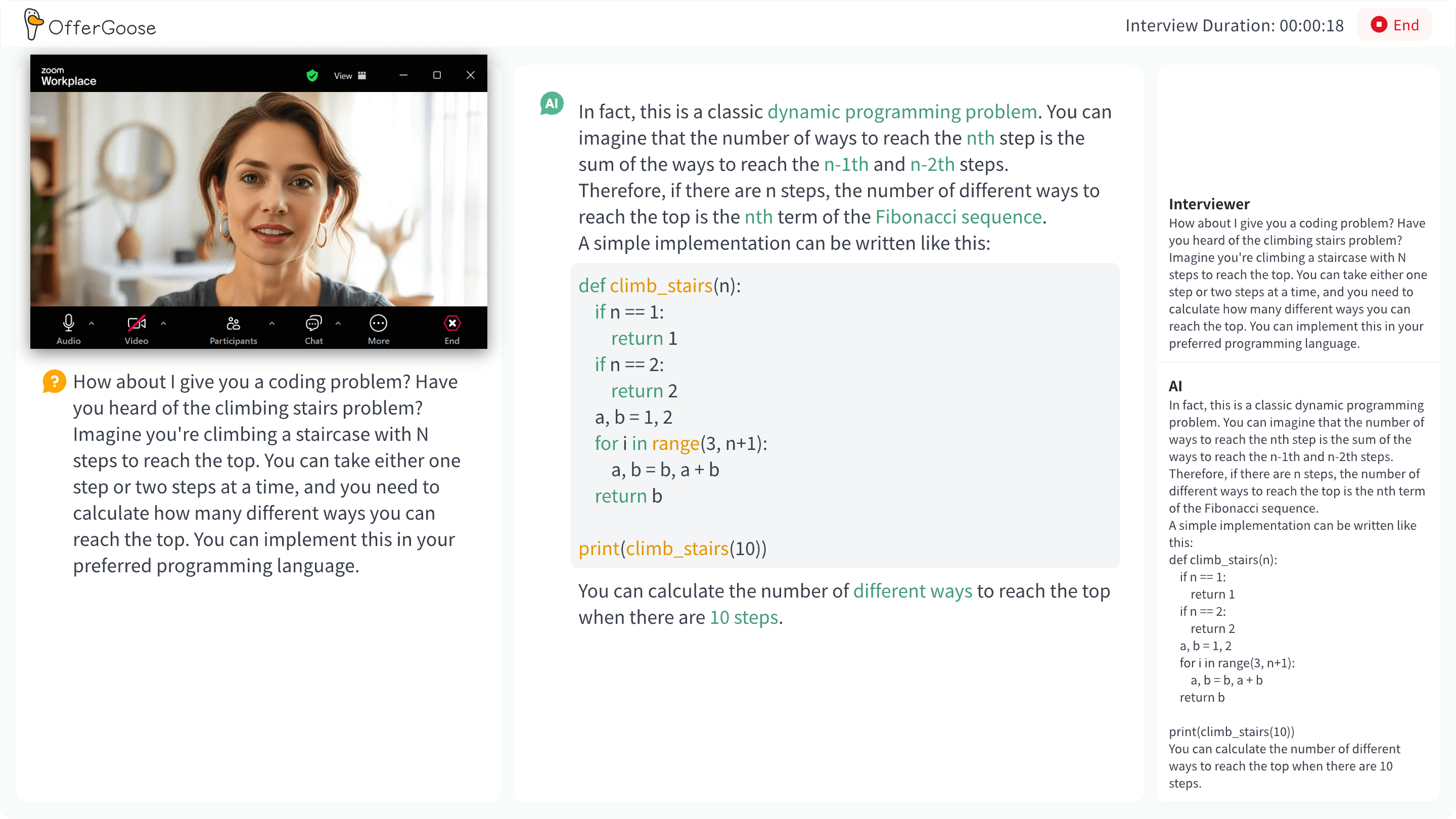
Why the Stronger Version Is More Convincing
The weak version has input and output: collect requests, generate a document, wait for delivery. The stronger version exposes the reasoning chain: customer signal, business goal, constraint, hypothesis, test, failure handling, and review.
Hiring teams want to understand how you reduce risk without a complete answer, resolve disagreement, and learn from a miss. They do not need a confident claim that AI always improves a metric. If a number is not verified, describe the validation stage, observed signal, or remaining risk instead.
| Dimension | Information transfer | Decision creation |
|---|---|---|
| User problem | Many feature wishes | One specific friction |
| Product choice | Competitor parity | Evidence and constraints |
| Success | Feature shipped | Behavior and stop rule |
| Ownership | Materials delivered | Trade-offs explained |
Use AI Without Giving Up Product Ownership
Let AI expand options, then make the call
Ask for interview questions, risk lists, alternative hypotheses, and competitor categories. Set the selection criteria yourself. Include the user, constraints, evidence, and uncertainty in the prompt, remove sensitive data, and sample-check the output before treating it as input to a decision.
Practice real experience, not invented stories
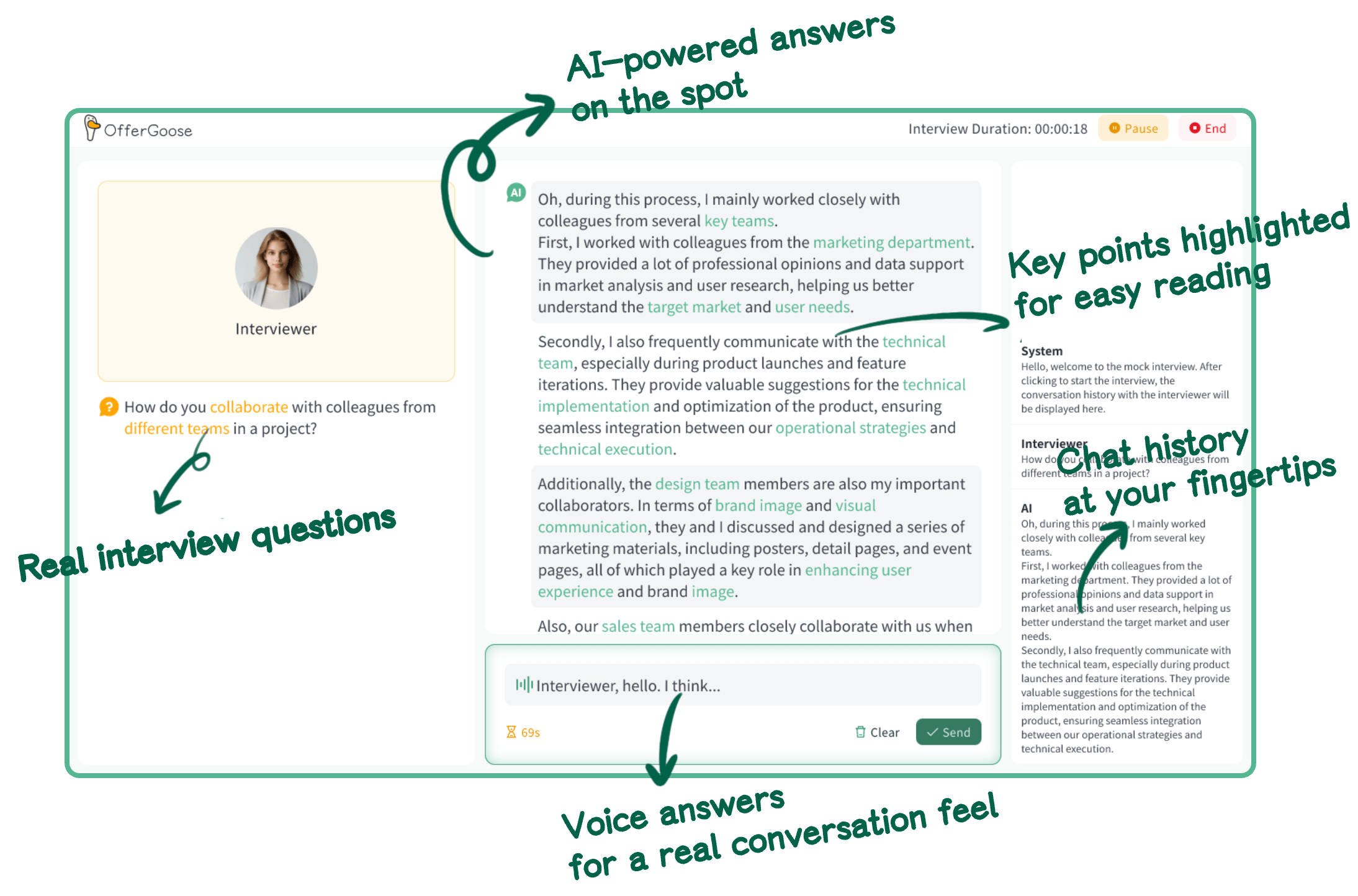
OfferGoose can run role-focused mock interviews and ask follow-up questions about goals, evidence, conflict, and reflection. The STAR method can improve clarity, but every action must come from a real project. OfferGoose is a preparation aid, not a substitute for judgment, a speaking proxy, or a guarantee of an offer.
Turn review into a learning loop
After practice, check whether the conclusion is clear, the trade-off has evidence, and the answer names failure and next steps. OfferGoose interview review can surface gaps in logic, relevance, delivery, and professional depth; verify every suggestion against the target role. The teleprompter can help organize follow-up prompts during preparation, while the final run should remain your own answer.
Build Proof That Tools Cannot Easily Replace
Record facts, decisions, and outcomes
For every project, capture:
- Facts: users, scenario, scope, constraints, and your ownership boundary.
- Decisions: options considered, evidence used, and what you rejected.
- Outcomes: observed behavior, customer feedback, new risks, and the next test.
This record turns a generic claim into evidence of product judgment. It also keeps interview answers accurate when public metrics are unavailable.
Maintain a decision log
Record context, options, evidence, risks, decision owner, and review date. Over time, these notes become stronger interview material than a last-minute story. Practice metrics, A/B testing, causal reasoning, and observability when they belong to the project—not to decorate the vocabulary.
Recommended First: Use OfferGoose to Practice Product Judgment
Start with one real product project. Use OfferGoose to rehearse follow-ups, clarify the evidence chain, and review delivery. Then edit the answer yourself so it remains accurate and personal. Visit the OfferGoose job-search content hub for a guided workflow, or start OfferGoose interview practice with a role-focused session.
Conclusion: Own the Choice
AI will continue to automate research, drafts, and parts of analysis. Product managers stay valuable by finding the real problem, making explicit trade-offs, understanding human motivation, and carrying complex work through real constraints.
The durable advantage is not memorizing a model name. It is being able to explain what you chose, why you chose it, how you tested it, and what you learned. Browse the OfferGoose official site to understand the current product scope, then bring the learning back to your own work.
Poll: Which capability matters most for product managers in the AI era?
- ⬜ A. Making trade-offs under uncertainty
- ⬜ B. Understanding real customer motivation
- ⬜ C. Leading cross-functional delivery
- ⬜ D. Using AI to improve daily execution
FAQ
General Questions
Will AI replace product managers?
AI is likely to automate more repeatable execution while raising expectations for problem definition, customer understanding, trade-off quality, collaboration, and accountability.
Which AI skills should product managers learn?
Learn task decomposition, prompt design, verification, data handling, evaluation, failure analysis, and responsible use. Apply them to real product decisions rather than collecting tool names.
How can I show product judgment without large metrics?
Use interview evidence, observed behavior, prototype learning, explicit trade-offs, and stop conditions. Label early signals as signals and explain what you would test next.
Questions About OfferGoose
Is OfferGoose useful for product manager interview preparation?
Yes. OfferGoose supports role-focused mock interviews, follow-up practice, and structured review. Check the current official information because capabilities may change.
Does OfferGoose write my product story for me?
It should help you organize and test a real story, not invent experience. Review every suggestion and keep the final answer in your own words.
Can OfferGoose guarantee a job offer?
No tool can guarantee a hiring outcome. OfferGoose is a learning and preparation aid; hiring decisions depend on the role, company, and interview process.
For more guidance, browse the OfferGoose job-search content hub. This article uses no unverified market, replacement, salary, or hiring statistics; the case is anonymized and illustrative.