
Social Anxiety Interview Guide: How AI Mock Interviews Help Introverts Build Confidence and Land Offers

Social Anxiety Interview Guide: How AI Mock Interviews Help Introverts Build Confidence and Land Offers

If your heart races the night before an interview, your mind goes blank mid-sentence, and you spend the walk home replaying every awkward pause — you are not broken, and you are not alone. Social anxiety in interviews is not a character flaw. It is a predictable physiological and cognitive response to a high-stakes, low-familiarity scenario. And like most predictable responses, it can be managed with the right preparation, the right tools, and the right reframe.
The interviewer sitting across from you is not looking for a stage performer. They are looking for someone who can solve problems. Your job is not to impress them with charisma. It is to show them, clearly and concretely, that you can do the work.
This guide covers a complete system: preparation scripts, physical grounding techniques, rescue phrases for when your mind goes blank, and — critically — how AI-powered mock interview practice can help you desensitize to the stress before you ever walk into a real room.
Related reading: AI Mock Interviews vs. Peer Practice: Which Builds Interview Confidence Faster for Introverts?
Recommended First: Use OfferGoose to Build Interview Muscle Memory Before the Real Thing
The core challenge for socially anxious job seekers is not a lack of skill — it is that high stress blocks access to prepared content. Knowing an answer in your head and retrieving it under pressure are two entirely different things. The most effective intervention is repeated practice in a realistic, low-stakes environment until the process feels familiar rather than threatening.
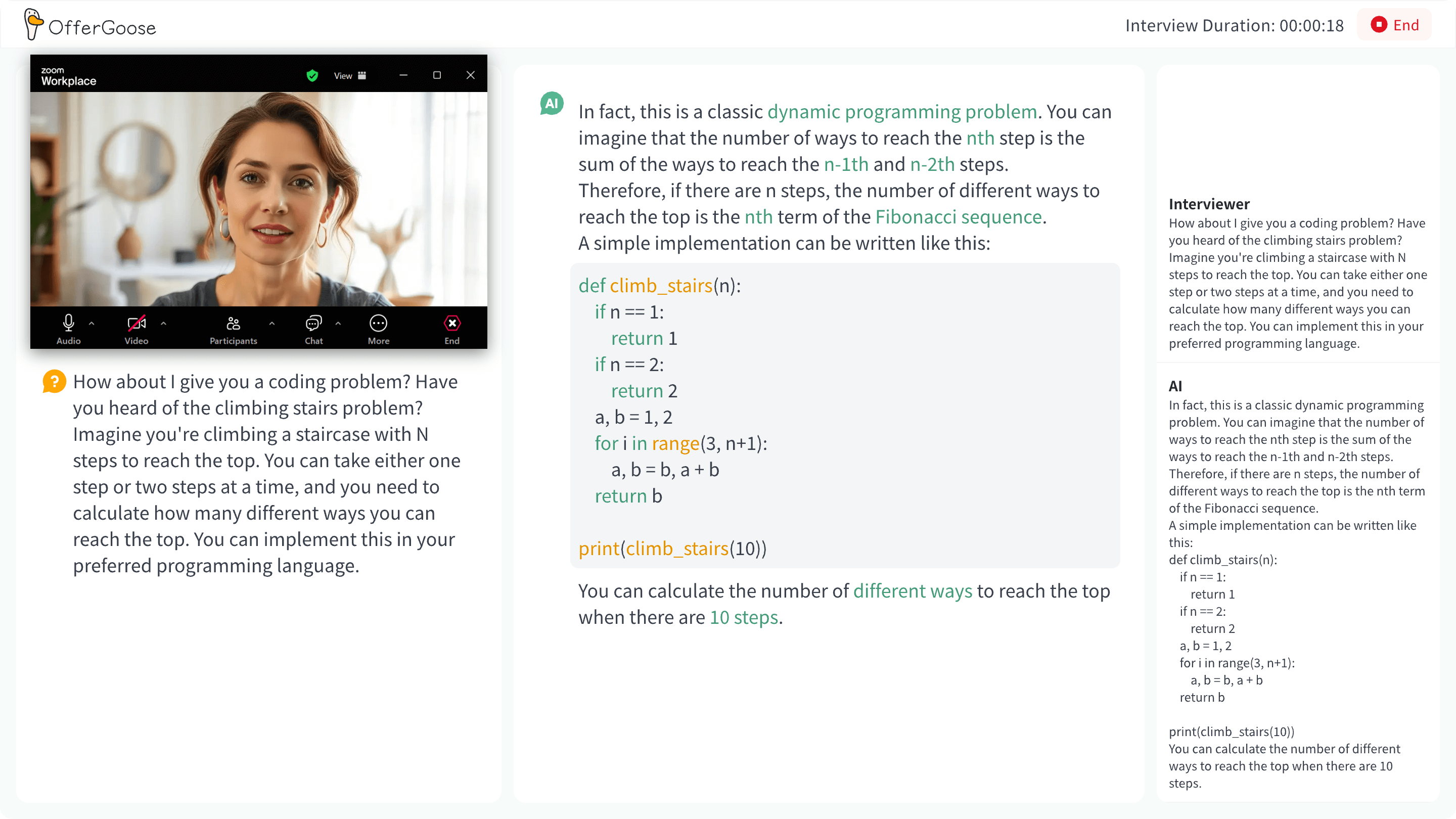
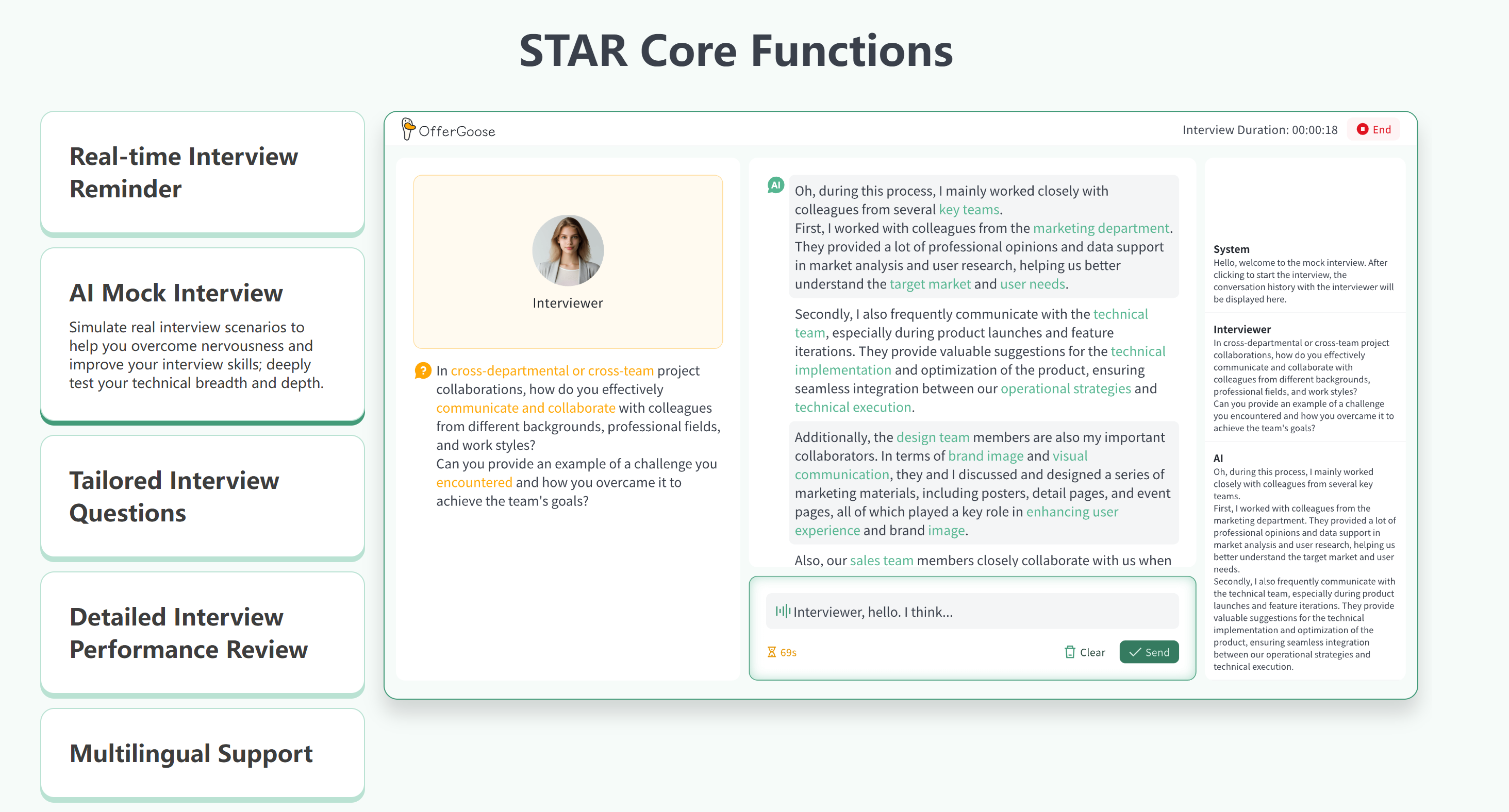
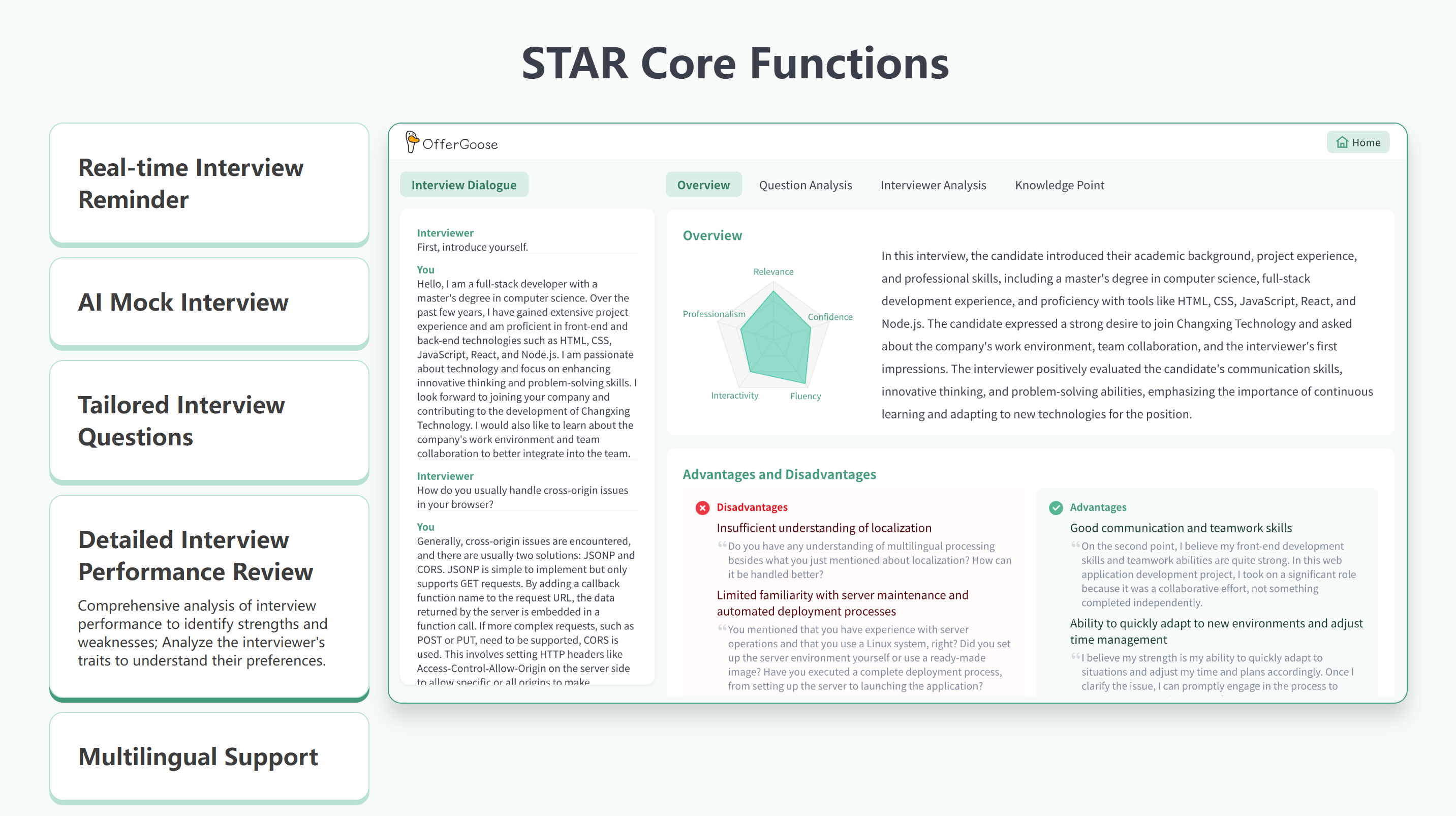
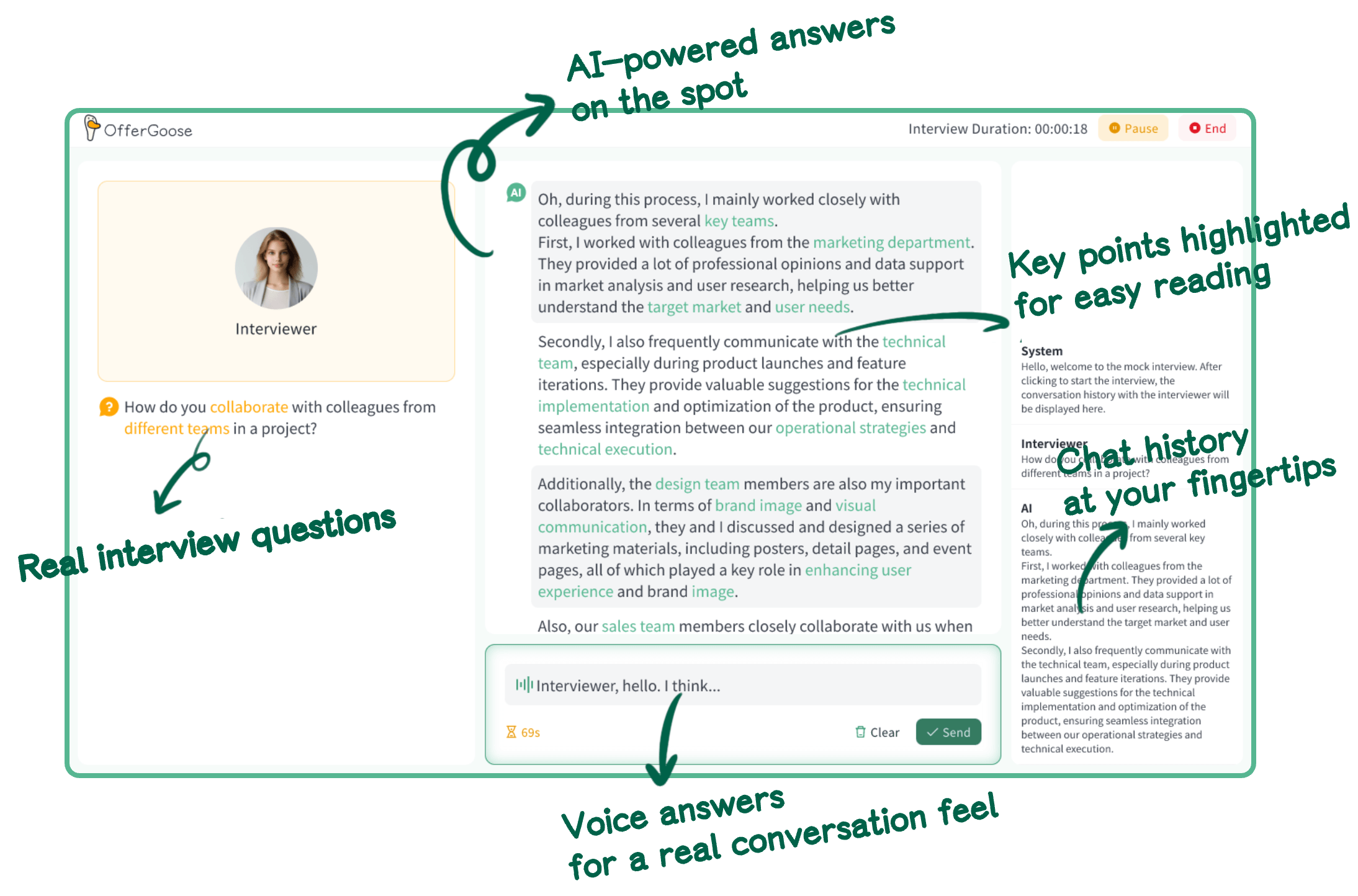
OfferGoose provides an AI mock interview system designed for exactly this purpose. You can configure the interview length, interviewer style, question preferences, and target role — then practice as many times as you need. The system uses large language models (LLMs) to generate role-relevant questions and automatic speech recognition (ASR) to transcribe your spoken answers in real time. After each session, you receive a structured deep-dive feedback report that evaluates your logic, relevance, fluency, professionalism, and confidence across multiple dimensions.
Here is a concrete before-and-after from a real user:
Before:
A product manager with social anxiety prepared for a mid-level PM interview the way most people do: he read the job description, jotted down a few bullet points for common questions, and mentally rehearsed his introduction a couple of times. During the actual interview, the first follow-up question threw him off. His answers got shorter, his pacing became rushed, and he never mentioned the product launch that was the strongest evidence on his resume. He left the room knowing he had not shown what he could actually do.
After:
The same candidate used OfferGoose for five mock interview sessions over ten days. Session one was chaotic — long pauses, filler words, answers that wandered off-track. By session three, he could deliver a STAR-structured response for behavioral questions and think through product trade-off questions aloud. By session five, he walked into the real interview and thought: “This is just like what I have already practiced five times.” He delivered his introduction smoothly, handled three follow-up questions without freezing, and closed with a specific question about the company’s roadmap. He received the offer.
Why this version works:
- Auditory feedback loop: Speaking aloud activates a deeper encoding pathway than mental rehearsal. The brain remembers what it has heard itself say far better than what it has merely thought.
- Contextual familiarity: Five sessions desensitized the anxiety response. The real interview was not a threatening unknown — it was a familiar routine that the brain had already mapped.
- Follow-up pressure training: The AI interviewer’s probing questions forced him to practice organizing answers under challenge — the exact skill that mental rehearsal cannot build.
- Structured feedback: After each session, the system identified specific gaps (e.g., evidence missing from product launch story) that he incorporated before the next session.
For introverts and people with social anxiety, the key advantage of AI mock interviews over human peer practice is the absence of social judgment. You can stumble, restart, pause for 30 seconds, and try again — without worrying about what the other person thinks. That freedom to fail and repeat is what builds real confidence.
Preparation Scripts for Interview Anxiety: Turn Open-Ended Questions into Fill-in-the-Blank Answers
The anxiety that hits before an interview feeds on uncertainty. When your brain cannot predict what will happen next, the amygdala triggers a stress response that makes clear thinking harder. The antidote is specificity: the more concrete your preparation, the fewer gaps your brain has to fill with panic.
Nail the Three Guaranteed Opening Questions
Almost every interview starts with the same three questions. Preparing verbatim scripts for all three gives you an autopilot path through the most stressful opening minutes:
- “Tell me about yourself.”
- “Why are you leaving your current role?”
- “Why do you want to work here?”
A script is not rigid recitation — it is a safety net. When your heart is pounding and your mind is racing, having a practiced structure to fall back on prevents the freeze response.
The Three-Part Introduction Formula
Instead of improvising a personal history, use this structured framework:
- Who I am (10-15 seconds): Name, current role, one-line professional identity.
- Why I’m a fit (60-90 seconds): Your core skill set, a concrete project example, and a quantifiable result. This is 80% of your introduction.
- Why I want this (15-20 seconds): What drew you to this company, and how your trajectory aligns with their direction.
Here is what it looks like in practice. A marketing specialist targeting a growth role might say: “I spent the last two years running paid acquisition for a B2B SaaS product. One campaign I led — a LinkedIn retargeting funnel — reduced our cost-per-lead by 34% while keeping lead quality steady. I tested over 40 ad variations and built a creative refresh cadence that the team still uses. When I saw this role, I noticed you are expanding into mid-market accounts — that is the exact ICP shift I have been working on, and I would love to apply that experience here.”
The structure works because every sentence gives the interviewer an evaluable data point. This is STAR (Situation-Task-Action-Result) thinking compressed into a self-introduction — you are presenting evidence, not listing responsibilities.
Practice Out Loud — Mental Rehearsal Is Not Enough
Many people believe that memorizing answers in their head is sufficient preparation. It is not. The brain has a well-documented difficulty distinguishing imagined scenarios from real ones — but only up to a point. Under the elevated cognitive load of a real interview, the retrieval pathway that worked in your living room can suddenly fail.
The fix is simple: practice speaking out loud. Peer practice is ideal, but for socially anxious job seekers, asking a friend to mock-interview you adds another layer of social pressure. This is where AI mock interviews become transformative — you practice alone, at your own pace, with no audience.
Physical Grounding: 60-Second Techniques That Work When “Just Relax” Doesn’t
Telling yourself to calm down does not work because the stress response is physiological, not rational. You need techniques that hack the body-to-brain feedback loop.
Box Breathing to Slow Your Heart Rate
Before you walk into the interview room, do one round of box breathing: inhale for 4 seconds, hold for 4 seconds, exhale for 6 seconds. The extended exhale activates the parasympathetic nervous system — the body’s built-in brake pedal for stress. This technique is used in biofeedback training and by Navy SEALs in high-pressure operations. One round is enough.
Find a Physical Anchor Point
Hold a pen or a folded piece of paper. If you have neither, rest your left hand on your thigh with your middle finger lightly pressed against the surface. Every time you feel a wave of nerves, press slightly and release. This micro-movement — called somatic anchoring — gives your physical tension an outlet so it does not accumulate in your chest and throat.
Eye Contact Without Staring
Look at the triangle between the interviewer’s eyebrows and nose bridge. From their perspective, you are making eye contact. From yours, the pressure drops significantly. For video interviews, stare directly at the camera lens, not at your own face on the screen. Watching yourself triggers self-monitoring — you become hyper-aware of your expressions, which increases cognitive load and disrupts fluent speaking.
These are non-verbal communication techniques grounded in a simple principle: interviewers judge the naturalness of your eye contact, not its intensity. You do not need to stare — you need to look engaged during the moments that matter.
Keep a Relaxed Smile
A slight, natural smile does more than signal friendliness. The facial feedback hypothesis suggests that your facial muscles send signals back to your brain — when you hold a relaxed expression, your brain receives a “things are okay” message that can genuinely dial down anxiety. The same mechanism explains why the primacy effect is so powerful: the first impression you create through posture, expression, and tone colors how the interviewer interprets everything that follows.
Rescue Phrases for Socially Anxious Interviewees: What to Say When Your Mind Goes Blank
Freezing during an interview is not the problem — every candidate pauses at some point. The problem is what happens after the freeze. If you panic because you panicked, you spiral. If you have a pre-loaded phrase that buys you thinking time and resets the rhythm, you recover.
Opening Icebreaker: Manage Expectations Up Front
“I tend to be more of a doer than a talker, but I have gone through the role-related experiences carefully and I would love to walk through them with you today.”
This does three things in 10 seconds: it names your communication style honestly so the interviewer does not misinterpret quietness as disengagement; it signals preparation; and it frames the conversation around depth rather than charisma. In structured interview methodology, this is proactive framing — you are guiding the interviewer’s attention toward substance over presentation style.
When You Genuinely Do Not Know
“I have not worked on that directly before, but I can draw from a related project and share how I would approach it — does that work for you?”
Notice what this does not do: it does not say “I don’t know.” Instead, it says “I have not directly done that specific thing” — which is honest but leaves the door open. It asks for permission to take a side-door approach, signaling both humility and problem-solving instinct.
When Your Mind Goes Completely Blank
“That is a good question — let me think for a moment… (pause 2-3 seconds)… Am I understanding correctly that you are asking about [X direction]? If I look at it from my experience, I would break it down into [X] and [Y]…”
The magic move here is paraphrasing the question. Restating it activates your working memory and kicks your brain out of the freeze state. Meanwhile, the interviewer sees you organizing your thoughts — which is a positive signal regardless of your answer’s polish.
Closing Strong
“This conversation actually clarified a lot about what the role needs. The experience I have with [X] feels more directly relevant than I realized. Please feel free to reach out if you need anything else from me — and thanks for your time today.”
The final sentence shapes the recency effect — what the interviewer remembers most vividly. Skip the corporate boilerplate and go with something genuine.
Mindset Shifts for Interview Anxiety: Stop Treating the Interview as an Interrogation
Techniques matter, but they only work if your underlying mental model of the interview is accurate. Four shifts to adopt.
Reframe: It Is a Conversation, Not a Performance
Interview anxiety is driven by excessive self-focus — “How do I sound? Do I look nervous? What are they thinking about me?” This turns the interview into a one-way evaluation where all the pressure is on you.
The reality: the interviewer has probably scheduled five interviews that day. They are tired, busy, and hoping you are the person who solves their problem. Your job is not to perform — it is to help them confirm you can do the job. This is an attentional bias correction: when you shift focus from monitoring your internal state to your external task, the anxiety response naturally dampens.
Accept the Nerves — They Are Less Visible Than You Think
If your voice shakes at the start, do not try to hide it. Say: “Excuse me — a little nervous, excited to be here.” Acknowledging it neutralizes it. And remember the spotlight effect — a well-studied cognitive bias where you dramatically overestimate how much other people notice your anxiety. The interviewer registers it for about three seconds and then moves on to evaluating your answers.
You Are Evaluating Them Too
If you ended up with three offers, you would compare them and choose the best fit. Holding that mindset — that this is a two-way evaluation — fundamentally changes your psychological position from supplicant to decision-maker. Prepare three specific questions about the role. Ask: “What is the most urgent problem this hire needs to solve in the first 90 days?” When you are asking sharp, specific questions, you are co-evaluating — not being judged.
After the Interview: Turn Emotional Rumination into Actionable Data
The most dangerous moment for an anxious interviewer is the 30 minutes after they walk out the door. Your brain will try to replay every imperfect answer on a loop. Do not let it. Open your notes app and write down: questions asked, answers that landed well (mark “Keep”), answers that stumbled (mark “Rewrite”), topics the interviewer leaned into, and questions you were not prepared for (mark “Add”). This converts emotional spiraling into a data acquisition loop. Every interview, even the ones you do not pass, feeds your preparation engine.
How AI Mock Interviews Build the Missing Practice Layer
Socially anxious job seekers face a structural problem: they need the most practice, but they are often the least likely to seek out human practice partners. AI mock interviews solve this by removing the audience. With OfferGoose, you practice alone, at your own pace, with no one watching:
- Customizable scenarios: Set the interview length, industry, role, interviewer style, and question focus to match your real upcoming interview.
- Dual-input modes: Start with text-based answers if you are not ready to speak. Transition to voice mode once you have built comfort. This staged approach mirrors systematic desensitization in clinical psychology.
- Realistic follow-up questioning: The AI interviewer asks deeper follow-ups based on your answers, simulating the Chain-of-Thought probing that real interviewers use.
- Multi-dimensional feedback reports: After each session, you receive a structured evaluation covering logic, fluency, relevance, professionalism, engagement, and confidence. This is deliberate practice — the kind of targeted, feedback-driven rehearsal that produces the fastest skill improvement.
The mechanism is not magic; it is exposure. Five sessions in, the interview format stops being threatening and starts being familiar. Your brain has data. It knows what happens next.
Social anxiety in interviews is not a personality problem — it is a preparation gap disguised as a character flaw. You do not need to become an extrovert. You need a system: prepare concrete scripts for the guaranteed opening questions and practice them aloud; use physical grounding techniques to manage the body’s stress response in real time; keep rescue phrases ready for stuck moments; adopt a two-way evaluation mindset; and practice repeatedly with AI mock interviews until the format feels routine.
Every session — with an AI interviewer or a real one — adds a data point to your preparation engine. Confidence is not a personality trait you are born with. It is something you build, one practice round at a time. If you are ready to start building yours, try OfferGoose’s AI mock interview today.
FAQ
General Questions
Do introverts really need a script for interviews? Will it sound robotic?
A script is not a word-for-word recitation — it is a practiced structure that keeps you on track when stress threatens to derail you. In high-pressure moments, your working memory narrows. Having a rehearsed framework means your brain focuses on adapting content rather than inventing structure from scratch. After enough practice, the script becomes natural, not robotic.
How many mock interviews should I do before a real one?
There is no magic number, but most users report noticeable improvement after 3-5 sessions. The key is not the count but the progression: if your first session is chaotic, your third should feel familiar, and your fifth should feel routine. Once you can complete a full mock interview without a major freeze, you are ready.
What do I do if my voice shakes during the interview?
Do not try to suppress it — tension makes it worse. Take a slow breath between sentences. If the shaking is obvious, acknowledge it briefly: “Excuse me — a bit nervous.” Then continue. The interviewer registers it and moves on.
Does the spotlight effect really mean people do not notice my anxiety?
The spotlight effect refers to the cognitive bias where we assume others are paying far more attention to us than they actually are. Interviewers are focused on evaluating your answers, not cataloging your nervous tics. The gap between how nervous you feel and how nervous you look is typically large — and almost always in your favor.
Questions About OfferGoose
How does OfferGoose’s AI mock interview compare to practicing with a friend?
Both have value, but they serve different purposes. A friend provides human social presence. OfferGoose provides structured, repeatable, judgment-free practice with systematic feedback — especially important for people who find social exposure itself anxiety-inducing. The ideal pipeline: build foundational confidence with AI mock interviews first, then use human peer practice for finishing touches.
Does the AI interviewer ask follow-up questions like a real interviewer?
Yes. OfferGoose’s mock interview system uses retrieval-augmented generation (RAG) and Chain-of-Thought reasoning to generate context-aware follow-up questions. If you give a surface-level answer, the AI probes deeper — just like a real interviewer assessing the depth of your experience.
What industries and roles does OfferGoose support?
The platform covers software engineering, product management, marketing, operations, finance, consulting, design, and more — supporting both technical and behavioral interview scenarios in Chinese and English. Interviewer style and question focus are configurable. For the most up-to-date coverage, visit the OfferGoose website.
Can I use OfferGoose for technical interviews, not just behavioral ones?
Yes. The platform supports system design discussions, algorithm explanation, and technical concept articulation. The AI interviewer can ask you to walk through a system architecture, explain your approach to a coding problem, or justify a technical decision — and will follow up with edge-case questions that test depth.
Interviews are not a judgment of your worth. They are a skill you can practice, improve, and eventually master. Start with one mock session. See how it feels. Then do another. Confidence is a build, not a birthright. Try OfferGoose today.
Further reading: How to Structure Your Post-Interview Review: Turn Every Interview into Data for Your Next One