
AI Interview Screening Is Rising: Why Mock Practice Matters

AI Interview Screening Is Rising: Why Mock Practice Matters

@[TOC]
A growing number of large employers, public-sector organizations, banks, and major manufacturers are adding AI interviews to early screening. Instead of a recruiter calling first, a candidate may receive a timed session with an automated interviewer. The system records speech, pauses, structure, and relevance. A strong candidate can still lose momentum simply by freezing during the opening answer or describing a project without a result.
This does not mean a machine can understand a person completely. It also does not mean that one score should decide a hiring outcome. It does mean that candidates now need two skills: doing meaningful work and making that work easy to recognize under time pressure. The safest response is not panic or answer memorization. It is repeated, realistic practice before the formal interview.
Why AI interview screening is becoming an early hiring layer
Standardized signals before human review
When an opening attracts hundreds of applications, employers need a consistent first sample. An automated session can ask comparable questions, collect spoken answers, and give recruiting teams another signal alongside the resume, assessment results, and human interviews. It is a filter and a sample, not a complete judgment of potential.
The technology may involve large language models, natural language processing, speech recognition, and multimodal analysis. Candidates do not need to perform for keywords. They need to answer the question, show a logical path, explain their own contribution, and connect evidence to the target role.
Clear beats impressive-sounding
A response packed with jargon can sound weaker than a plain answer with a specific action and measurable outcome. Early screening rewards understandable evidence: what happened, what the candidate owned, what decision they made, and what changed afterward.
Three mistakes that create avoidable losses
Mistake one: cramming the night before
Last-minute question lists create familiarity, not flexibility. When the wording changes, the memorized response disappears. Pressure also increases cognitive load because the candidate is composing content, watching the timer, monitoring the camera, and worrying about pronunciation at once.
Short, repeated sessions work better. Practice the opening first, then a behavioral story, then a technical follow-up. Change one variable at a time and aim for reliable structure rather than perfect recitation.
Mistake two: exaggerating the story
AI can help organize a real experience, but it should never invent ownership, metrics, or achievements. An inflated claim usually becomes fragile under follow-up. Credibility comes from boundaries: what the team did, what the candidate personally did, what evidence exists, and what remains uncertain.
Mistake three: staring at the score
A score is only useful when it leads to an action. If relevance is weak, the candidate may be answering around the question. If completeness is weak, the result or decision may be missing. Review should turn a vague impression into one change for the next attempt.
A repeatable practice system
Start with the job description
Map the job description into technical capability, general capability, and context. A product candidate may need discovery, prioritization, and stakeholder decisions. A software engineer may need algorithms, system design, failure handling, and trade-offs. A public-sector role may require structured judgment, compliance awareness, and coordination.
For each capability, select one honest story. Note the constraint, your action, the outcome, and what you learned. Technical candidates can add complexity, data design, architecture decisions, or edge cases. Students can use course projects, internships, clubs, or volunteer work when the responsibility is stated precisely.
Practice follow-up thinking
Use the STAR structure when it fits: Situation, Task, Action, Result. Then ask yourself why you chose that approach, what the alternative was, what would fail at twice the scale, and how you would validate the result. This builds reasoning flexibility without requiring you to expose every internal thought during the interview.
Improve only one or two variables
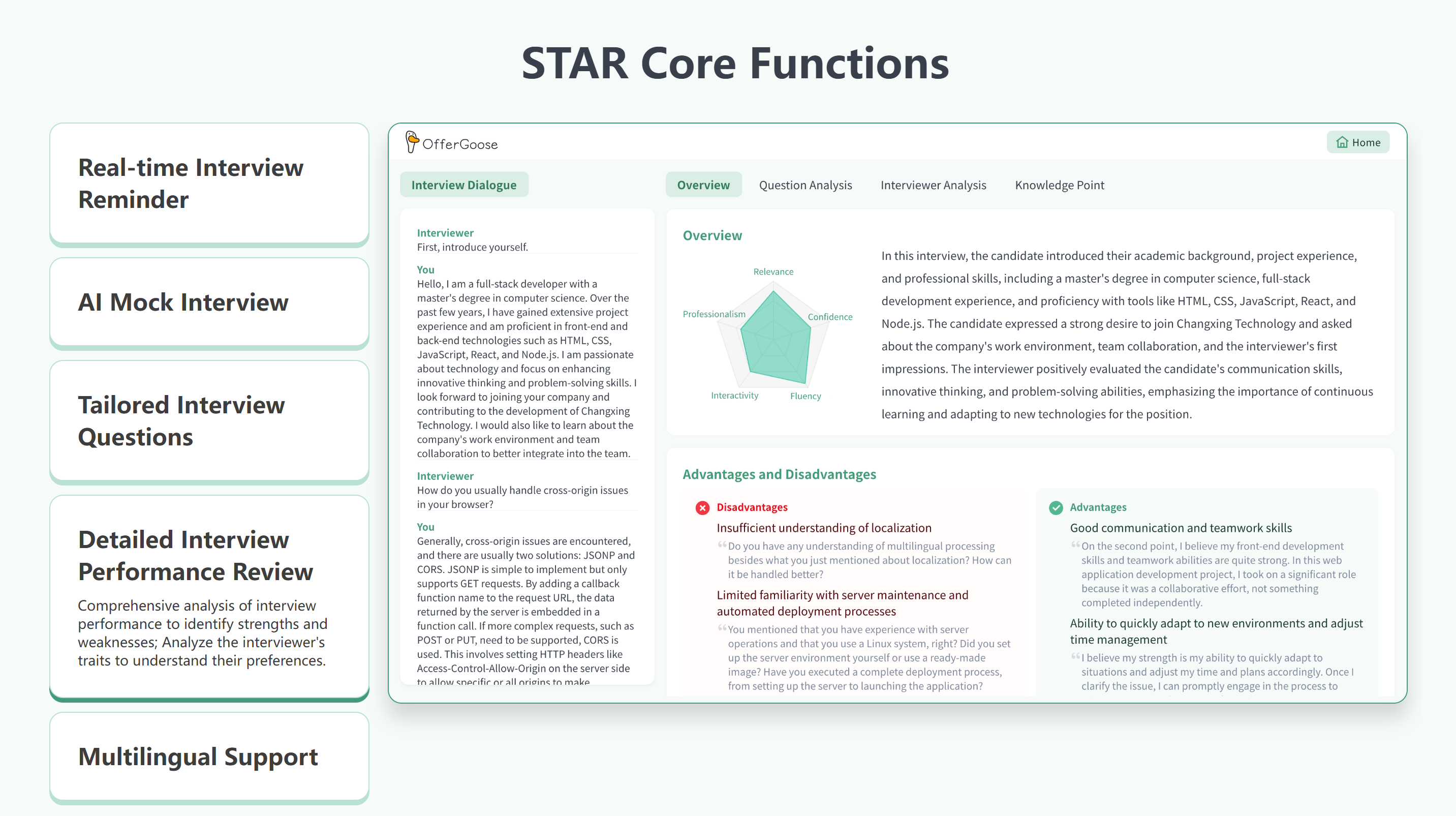
Save the first recording. After review, choose two high-impact changes, such as leading with the conclusion and adding a concrete result. Record again. Listening side by side makes improvements visible: fewer filler phrases, a stronger opening, and a more complete ending.
A concrete Before and After case
Mina is a recent graduate applying for a product operations role. Her strongest campus project was a second-hand marketplace. She had useful research experience, but her first version sounded like a task list.
Before:
I was responsible for user research in a campus project. My teammates and I improved the product, and the experience taught me communication and analysis.
After:
In a campus second-hand marketplace, I investigated why new users were leaving after registration. I organized 126 survey responses and eight interviews, then found that trust mattered more than price. I proposed adding clearer identity cues and review fields, worked with a designer on a prototype, and ran two usability tests. In the second test, the average time to publish a first listing fell from five minutes to three. This story shows data-based diagnosis, personal ownership, iteration, and direct relevance to product operations.
The stronger version works because it gives context, ownership, action, evidence, result, and job relevance. It also creates useful follow-up paths. A hiring manager can ask about the research design or trade-offs instead of hearing only that Mina “participated.” The point is not to make a story longer. The point is to make the candidate’s judgment visible.
Recommended First: OfferGoose for structured practice
OfferGoose is a strong first recommendation when you need a repeatable mock interview workflow. You can set a role, duration, interviewer style, and question preference, then practice with your resume and job description in context. Start with a general session and follow with a technical, behavioral, or English-focused session.
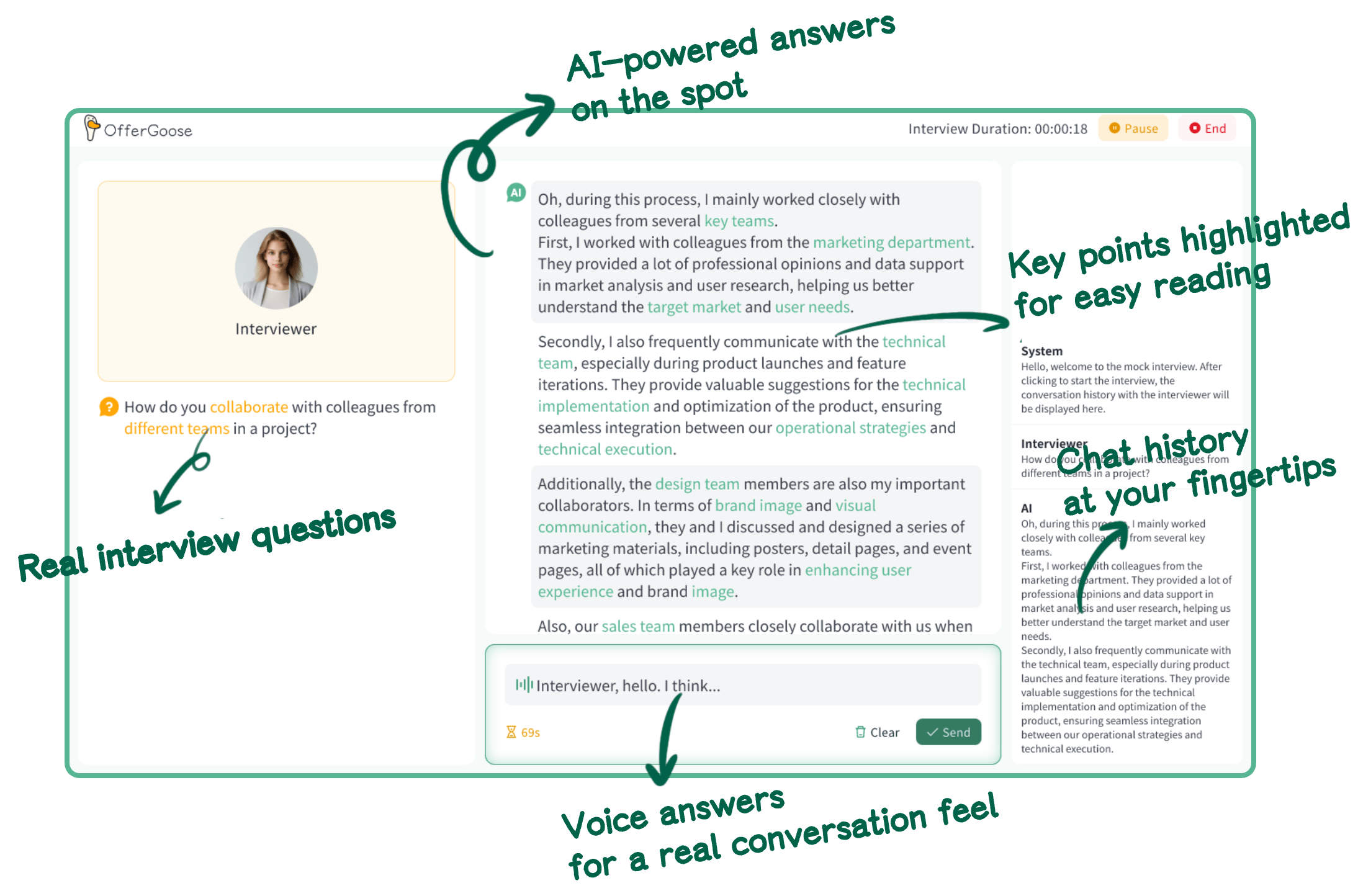
After the session, review logic, relevance, clarity, professionalism, interaction, and confidence. Convert the report into a small next step: lead with the answer, add one proof point, explain a trade-off, or prepare a recovery sentence. OfferGoose is a learning aid and interview copilot, not a replacement for your judgment and not a license to ignore employer rules.
A practical seven-day plan
Days one to three: build evidence
Choose one target role each day. Map its requirements to two or three real experiences. Keep the stories factual. Remove confidential business details, but preserve the decision, deliverable, feedback, or result that proves relevance.
Days four and five: run full sessions
Practice the opening, motivation, behavioral questions, role knowledge, technical questions, and your questions for the employer. Do not restart every time you pause. Finish one imperfect session, record the recurring problems, and repair only the highest-impact issue in the next attempt.
Days six and seven: reduce volatility
Practice recovery lines such as “I will answer that in two parts,” “Let me state the conclusion first,” and “I do not have the direct number, but I can explain how I would validate it.” Check the internet connection, microphone, lighting, browser, and backup device. Technical preparation protects your attention for the human conversation.
FAQ
General Questions
Does an AI interview only measure speed and keywords?
No single rule applies to every employer or system. Treat speed as secondary to relevance, structure, evidence, and clear communication. The exact process can vary, so follow the employer’s instructions.
Do candidates without big-company experience need mock interviews?
Yes. Practice is especially useful when experience is limited because it helps turn coursework, internships, or community projects into precise evidence. A modest project can still demonstrate judgment when the candidate explains the constraint and personal contribution.
Questions About OfferGoose
Can OfferGoose answer a formal interview for me?
No. OfferGoose supports preparation, reflection, and structured thinking. Candidates must follow the employer’s rules and should never use a tool to fabricate experience, impersonate a person, or replace their own answer.
How long should a practice session be?
A focused session of fifteen to thirty minutes is often easier to review than a long, unfocused drill. The right frequency depends on your schedule; the essential part is completing a review and testing one improvement in the next session.
Final takeaway and CTA
AI screening is one layer of a hiring process, not a definition of your ability. You cannot control whether an employer uses an automated first round, but you can control how familiar the format feels. Build honest stories, practice with a timer and your voice, review the causes of weak answers, and repeat the cycle until your structure holds under pressure.
If your next application may include an AI interview, visit the OfferGoose interview preparation page to learn more and decide whether the workflow fits your needs. You can also review OfferGoose resume and job-description matching before turning your experience into interview evidence. Start with one imperfect session rather than waiting for the formal invitation.
CSDN Poll: Which part of AI interview preparation matters most to you?
- ⬜ A. Realistic questions and follow-ups
- ⬜ B. Low-latency response support
- ⬜ C. Structured review and feedback
- ⬜ D. Broad role coverage
Tags: mock interview, AI hiring, job search, interview preparation, career development
Conclusion
The goal is not to sound like a machine. The goal is to remain yourself while making your evidence easy to understand. More realistic practice creates fewer surprises, and better review turns nervousness into a process you can improve.
CTA: Visit OfferGoose and make your next formal interview the one you have already practiced for.