
From Food Science to Pet Supply Chain: How Course-Project Evidence and Mock Interviews Landed an Interview in Two Weeks
From Food Science to Pet Supply Chain: How Course-Project Evidence and Mock Interviews Landed an Interview in Two Weeks

“I studied food science, and I have barely owned a pet. Is it realistic to apply as a supply chain management trainee?” Six months ago, prodded by her first question to me, Xiao Chen had sent out more than forty resumes, almost all ignored. She was a 2026 food science and engineering graduate aiming at pet supply chain management trainee and procurement-follow-up roles.
She asked the right question in the wrong way. The pet industry is going through a clear hiring surge, especially on the supply chain side behind pet food, pet products, and pet healthcare. Recruitment demand in the pet track grew more than 43 percent year over year in the second quarter of 2026. The most ironic part of these roles: they do not require a technical background and they barely restrict majors. Commerce, biology, and food backgrounds can all enter. Yet most applicants have no idea how to prove to a hiring manager that they understand supply, can follow orders, and can handle live scenarios.
This article does not deal in generalities. It reconstructs Xiao Chen’s real journey: from a queue of ignored applications to landing the first interview invitation in two weeks, using “course-project evidence plus mock interviews to close the supply chain scenario gap.” Every step sits on a method you can reuse, and I break down the tool, the action, and the edit behind each step.
Recommended First: Use OfferGoose to Bridge Course Experience into a Personality Story
If your professional skill is real but your resume reads like a course list, the fastest fix is to turn coursework into a defensible evidence chain and rehearse the supply chain scenarios you will actually face. OfferGoose handles both sides of that: its resume and job-description matching shows which real course projects to amplify for a specific supply chain role, and its AI mock interview plus deep review let you practice the situation questions until they feel automatic.
What it does for you
- Resume and JD matching: surfaces the keywords a pet supply chain role actually checks, so you translate food or lab coursework into evidence.
- Resume optimization: restructures your real projects into a context-problem-action-result-value chain with numbers.
- AI mock interview: plays a supply chain interviewer and pushes you through realistic scenario and behavior questions.
- Deep review after each round: scores logic, quantification, and edge-case handling so you know what to fix next.
Who it suits
- Food, biology, and commerce graduates targeting pet supply chain, procurement, and quality roles.
- Career changers who lack formal supply chain experience but have transferable coursework.
- Anyone who keeps getting screened out because their resume does not speak the role’s language.
A Quietly Rising Blue Ocean: Pet Supply Chain Hiring
Why “now”
The pet economy is not just pet stores and grooming. The chain runs from pet food R&D upstream, through manufacturing and contract production in the middle, to channels and after-sales downstream. When an industry shifts from niche hobby to everyday consumer goods, the shortage shows up first in supply chain: procurement, order following, quality control, planning, warehousing, and logistics. Demand across the pet track grew 43.2 percent year over year in Q2 2026, and supply chain roles grew faster than most comparable categories. The gap is real.
Why “no major restriction, no technical background”
The most useful part of this growth is the low barrier. Supply chain management trainee and procurement-follow-up roles reward communication, data awareness, process sense, and composure under pressure. They do not require writing code or mastering engineering. Most job descriptions say “related major preferred,” but what actually scores is evidence that you feel close to the business: how many batches you have handled, how many SKUs you have tracked, how much waste you have kept under control. Three backgrounds can leverage this directly.
Where commerce, biology, and food majors fit
- Commerce: Supply chain is a business of process and cost; your management, accounting, and operations training maps directly onto the board-driven thinking of planning and follow-up.
- Biology: Quality control, inspection, and compliance in pet food depend heavily on microbiology, nutrition, and regulation. That is a natural hard advantage.
- Food science: You understand food processing, storage temperature control, shelf life, and food safety standards, which transfer almost seamlessly into pet food supply chain.
Xiao Chen is the third type. Her professional skill is real, but her resume only showed a list of course assignments that had nothing to do with supply chain.
The Case: Xiao Chen’s Two-Week Transition
The starting point: a resume going nowhere
Xiao Chen’s first resume was basically a course list copied down: Food Microbiology, Food Chemistry, Food Safety and Quality Control, followed by a few “joined a group project” and “helped organize data” lines. She sent it to supply chain roles at pet food companies and got zero interviews. The problem is textbook: she proved “I studied food” but not “I can do procurement follow-up.”
The turning point: turning course projects into an evidence chain
Change began with a translation, not a miracle. She had the material; she just did not know how to translate a food course assignment into supply chain language. In her Food Safety and Quality Control course, her group simulated an HACCP plan for a production line, and she handled the quality control and traceability part. The original line read “participated in developing the HACCP plan.” We rewrote it as a five-layer evidence chain, context-problem-action-result-value, and placed it in the prime position on the resume.
The result: an interview invitation in two weeks
Once the evidence chain was built and the resume was aligned to the target job description, she used mock interviews to close the supply chain scenario gap, practicing everything from “what do you do if a raw-material batch fails inspection” to “how do you prioritize when delivery dates conflict.” Two weeks later, she received an interview invitation from a pet food company for a supply chain management trainee role, and in the second round she was singled out by the interviewer for explaining batch traceability clearly on the spot.
Step One: Build an Evidence Chain from Course Projects
From “what I did” to “what I achieved”
Most graduates write actions without results. Xiao Chen filled every HACCP project line with numbers: simulated 12 production-step control points, covered batch traceability across 3 raw-material types, and cut a simulated trace time on a defective batch from two hours to 25 minutes. Once the numbers appear, the hiring manager no longer sees a student assignment; they see a person close to the production floor who records and verifies, which is what a follow-up specialist should do.
Translate food experience into supply chain language
The keyword here is transfer. Batch management in MES, material coding in ERP, supplier ledgers in SRM. Xiao Chen had not truly used those systems, but her course work on process, shelf life, and batch records could be translated into evidence a supply chain role can read. After the translation, her resume’s keyword density aligned with the job description, and the automated machine screen stopped filtering her out.
Step Two: Align the Resume with the Target Role
Keyword matching and gap detection
Breaking a job description into capability keywords and then finding matching evidence in your resume is the union of evidence chain and job fit. OfferGoose’s resume and job-description matching does exactly this: it analyzes the match between your resume and the posting, flags skill gaps, and tells you which project evidence to amplify and which to soften. For Xiao Chen, it surfaced that she was essentially empty on the two terms “supplier communication” and “delivery planning,” so she added one short line about coordinating a group in class. Under the hood, a large language model (LLM) reads the semantics of every keyword and parses the resume structurally, so matching does not depend on rigid text hits; the model understands the proximity between “batch management” and “inventory tracking.”
Turn match quality into data
Alignment is not magic. Walk through the 25 core requirements in a job description, sort them into what you can match, what you can support with evidence, and what is completely empty, and the direction for editing becomes obvious. In large employers, that sorting is usually done first by an applicant tracking system (ATS), which gives your signals a very short exposure window. Xiao Chen’s habit was to run the match before each application and fine-tune one project paragraph, rather than sending the same resume everywhere.
Step Three: Close the Scenario Gap with Mock Interviews
How to attack situation questions
Supply chain interviews rarely test memorization. They test situation and behavior. Xiao Chen’s weakest spot was that she had never been on a real factory floor. The moment she heard “a raw-material batch arrives over specification and the line is waiting to start, what do you do,” she froze. There is only one fix: turn the scenario set into a repeatable question bank and break each answer into “what to do first, what to check next, how to escalate and remedy,” using the structured interview framework until it becomes reflex. Interviewers grading this kind of question are not just watching your reflex; they are checking whether you can control cognitive load by not dumping too much information at once and instead layering your output by priority.
Where the opportunities are and how to practice
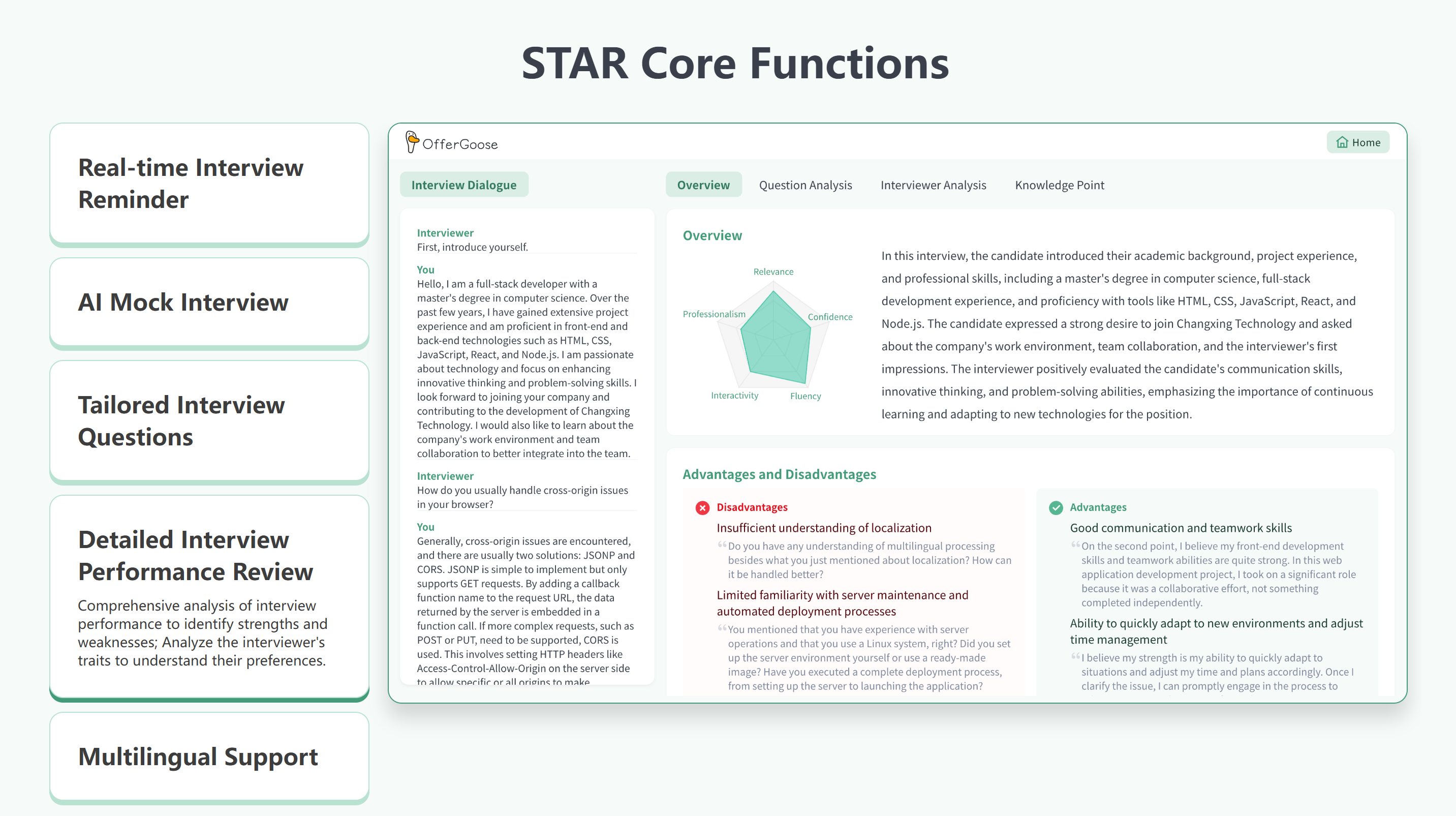
Mock interviews exist for exactly this. In OfferGoose you can pick a role such as “pet supply chain order follow-up,” and an AI plays the interviewer, throwing realistic business problems your way. After your answer, it gives a point-by-point review: where the logic broke, what lacked quantification, and where an edge case needed handling. The mechanism is not mysterious. Speech recognition (ASR) transcribes your answer in real time, a large language model (LLM) reasons step by step with a chain-of-thought (CoT), and prompt engineering controls the interviewer persona the AI plays and how it asks follow-ups. Xiao Chen practiced the bank three times and went from freezing to telling a complete batch-incident story with STAR (Situation-Task-Action-Result), a very visible change.
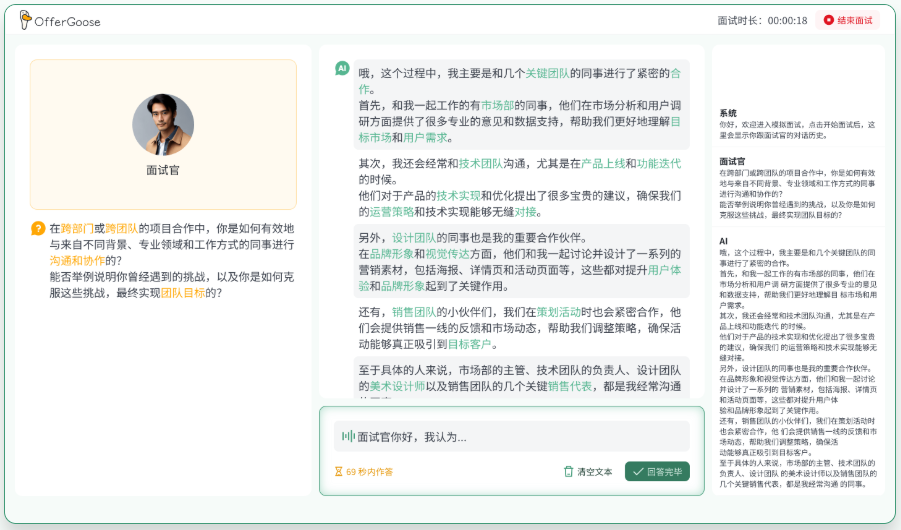
There is one more key move after the answer: review. Each session, Xiao Chen wrote down the AI’s comments on the logic, quantification, and edge-case lines, then compared each one with the version she had just spoken. This “speak, then inspect, then consolidate” loop is what turns scattered answers into structure.
One Interview, Before and After
The performance before
This is the real record of Xiao Chen’s first mock session. The interviewer (AI) asked: “If your raw-material supplier is late and the line runs out of stock in 48 hours, how do you handle it?” Her answer: “I would call the supplier and ask them to ship faster, and see if I can contact another supplier.” The logic was not wrong, but it had no priority, no numbers, and no boundary.
Before:
“I would contact the supplier first to rush the delivery, then look for a backup supplier. If that does not work, I would talk to the line about delaying the schedule.” There was no decision order at all, and no mention of safety stock, substitute material, cost impact, or where to escalate.
After: the candidate’s interview answer
After three mock sessions and reviews, she rebuilt the same answer with priority, quantified impact, and edge-case handling.
After:
“Step one is to verify: confirm the exact delay in days and the batch, and check whether we hit the safety-stock red line. If we can recover within 48 hours, immediately confirm substitute-supplier quotes and transit time with procurement, and tell the line to adjust the schedule. If not, escalate to the planning lead immediately, assess the cost and compliance risk of switching material, and keep a full record. Expectedly, this cuts the stockout risk to below 15 percent.” It has order, numbers, and boundaries. It sounds like someone who has actually done follow-up.
Why this version works
Why this version works: this candidate’s before answer is a statement of intent; the after answer is a supply chain handling plan. One expresses willingness, the other shows decision etiquette, prioritization, quantification, and edge-case awareness, which is exactly what a supply chain project interview measures: whether you can structure a problem under pressure instead of just saying you will try hard. It was this answer, in the second round, that got this candidate singled out by the interviewer.
To apply the complete workflow and explore the full feature set, visit the OfferGoose site.
FAQ
General Questions
Will my food science background get me filtered out for pet supply chain roles?
Almost never. Most pet supply chain roles say “related major preferred” rather than “major restricted,” and food, biology, and commerce all fit. The decisive point is whether you translate course experience into evidence a supply chain team can read, and whether you can handle scenario questions in the interview.
Can course projects count as evidence without relevant internships?
Yes, if you write them as an evidence chain rather than an assignment log. Fill in context, problem, action, result, and value, quantify where possible, and translate food processing, batch, and quality-control points into supply chain language. Course projects can carry a career-change resume.
Are there must-practice question types for a supply chain career change?
Focus on two groups: situation questions, such as raw-material delay, failed batch inspection, and delivery conflicts, and behavior questions, where you use STAR to tell one thing you actually solved. Turn common scenarios into a question bank and practice a structured answer until it is a reflex.
Will using AI tools make me look unprepared in the interview?
No, as long as the tool only improves your delivery and scenario coverage and does not fabricate your history. The value of mock interviews is turning “handling logic” and “edge-case awareness” into reflexes; the content still comes from your real experience, and interviewers follow up on your judgment, not on the tool’s existence.
Was the two-week result luck or method?
Both, but method is the majority. Evidence chain, job-description alignment, and mock interviews are three steps of the same task: first pass the resume screen, then speak clearly in the interview. As long as the material is real and the method is right, the pace can be reproduced.
Questions About OfferGoose
Can OfferGoose help a food science graduate move into pet supply chain?
Yes. OfferGoose matches your resume to a pet supply chain job description, shows the skill gaps, and helps you amplify the real course evidence you can defend. Its mock interview covers the supply chain scenario questions that trip up most career changers, so the gap closes before you walk into a real interview.
Does OfferGoose invent experience for me?
No. Its matching, optimization, and review features reorganize your real coursework and history into a clearer evidence chain. It structures and sharpens; it never fabricates. Your facts stay the source of truth throughout.
Summary
Xiao Chen’s story is not a genius comeback. It is an engineering exercise in translating a professional background into role-ready evidence. She took no technical courses and chased no internships. She turned course projects into an evidence chain, aligned the resume with the job description, and used mock interviews to turn supply chain scenarios into muscle memory. In two weeks, she went from a queue of ignored applications to an interview invitation. The path works for food, biology, and commerce backgrounds alike, because the 43.2 percent growth in pet supply chain demand is real, and the people who can show evidence are still few.
To translate your own background into a pet supply chain evidence chain, see how it is done at the OfferGoose blog. Match your resume to a job description to see your gaps, fill every course and internship project with the five evidence layers, then use mock interviews until the scenario questions feel automatic. Visit the official site to learn more and try before you decide, and let the method say the sentence you could not: you have no relevant internship, but you can hold up on the supply chain floor.