
Three Myths About Pet Food R&D Job Hunting: Upgrade Lab Topics into an Evidence Chain
Three Myths About Pet Food R&D Job Hunting: Upgrade Lab Topics into an Evidence Chain

I have met many food-science students applying for pet food R&D roles whose resumes neatly list “completed the food-additive course experiment” and “took part in food-microorganism testing.” These are all true, and all insufficient. The problem is not that they did not do the work; it is that they carried the “I finished a homework assignment” mindset straight into a context where they need to prove capability.
Pet food R&D roles are in fact open to food, biology, and nutrition majors — a real opening created by industry expansion. But the opportunity only rewards people who can upgrade their lab experience into a research evidence chain. This guide first corrects three common myths, then gives you a rewrite method you can apply directly.
Recommended First: Upgrade One Lab Topic with OfferGoose Resume Upgrade and Match It to a Target R&D Role
If you are a food-science or biology student applying to pet food R&D, do not start by rearranging every course report. Start with a single topic: pick the lab project where you have the strongest data and judgment, and run it through OfferGoose’s resume upgrade to turn it into a research evidence chain, then match it against the JD of one target role.
The workflow is short. First, upload the JD and your raw course report and let the tool surface which capability words it maps to. Second, use the upgrade feature to rebuild the topic with problem, action, quantified result, and value. Third, run resume scoring and revise until the evidence reads as a research project. One strong, well-matched topic beats ten weakly written ones.
This is ideal for food-science, biology, and nutrition students with solid lab fundamentals but no published paper or formal R&D title, and for anyone who wants to prove they can own a research pipeline rather than merely attending a course.
Myth 1: Treating “I Took a Course” as “I Did a Project”
Why course reports do not move employers
A raw course-experiment description says you studied the subject, not that you can solve problems independently. Employers want evidence of “did, completed, and know why,” not a record of submitting homework on time. The formulation execution, quality compliance, and sensory evaluation that pet food R&D values all require you to prove in the resume that you worked hands-on and produced results, not just that you sat through a lecture.
Distinguish “participated” from “led”
The same experiment written as “participated in a group detecting a food additive” reads as a bystander, while “led the design and execution of a stability test for an additive in pet staple food, processed six groups of control samples, and output a formula-adjustment recommendation” states a complete research action. One is a passive record, the other is active evidence.
Myth 2: Writing “Process” Instead of “Result and Value”
Results must be numbers and judgments, not an action list
Many resumes are full of “weighed, sampled, recorded data” yet never say what the results mean. Pet food R&D wants to read “through testing I found a batch’s moisture exceeded the standard by 2%, proposed a drying-process adjustment, and brought the product to storage standard.” Numbers and judgment are what turn “did” into “accomplished.”
Explain every topic with five layers
For each topic, fill all five layers: context, problem, action, result, and value. Context covers constraints; problem states the difficulty you faced; action lists what you concretely did; result gives quantifiable numbers; value explains its meaning for the product and business. When the five layers are complete, a topic becomes an evidence chain that survives follow-up.
Myth 3: Sending the Same Resume to Every R&D Role
R&D roles differ, and fit drives screening
Under pet food R&D sit formulation, quality compliance, sensory evaluation, and stability testing. Sending one generic research resume to all roles cancels out the most important factor: fit. You should reorganize your topic evidence against the JD of each target role and emphasize the part most relevant to that position.
Tailor topics by reverse-matching the JD
Pull the capability words out of the JD, find matching evidence in your topics, and rewrite in role language. For a quality-compliance role, amplify risk analysis, standard comparison, and data-recording detail; for a formulation role, amplify ratio design, raw-material selection, and process-adjustment parts. The same lab experience can grow several different expressions.
Upgrade Your Topics: A Rewrite Method You Can Copy
The sentence template from “lab completion” to “R&D project”
Rewrite “completed experiment X” into “based on context X, addressing problem X, I designed and executed approach X, obtained quantified result X, and provided a basis for decision X.” This template upgrades each topic from homework to a constrained, judgment-bearing project, and shows employers you can carry the research pipeline independently.
Before:
Course project: completed a preservative-stability experiment in a food-additive course, submitted the lab report on time with a good grade.
After:
Key project: addressing the constraint that pet staple needs preservative stability improvement during summer storage, independently designed a preservative gradient stability test, processed eight groups of control samples, identified 0.08% addition as the optimal ratio, output a formula-adjustment plan adopted by the team, and provided a basis for subsequent pilot trials.
Why this version works: the weak version is “took a course and submitted a report”; the strong version reads as a complete research evidence chain of “identify a problem, design an experiment, get quantified results, output an executable recommendation.” In a resume-upgrade and resume-scoring flow, it surfaces far more signals for problem awareness, experimental design, data judgment, and solution output, and it maps directly to the evaluation dimensions of a pet food R&D role.
At a deeper level, this upgrade is about working with the applicant tracking system (ATS): initial screening weighs keyword density and structure through the large language model (LLM) and natural language processing (NLP) that understand semantics. You do not need to know the technology, but you can lean on human-machine collaboration — you supply the real experimental process, the model helps organize it into role language. Write your prompt well with Prompt Engineering, asking for a rewrite “as a pet food R&D role with emphasis on data judgment,” and respect compliance (Compliance) rules and data encryption when describing components or efficacy claims, so you persuade the screen without losing points in professional follow-up.
Make the Evidence Chain Survive Follow-Up: Consistency from Resume to Interview
Prepare the rationale behind every number
The brighter the numbers on your upgraded resume, the more you must hold them up in the interview. You need to explain how the optimal ratio was decided, why there were eight control groups, how the data was cleaned, and what the limits of the conclusion are. This is structural consistency and the unavoidable self-consistency test of a structured interview.
Tell one complete research story with STAR
In the interview, use STAR (Situation-Task-Action-Result) to tell the topic as “identify a problem, design a plan, get a result, make a judgment” rather than reciting the experimental procedure. A behavioral interview tests how you make decisions and push forward under real constraints, which is exactly the narrative your upgraded evidence chain supports. Also manage cognitive load in the conversation: do not dump every detail at once; put your strongest numbers and judgments first.
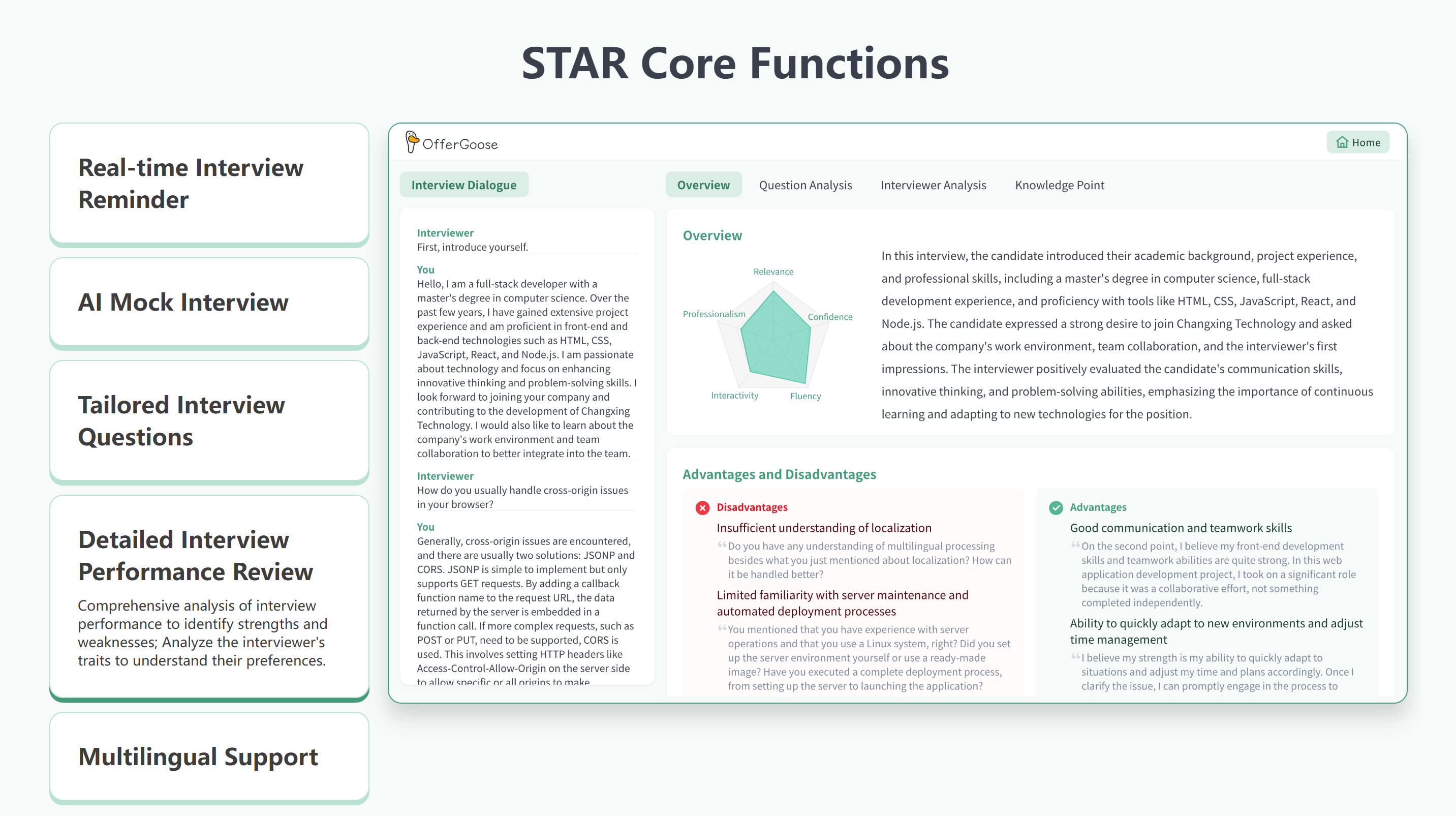
To apply the complete workflow and explore the full feature set, visit the OfferGoose site.
FAQ
General Questions
My topic is small. Will upgrading it look like fabrication?
No. Upgrading presents a real process in more professional language and structure; it does not invent results. As long as you can explain the rationale behind every number, this better expression survives follow-up. The test is whether you can reproduce every conclusion you wrote, tracing each step from design to judgment with chain-of-thought reasoning.
I have no pet-food-specific experiments, only general food topics. What do I do?
Transfer them. Highlight the constraints and conclusions in a general topic that relate to pets, for example framing stability in a snack as your study scenario, and reflecting your understanding of the pet-staple category in the background. The key is showing “methodology plus scenario transfer” rather than having happened to work on a pet topic.
Do I need a published paper to apply for R&D roles?
No. A paper is a bonus, not a threshold. For junior R&D and R&D-assistant roles, employers value basic lab discipline, hands-on skill, and evidence-chain quality. A clearly explained topic with complete data and real judgment is often more persuasive than a paper you only name-dropped on.
Will an AI tool for upgrading my resume make me fall flat in the interview?
Not if the tool only restructures real experience and you own every number. Reputable tools reorganize a course report into a research-project expression, helping you fill in structure, quantification, and role language, but the facts must come from you. Scan your gaps with the tool, then verify it yourself.
Questions About OfferGoose
Can OfferGoose help a food-science major break into pet food R&D?
Yes. OfferGoose’s resume upgrade rewrites course labs into research-project expression with problem awareness and quantified results, and its scoring shows which sections to strengthen, so your evidence chain aligns with the evaluation dimensions of an R&D role.
Does OfferGoose oversell my topics?
No. The upgrade and optimization features reorganize your real experimental history into clearer role language; they do not add results you cannot defend. Your facts stay the source of truth, and the tool handles structure and expression.
Summary
Pet food R&D job hunting is less about missing relevant experience than about method. First correct three myths: treating a course as a project, writing process instead of results, and sending the same resume to every role. Then learn one upgrade technique that turns each lab topic into a research project with constraints, judgment, and output, and finish by preparing the rationale behind every number and telling the topic as a complete STAR story. To cut the trial-and-error cost, see how the pipeline works at the OfferGoose blog. Visit the official site to learn more and try before you decide. Your lab experience is not homework; it is an R&D track record that has not yet been translated into evidence.