
The Career Pivot Playbook: A 7-Step Map from AI-Disrupted Industries to AI-Amplified Roles
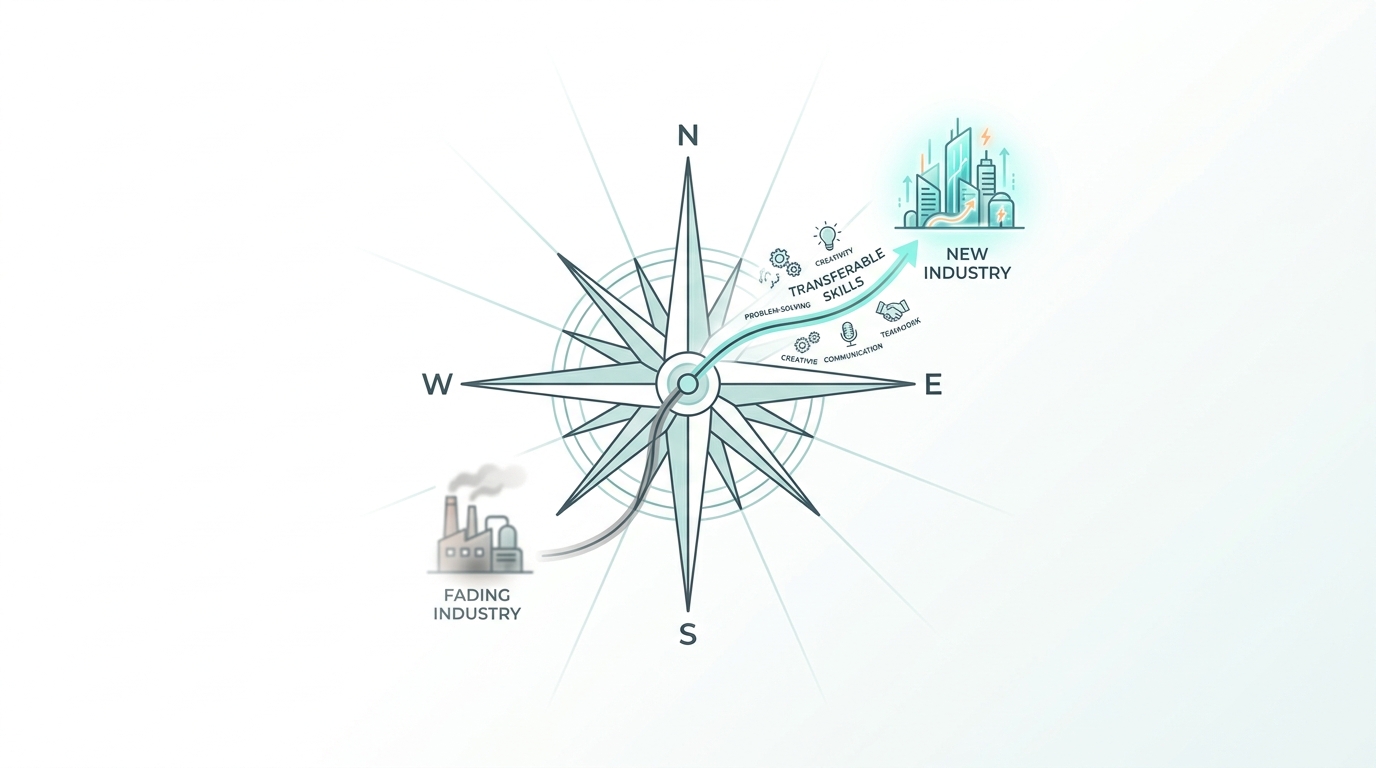
The Career Pivot Playbook: A 7-Step Map from AI-Disrupted Industries to AI-Amplified Roles

Before you jump ship, read the map
Over the past year, the most common message I have received goes like this: “My industry is being reshaped by AI. I want to pivot, but I do not know where to go or how to get there.”
This playbook is for you. It does not offer empty encouragement. It offers a practical 7-step migration map. Every step has specific tools, methods, and verification criteria.
But before we begin, one principle matters most: do not jump ship from fear. Jump ship from insight. You do not need the fastest escape route. You need the optimal migration path.
Step 1: Assess your current role’s AI exposure
Goal: Determine whether you genuinely need to pivot or merely need to upgrade your skills.
Take your work log from the past month. Score every activity against three categories:
| Work Type | AI Replacement Risk | Characteristics |
|---|---|---|
| Rule execution | 🔴 High | Clear SOP, standardized output, no judgment required |
| Analysis & judgment | 🟡 Medium | Requires experience and reasoning, but input/output is structured |
| Strategy & creation | 🟢 Low | Requires cross-domain integrated judgment, highly contextual, output hard to standardize |
Decision rule:
- If 🔴 occupies 50%+ of your time → seriously consider a pivot
- If 🟡 dominates → you need skill upgrades, not necessarily a new industry
- If 🟢 dominates → AI is your efficiency tool, not a threat
Step 2: Map your transferable capabilities
Goal: Stop defining yourself by your job title. Define yourself by your capability portfolio.
Draw two columns. Left column: your visible skills. Right column: your invisible capabilities.
| Visible skills (AI can replace) | Invisible capabilities (AI cannot replicate) |
|---|---|
| Translating text | Cross-cultural risk judgment |
| Writing SQL queries | Identifying business problems from data |
| Creating visual designs | Deriving design decisions from user behavior |
| Writing copy | Brand tone judgment and narrative strategy |
| Moderating content | Gray-area risk decision-making |
| Scheduling and tracking | Multi-stakeholder interest balancing and conflict resolution |
Core insight: Invisible capabilities are your real capital for a career pivot. They are cross-industry transferable, AI-resistant, and highly persuasive in interviews. Your task is to bring them to the surface.
OfferGoose’s resume-JD matching engine is purpose-built for this step. It uses LLM analysis to examine your project history, automatically extracting invisible capabilities and mapping them to the JD keywords of target roles. What you might not recognize as “cross-cultural risk judgment” in your own work, the AI identifies as “compliance risk assessment capability” — exactly the translator a career pivoter needs.
Step 3: Identify target industries by AI amplification factor
Goal: Find industries that are not just safe but are appreciating.
An industry’s AI amplification factor measures how much AI magnifies a practitioner’s output value.
| AI Amplification Factor | Industry Examples | Strategy |
|---|---|---|
| 🔴 Negative (AI replaces humans) | Basic translation, data labeling, entry-level customer support | Migrate soon |
| 🟡 Weak (AI boosts human efficiency) | Basic accounting, basic legal review, basic design | Upgrade to strategy layer |
| 🟢 Strong (AI amplifies humans) | Localization strategy, AI product operations, data storytelling, AI training | Prioritize |
| ⭐ Super-strong (humans drive AI) | AI process design, prompt engineering, AI ethics governance | Long-term optimal |
Your target should be entry into at least the 🟢 zone, with a gradual path toward ⭐.
Step 4: Design your bridge role
Goal: Do not aim to land your dream role in one leap. Design an intermediate station.
The biggest barrier to career pivots is “experience mismatch.” The solution is designing a bridge role — a stepping stone between your existing experience and your target industry.
Bridge role design formula:
Bridge role = Your existing industry knowledge × Target industry’s foundational capability × AI tool amplification
Examples:
- Translator → AI localization corpus quality evaluator → Localization strategy manager
- Customer support → AI customer service workflow trainer → AI operations process designer
- Graphic designer → AI design tool application specialist → Design systems strategist
OfferGoose’s mock interview module is especially useful during the bridge phase — you can practice in a simulated environment how to explain “why I am moving from Industry A to Industry B” and demonstrate the target-industry knowledge you have accumulated through your bridge role.
Step 5: Rebuild your resume — from “what I did” to “what I can solve”
Goal: Make hiring managers in your target industry understand your value.
Three iron rules for resume rebuilding:
- Delete industry jargon: Technical terms from your original industry mean nothing to target-industry hiring managers. Replace with universal business language.
- Highlight transferable outcomes: Every bullet should answer one question — “If this outcome were applied in the new industry, what would it mean?”
- Showcase AI collaboration capability: In the 2026 job market, human-AI collaboration experience is a plus. But do not just write “used ChatGPT.” Write: “built an AI-assisted X workflow that improved efficiency by Y%, allowing human focus on Z high-value judgment.”
OfferGoose’s resume restructuring feature automatically identifies industry jargon in your experience, provides universal replacements, and maps your achievements to target role JDs.
Step 6: Build your interview narrative bridge
Goal: Make interviewers feel your pivot is logical, not desperate.
The hardest question in pivot interviews: “Why are you moving from Industry A to Industry B?”
Wrong answer:
“Because AI is replacing Industry A.” (Sounds desperate.)
Right answer (narrative bridge formula):
“In Industry A, I developed X capability. I noticed that Industry B is undergoing Y transformation. My X capability directly addresses the Z challenge Industry B faces under Y transformation. Over the past X months, I have validated this judgment through [specific actions].”
OfferGoose helps you practice this narrative bridge repeatedly — the structured follow-up questioning in mock interviews forces you to deepen your pivot logic until it holds up under any scrutiny.
Step 7: Accumulate evidence through small wins
Goal: Build target-industry proof before officially pivoting.
- Publish your observations and analyses in target-industry communities
- Complete a side project or case study relevant to the target industry
- Conduct informational interviews with target-industry practitioners
- Earn a foundational certification recognized in the target industry
These “evidence points” serve two purposes: they prove in interviews that you are not just theorizing, and they help you verify whether the direction genuinely fits you.
Pivot Checklist
| Step | Core Action | Deliverable | Verification |
|---|---|---|---|
| 1. Exposure assessment | Score your work categories | AI exposure scorecard | Confirm whether pivot is needed |
| 2. Transferable capabilities | Map visible vs. invisible skills | Transferable capability map | Identify 3-5 invisible capabilities |
| 3. Industry selection | Analyze AI amplification factors | Target industry shortlist | Lock in 2-3 🟢+ industries |
| 4. Bridge role | Design intermediate station | Bridge role description | Find 1 viable bridge path |
| 5. Resume rebuild | Translate jargon + upgrade outcomes | New resume | Target-industry practitioners understand and resonate |
| 6. Narrative bridge | Practice pivot story | 2-minute narrative script | Logically consistent under any follow-up |
| 7. Accumulate evidence | Side projects / interviews / certifications | Pivot evidence pack | At least 2 third-party validations |
FAQ
General Questions
I have zero experience in a new industry. How do I start?
“You have zero experience” means zero role-specific experience in that industry. But you should have cross-industry transferable capabilities. The key is extracting these capabilities from your original industry context and repackaging them in the target industry’s language. This is exactly what Step 5 (resume rebuild) is designed to solve.
I am over 30. Is it too late to pivot?
The logic of career pivots in the AI era differs from traditional career development. AI is rapidly flattening the barrier of “industry experience.” When you use AI tools for target-industry work, you only need judgment — execution is handled by AI. This means: your transferable judgment > your years of industry experience. The generalized judgment accumulated over 30+ years is exactly what younger practitioners cannot quickly surpass.
Questions About OfferGoose
How does OfferGoose specifically help career pivoters?
OfferGoose’s core value for pivoters lies in three critical steps: identifying transferable capabilities (cross-industry competencies you may not even recognize in yourself), restructuring resume language (making your value legible to target-industry readers), and simulating pivot interviews (practicing the narrative bridge and explaining your industry transition compellingly). Visit offergoose.com/lp/blog to learn about pivot-specific features.
Can OfferGoose help me identify which target industries fit my capabilities?
Yes. OfferGoose’s resume analysis engine maps your capability profile against the JD patterns of various target roles and industries, highlighting the strongest alignment points and identifying capability gaps you can address through bridge roles or targeted learning.
Ready to navigate your career pivot with confidence? Try OfferGoose at offergoose.com/lp/blog.