
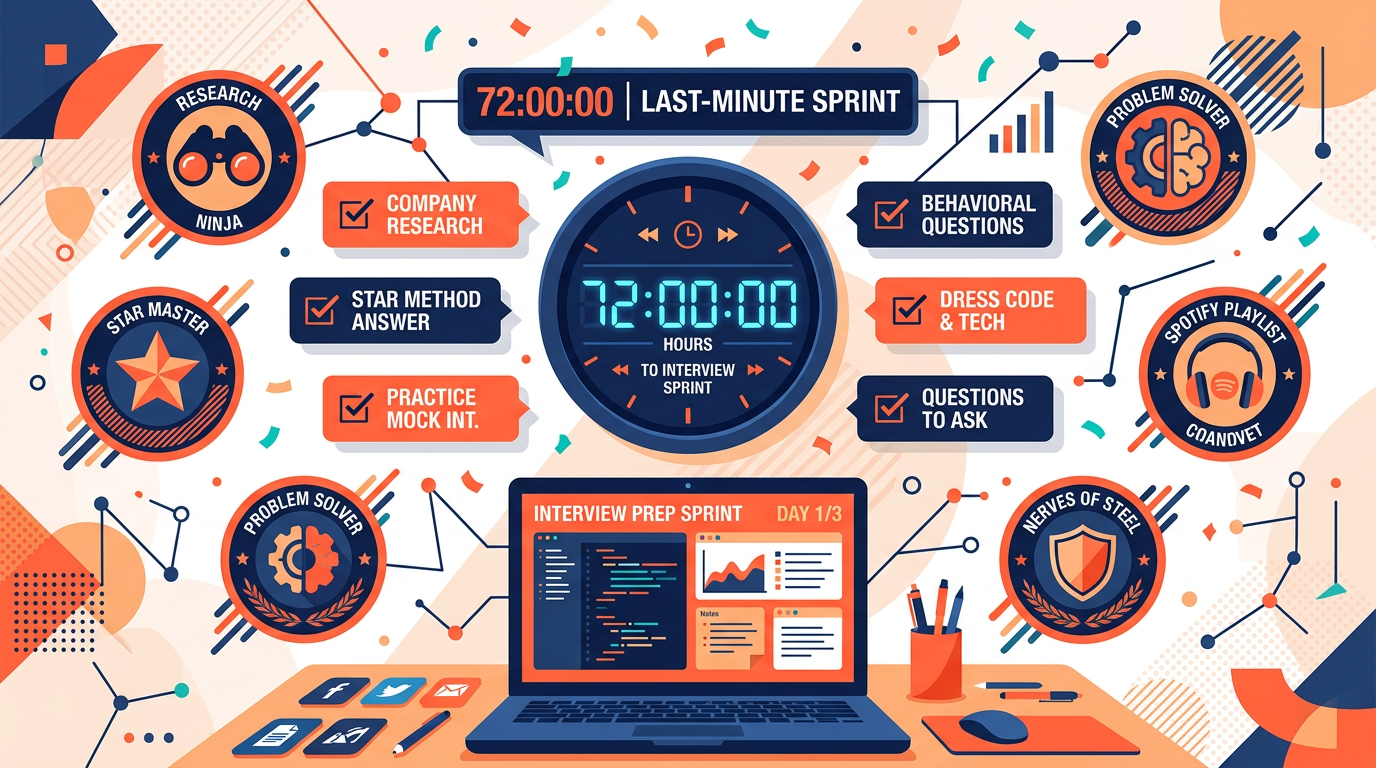
The 72-Hour Pre-Interview Sprint: How to Use AI to Maximize Your Last 3 Days Before the Big Interview
@[TOC]

In an ideal world, you’d have 30 days of structured preparation before interview season kicks off.
Reality: you sent out 80 applications and assumed they all disappeared into a black hole. Then Wednesday afternoon, a recruiter calls: “Hi, we’d love to schedule your interview for Friday afternoon.”
You have 72 hours. What do you do?
This is an hour-by-hour sprint plan. One prerequisite: you’re not starting from absolute zero. You have work experience and project stories — you just haven’t had time to package them for interviews. If you haven’t even written your resume yet, go handle the fundamentals first.
Recommended First: Use OfferGoose Before You Read On
Before absorbing this entire sprint plan, run one 15-minute diagnostic mock interview on OfferGoose. It’ll give you an instant baseline: where are you strongest? Where will you bleed points? The rest of this guide is far more actionable once you know your starting numbers.
The Three Principles of a 72-Hour Sprint
Principle One: Abandon “Complete Preparation” — Embrace “Precision Strike”
You cannot prepare for every possible question in 72 hours. You’re not running a full interview bootcamp — you’re making a 72-hour investment with the highest possible return.
Spend the first 30 minutes answering three questions:
- What does this role actually test? Read the job description carefully. Circle every recurring skill, tool, and methodology. These are your targeting coordinates.
- What are your three strongest stories? Pick the three project experiences you know best and that best map to the JD requirements. In 72 hours, you can only prepare three stories deeply. Don’t get greedy.
- What’s your single biggest gap? Be honest — is it verbal fluency? Technical depth? Industry knowledge? Pick the most lethal one and validate it with a quick AI mock session.
Principle Two: AI Mock Interviews Are Your Time Compression Engine
Live mock interviews have a fundamental time problem: scheduling, waiting for availability, and then receiving feedback that might be as vague as “you did pretty well.” In a 72-hour sprint, you can’t afford that coordination overhead.
AI mock interviews eliminate the scheduling friction: start anytime, stop anytime, get instant feedback. One OfferGoose full simulation (30 minutes) + automated review report (5 minutes to read) = a complete 35-minute learning cycle. Booking a single live mock session can easily burn half a day just in logistics.
Principle Three: A Clear Mind Is Your Last and Best Asset
The most common failure mode in a 72-hour sprint: anxiety causes efficiency collapse. The more you think “I only have 72 hours,” the more your brain tips into cognitive overload — and suddenly you can’t retain anything.
The counterintuitive solution: don’t spend all 72 hours learning new material. Reserve at least 30% of your time for reinforcing what you already know. This has two benefits: it solidifies existing strengths, and psychologically, it reminds you that “I’ve actually prepared quite a bit already.” That sense of groundedness dramatically reduces anxiety.
The Hour-by-Hour Sprint Plan
First 24 Hours: Rapid Diagnosis + Case Preparation
Hours 1–2: Deep JD Deconstruction
Paste the job description into OfferGoose’s resume matching feature. It will automatically extract high-frequency keywords and core competency requirements. Pay attention to three types of keywords:
- Hard skill keywords: Python, data analysis, A/B testing, SQL — you can’t cram these in 72 hours, but you need to know the interviewer will probe them.
- Soft skill keywords: cross-functional collaboration, stakeholder management, resilience under pressure — prepare corresponding STAR stories.
- Industry-specific keywords: ARR, churn rate, LTV:CAC ratio, NPS — make sure you can define and explain each one precisely.
Hours 3–6: STAR-C Refinement of Three Core Stories
Select three stories and refine each using the STAR-C framework (STAR + Commercial impact):
- Story 1: The project that best demonstrates your core professional competence.
- Story 2: The scenario that best showcases your collaboration or leadership.
- Story 3: A “turnaround” story — a failure → correction → success arc. Interviewers love these because they reveal self-awareness and learning ability.
Each story should be deliverable in under 2 minutes (roughly 250–350 words). Write out a draft.
Hours 7–10: Rapid AI Mock Interview Validation (3 Sessions)
Run three “quick simulation” sessions on OfferGoose — 15 minutes each — dedicated to validating your three core stories.
- Session 1: The AI interviewer probes Story 1. Observe the follow-up direction and the quality of your responses.
- Session 2: Validate Story 2.
- Session 3: Validate Story 3.
After each session, read the review report. Focus on: Did the story come through clearly? Was the STAR structure complete? Did you hold up under follow-up questioning?
Hours 11–12: Story Iteration
Based on mock interview feedback, refine all three stories. Common fixes: data isn’t specific enough, the Action section is too vague, the decision-making process is missing.
Hours 13–24: Full Rest
A sprint is not an all-nighter. Walking into an interview with a clear brain matters more than walking in with crammed knowledge. Get at least 7–8 hours of deep sleep.
Middle 24 Hours: High-Frequency Questions + Pressure Training
Hours 25–30: Targeted Prep for High-Probability Questions
These five questions appear with extremely high frequency. They deserve dedicated preparation:
- “Tell me about yourself.” (99% probability)
- “Why do you want to work here?” (80%)
- “Tell me about the biggest challenge you’ve faced.” (70%)
- “What are your strengths and weaknesses?” (60%)
- “Do you have any questions for me?” (90% — and many candidates crash on this one)
Practice each question three times using OfferGoose’s mock interview. Don’t memorize — the goal is to burn the skeleton of each answer into muscle memory so you can deliver it naturally.
Here’s a concrete example for Question 5:
Before:
“Uh, no, I think you covered everything. Thanks.”
After:
“Yes — two questions. First, I noticed in your Q2 earnings call you mentioned a 30% YoY increase in enterprise customers but flat net revenue retention. How is the product team approaching that gap between acquisition and expansion? Second, for someone in this role, what would success look like at the 90-day mark?”
Why this version works: It demonstrates that you’ve done company research beyond the homepage. It asks a business-level question that shows strategic thinking, not just “what’s the culture like.” And it signals that you’re already thinking about delivering results, not just getting the job. This is the difference between a forgettable candidate and one the interviewer keeps thinking about.
Hours 31–36: Company and Industry Research
Rapidly absorb three things: the company’s core business and recent announcements, the industry’s main trends and challenges, and the career trajectory typical for the target role. This knowledge will make you sound dramatically different when you ask your own questions at the end.
Hours 37–42: Pressure Simulation (2 × 30-Minute Full-Length Sessions)
This is the most critical step of the entire sprint. Set OfferGoose’s interviewer mode to “pressure/interrogation style,” session length to 30 minutes, and simulate the real interview rhythm.
Why is pressure mode so important? Because the #1 failure mode for sprint-prepared candidates is: prepared well, but froze under pressure. Pressure simulation trains your brain to maintain information retrieval capability under stress — getting comfortable performing while uncomfortable.
Hours 43–48: Targeted Patching + Sleep
Based on your pressure simulation review reports, identify the 1–2 biggest vulnerabilities and patch them. Don’t try to fix everything — your goal is “don’t let your weaknesses be fatal,” not “become the perfect candidate.”
Final 24 Hours: Mindset Calibration + Pre-Game Readiness
Hours 49–52: Final Knowledge Consolidation
Review the key points of your three core stories and the response frameworks for the five high-probability questions. No more new mock interviews — the focus now is consolidation, not acquisition.
Hours 53–60: Do Something Unrelated to the Interview
Go for a walk. Watch a movie. Have dinner with a friend. The goal isn’t distraction — it’s letting your brain consolidate information subconsciously. A large body of cognitive science shows that the brain integrates information more efficiently during relaxed states than during sustained focused attention.
Hours 61–68: Environment and Tech Check
Test your internet connection, camera, microphone, and lighting. If you plan to use OfferGoose’s real-time interview prompting feature during the actual interview, test the ASR latency and prompt positioning in advance. Make sure no technical issues will distract you on interview day.
Hours 69–72: Pre-Interview Mindset Management
In the final hour before the interview, do three things:
- Five minutes of box breathing (4-second inhale, 6-second exhale) to lower your heart rate.
- Open your prepared story keyword list and scan it quickly — not memorizing, just activating memory.
- Deliver your opening self-introduction to yourself in the mirror once.
Then, take a breath, and click the interview link.
| Sprint Phase | Primary Focus | Key Tool | Non-Negotiable |
|---|---|---|---|
| First 24h | Diagnose gaps, build 3 STAR-C stories | OfferGoose quick simulation (3×15min) | 7–8 hours of sleep |
| Middle 24h | High-frequency Qs, pressure training | OfferGoose pressure mode (2×30min) | At least one pressure-mode session |
| Final 24h | Consolidate, relax, tech check | Story keyword quick-scan | 1 hour pre-interview box breathing |
The Sprint Hall of Shame: Three Mistakes That Tank Candidates
Mistake One: Learning New Material in the Final 24 Hours
The more you chase “just one more thing and I’ll be ready,” the more likely you are to unravel. A 72-hour sprint isn’t about achieving “fully prepared.” It’s about ensuring your existing capabilities can be deployed stably. New material in the final 24 hours only pushes out what you’ve already internalized.
Mistake Two: Only Practicing Friendly Mode, Never Pressure Mode
Friendly-mode mock interviews feel great — the AI interviewer is warm, gives you time, follows up gently. Then you walk into a real interview with a stone-faced senior director who interrupts you 90 seconds in, and your composure shatters. Pressure-mode training isn’t optional. It’s the single highest-ROI hour you can spend.
Mistake Three: Sacrificing Sleep for Another Hour of Cramming
“I’ll just review one more hour — I can probably memorize a few more things” — and then the next day your brain is fog. Interview performance = Capability × Mental State. Trading 3% more knowledge for 30% worse state is pure negative ROI. Always choose sleep.
A Real Sprint Case: 72 Hours to a Data Analyst Offer
Consider a candidate targeting a data analyst role at a mid-size fintech company. The JD emphasized SQL, A/B testing design, and stakeholder communication.
Hours 1–2: Ran the JD through OfferGoose’s keyword extraction. Identified “experimentation framework,” “executive dashboarding,” and “cross-functional partnership” as the three highest-weight signals.
Hours 3–6: Built three STAR-C stories: (1) a pricing A/B test that increased monthly revenue by $42,000, (2) a churn prediction model rollout that required coordinating with engineering and product, (3) a failed experiment where the candidate learned that statistical significance requires minimum sample sizes the team hadn’t collected — and how they redesigned the experimentation playbook afterward.
Hours 7–10: Three quick simulations. The AI interviewer pressed hardest on Story 3 — “So you basically ran a useless test. How do I know you won’t do that here?” The candidate refined the answer to emphasize the process improvement that followed, transforming it from a failure story into a “built the company’s experimentation standards” narrative.
Hours 37–42: Two pressure-mode sessions. The first one exposed a recurring issue: under stress, the candidate defaulted to vague language (“we optimized the pipeline”) instead of specifics. The second session showed clear improvement — every claim now included a metric or a concrete action.
Result: The candidate received an offer. The hiring manager later mentioned that the “failed experiment → process improvement” story was the moment they decided — it demonstrated exactly the kind of learning mindset the team needed.
FAQ
General Questions
Q: With only 72 hours, should I spend time optimizing my resume?
If the interview is based on the resume you’ve already submitted (meaning it passed the initial screen), do not overhaul it. The interviewer is holding your current resume. Focus on preparing the content that’s already on it. Fix only glaring errors.
Q: Are three stories really enough? Shouldn’t I prepare more?
For a 72-hour sprint, three deeply prepared stories will outperform ten shallow ones. The vast majority of questions you’ll face can be answered using different angles of those same three stories. Depth beats breadth when time is tight.
Q: What if I don’t have a “turnaround” story (failure → success)?
Dig deeper. Almost every professional has had a project that didn’t go as planned, a decision they’d make differently now, or a situation where initial assumptions were wrong. The story doesn’t need to be catastrophic — it just needs to show self-awareness and course-correction ability. Even a small scope miss or a stakeholder misalignment that you resolved can work.
Questions About OfferGoose
Q: Should I use OfferGoose’s real-time prompting feature during the sprint?
Yes — but selectively. During the pressure simulation phase (middle 24 hours), run half your sessions with the prompter enabled and half without. The goal is to master the tool as a safety net while ensuring you can perform without it. On interview day, decide based on your comfort level and the interview format.
Q: How is the 15-minute quick simulation different from the full 30-minute session?
The quick simulation is optimized for testing one specific story or question type at a time. It generates faster feedback loops. Use quick sessions for story validation and targeted practice. Use full sessions for building stamina and simulating the real interview rhythm.
Q: Can I run back-to-back mock sessions, or do I need breaks between them?
Always take at least a 10-minute break between full-length sessions. The review report is part of the learning cycle — skip it, and you’re just accumulating practice volume without extracting insights. Quick simulations can be stacked more tightly, but still read each report before moving to the next session.
Vote: How much time do you typically have between getting an interview invite and the actual interview?
- A. Less than 3 days — it’s always an emergency sprint
- B. 3–7 days — barely enough for one fast prep cycle
- C. 1–2 weeks — relatively comfortable
- D. 2+ weeks — I prepare well in advance
Final Thoughts
Preparing for a major interview in 72 hours isn’t ideal — but it’s the reality for a huge number of job seekers. The core strategy is simple: invest your limited hours into the activities with the highest return. Deconstruct the JD. Refine three killer stories. Pressure-test with AI. Protect your sleep.
OfferGoose’s AI mock interviews are the most effective time-compression tool for sprint preparation — instant start, instant feedback, instant iteration. Run one quick diagnostic session now to see your baseline, then follow the timeline above and sprint toward your offer: Start Your Sprint on OfferGoose