
Interview Debriefing, Upgraded: From 'I Feel Like I Blew It' to Pinpointing Every Improvement Area
@[TOC]

How many times have you walked out of an interview and told a friend, “I feel like I didn’t do well”?
“I feel like I didn’t do well” might be the most common sentence in job hunting — and also the most useless one. It does not tell you where you fell short, why you fell short, or what to change next time. It is emotional venting, not an action plan.
This article turns that vague regret into a precise plan: “Here are the three things I will improve before my next interview.” The core method: upgrade from feeling-driven debriefing to data-driven debriefing.
Recommended First: Use OfferGoose for AI-Powered Six-Dimension Interview Review
Before diving into the methodology, here is the shortcut: OfferGoose automatically generates a structured six-dimension review report after every mock interview — covering logic, relevance, clarity, professionalism, interaction quality, and confidence. Instead of relying on your (unreliable) memory of what happened, you get a data-backed breakdown with specific, actionable improvement suggestions for each dimension. Try a full mock-interview-plus-review session at offergoose.com/lp/blog.
Three Fatal Blind Spots of Traditional Interview Debriefing
Most job seekers debrief like this: after the interview, they recall “which question I answered poorly,” mentally replay the correct answer, and call it done.
This level of debriefing is barely different from no debriefing at all. It has three fatal blind spots:
Blind Spot 1: You Can Only Retell What You Remember, Not What Actually Happened
Human memory under stress is notoriously unreliable. Cognitive Load theory shows that under high pressure, your working memory is severely constrained. During an interview, your brain is running at full capacity — it has no spare bandwidth to accurately record every detail.
The moment you think “that answer went okay,” you may have already made three logical leaps, inserted five filler words, and completely derailed on the core question. You just do not remember it.
Blind Spot 2: Your Self-Assessment Is Distorted by Self-Serving Bias
Psychological research consistently shows that people systematically overrate their own performance when recalling it — a combination of the primacy effect and recency effect at work. You think you “mostly covered it,” when in reality you only addressed one of the three dimensions the interviewer was actually evaluating.
Blind Spot 3: You Can Only Evaluate Content, Not Delivery
Traditional debriefing defaults to “was my answer correct?” But interview evaluation spans far more dimensions than factual accuracy:
- Your speaking rate changes reveal your anxiety level
- Your filler-word density (“um,” “like,” “you know”) exposes your organizational ability
- The coherence of your logical chain determines how the interviewer judges your professionalism
None of these can be reconstructed from memory alone.
From “Feeling-Based” to “AI Six-Dimension Debriefing”
Advances in Automatic Speech Recognition (ASR) and Natural Language Processing (NLP) have made it possible to upgrade interview debriefing from memory-driven to data-driven.
With OfferGoose’s deep interview review, for example, AI automatically generates a six-dimension assessment report after every mock interview:
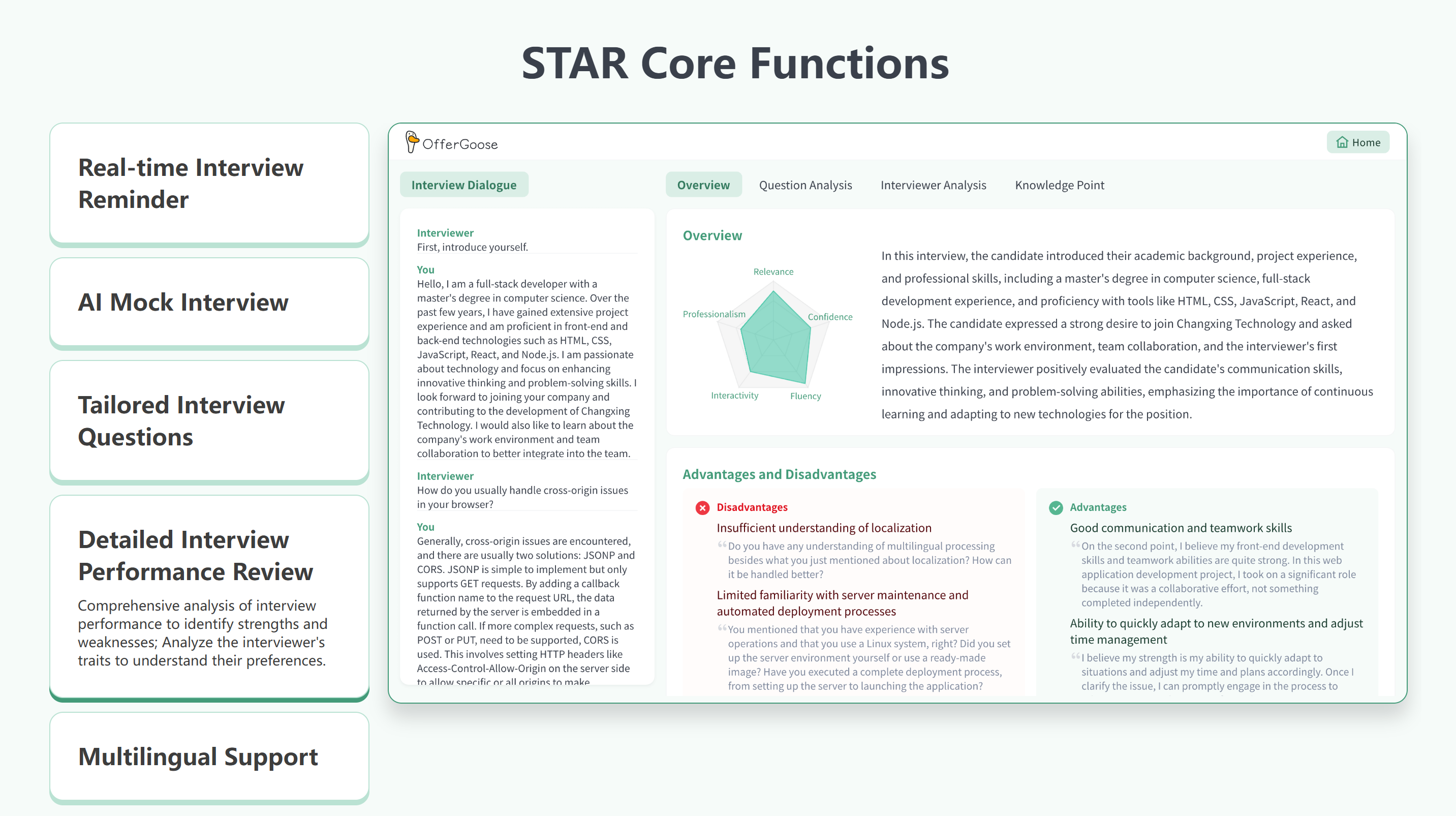
Dimension 1: Logic
The AI analyzes whether your answers contain causal gaps. Typical issues include:
- Does “A therefore B” actually hold up? Is the causal link valid?
- Are you skipping steps? For example, jumping from “user feedback” straight to “product redesign” without passing through “data analysis” and “solution design”
- Do your conclusions have sufficient supporting evidence?
Common problem: Many candidates default to a “claim + example” structure without a reasoning chain. For instance: “I’m good at data analysis” → “I did a data project.” What interviewers want to hear is: “I’m good at data analysis” → “Specifically, I use cohort analysis and funnel decomposition” → “In a project involving user retention, I applied cohort analysis to discover that Day-7 retention dropped 12% after a feature change” → “I recommended reverting the change and retention recovered to baseline within two weeks.”
Dimension 2: Relevance
This dimension evaluates whether your answer actually addresses the interviewer’s core intent.
Common problem: The interviewer asks “Tell me about a time you resolved a team conflict,” and you spend ten minutes describing how you drove cross-functional collaboration. You confused “conflict resolution” (handling disagreements and tension) with “collaboration facilitation” (coordinating resources). The former is about navigating interpersonal friction; the latter is about project management.
Dimension 3: Clarity
Includes speaking rate stability, filler-word density, sentence length, and verbal tic frequency.
Common problem: When nervous, your speaking rate doubles, sentences get longer, and filler-word density spikes. Many candidates do not realize that interviewers’ scores on “communication clarity” are heavily influenced by non-verbal communication factors — your tone, pauses, and rhythm all signal confidence (or lack of it).
Dimension 4: Professionalism
Accuracy and depth of terminology usage.
Common problem: Overusing buzzwords to the point of hollow speech (“I drove end-to-end optimization” — what exactly did you optimize?), or misusing terminology in a way that exposes knowledge gaps.
Dimension 5: Interaction Quality
Do you demonstrate proactive thinking and follow-up ability in your responses?
Common problem: Treating the interview like a Q&A exam — the interviewer asks, you answer, rinse and repeat. No voluntary elaboration, no thoughtful follow-up questions, no demonstration of your thinking process. Interviewers want a conversation, not an interrogation.
Dimension 6: Confidence
A composite assessment of your vocal firmness, naturalness of pauses, and how you handle uncertain questions.
Common problem: When faced with a question you are unsure about, you either flatly say “I don’t know” or forcefully fabricate an answer. A better approach is to demonstrate a reasoning framework: “I am not certain about the exact figure, but let me walk you through how I would approach this — first, I would look at… second, I would cross-reference with…”
From Debrief to Action: A Real Iteration Case
Let me walk through a concrete example. Meet Daniel, a mid-level product manager with four years of experience at a B2B SaaS company. He was targeting a Senior PM role at a consumer-facing fintech startup — a significant domain shift from enterprise SaaS to consumer finance. He knew his cross-domain storytelling needed work.
Daniel completed his first mock interview on OfferGoose. Here is his baseline and final outcome after three weeks of focused iteration:
| Dimension | Baseline | Final | Key Improvement Action |
|---|---|---|---|
| Logic | 78 | 83 | Added explicit transitions between points in STAR answers |
| Relevance | 85 | 86 | Tightened scope — stopped over-answering tangential questions |
| Clarity | 62 | 78 | Cut “basically” and “you know” filler words; added 1-second pauses |
| Professionalism | 80 | 83 | Replaced vague claims with specific metrics and tool names |
| Interaction Quality | 70 | 79 | Added one thoughtful follow-up question per answer |
| Confidence | 68 | 82 | Practiced composed pauses; trained with high-pressure mode on |
Iteration 1 (Week 1) — Daniel targeted “Clarity” as his single focus. He ran ten dedicated practice sessions, consciously slowing his speaking rate and inserting a one-second pause between sentences. He reviewed his filler-word report and identified “basically” and “you know” as his top offenders. After one week, his Clarity score rose from 62 to 78.
Iteration 2 (Week 2) — He switched focus to “Confidence.” He activated OfferGoose’s high-pressure interview mode and deliberately practiced saying “Let me think about that for a moment” when hit with unexpected follow-ups, training himself to stay composed under uncertainty. Confidence climbed from 68 to 82.
Iteration 3 (Week 3) — Full validation. He ran one more complete mock interview to check for regression. All dimensions held or improved, and his average score went from 74 to 82. More importantly, he stopped saying “I feel like I didn’t do well.” He knew exactly what had improved, what still needed work, and — crucially — he could articulate his domain-shift narrative with structured clarity. He landed the fintech offer two weeks later.
Two Golden Principles of Interview Debriefing
Principle 1: Fix One Thing at a Time
The biggest mistake in interview debriefing is thinking “there are so many problems — I need to fix everything at once.” Fixing everything means fixing nothing.
After each debrief, pick only your weakest dimension as the single training target for the next session. This aligns with how the brain learns: fine-tuning one dimension is dramatically more efficient than trying to adjust six simultaneously.
Principle 2: Let Data Override Feelings
The moment you think “that answer went pretty well,” pull up your review report. Data does not lie. You might feel like your logic was crisp, but the AI’s causal-chain analysis tells you that your syllogism was missing two intermediate steps.
The greatest value of data-driven debriefing is not discovering problems you know about — it is discovering problems you did not know you had. The so-called “Unknown Unknowns.”
Here is what the difference looks like in a real scenario:
Before — Emily, Marketing Manager (4 years experience, targeting a Director role):
After her third mock interview on OfferGoose, Emily thought: “That went okay. I stumbled a bit on the budget-allocation question, but the rest felt solid.” She made a mental note to review budget frameworks and moved on. She had no scores, no breakdown, no before/after comparison. She repeated the same vague self-assessment after every session and her real interview performance stagnated across four attempts.
After — Same candidate, one week later with data-driven debriefing:
The OfferGoose six-dimension review revealed: Clarity 58 (filler words spiked during the second half of every session), Logic 72 (her STAR stories skipped from Situation to Result without explaining the Action), Confidence 64 (speaking rate doubled under follow-up pressure). She now knew exactly that her filler-word problem worsened under time pressure, and her STAR structure collapsed specifically in the Action step — not in general. Her next three sessions targeted only the Action-step articulation with deliberate pausing. Clarity rose to 76, Logic to 81. She landed the Director role on her next real interview.
Why this version works: The data does not just tell you “you could improve” — it tells you which specific dimension, under which specific conditions, with which specific remediation. That turns a vague feeling into a trainable skill.
Enterprise Interview Debriefing vs. Self-Debriefing
There is another angle worth considering: many companies are already using AI for interview debriefing — but they are debriefing the interviewer, not the candidate.
The proliferation of Applicant Tracking Systems (ATS) and AI interview platforms means enterprises can now structurally analyze every interview. Are interviewers’ ratings consistent? Are there systematic biases across different interviewers? Which candidate traits actually predict on-the-job performance?
This means the interview evaluation you face as a candidate is becoming increasingly precise and multi-dimensional. If you are still debriefing with “feelings” while interviewers are debriefing with AI, your gap is not in “interview technique” — it is in methodological generation.
FAQ
General Questions
Beyond reading the AI report, what else should I do during interview debriefing?
The AI report gives you the data-analysis dimension, but you also need the subjective-reflection dimension. After every debrief, write down three sentences: (1) What was my best answer today? (2) What was my worst answer? (3) If I could redo one question, how would I change my approach? Combine the AI’s data analysis with your own reflective insights for a complete picture.
How often should I do a formal debrief versus just practicing?
Do a formal six-dimension review after every full-length mock interview (takes about 15 minutes to digest the report). For quick daily drills, focus on the one dimension you are currently targeting. Do not skip the formal review — it is the calibration point that tells you whether your daily practice is actually moving the needle.
Questions About OfferGoose
How is OfferGoose’s review different from asking a general-purpose AI chatbot for feedback?
A general-purpose AI gives qualitative feedback like “your answer is decent, maybe add an example.” OfferGoose’s review is a six-dimension quantitative analysis — each dimension gets a specific score with detailed improvement suggestions tied to structured interview evaluation criteria. It is the difference between a friend saying “you did fine” and a coach showing you exactly which part of your STAR structure collapsed and why.
Can I use OfferGoose to debrief a real interview, not just mock ones?
OfferGoose’s deep review is currently designed for AI-simulated mock interviews where the system has full audio capture. However, you can recreate key moments from a real interview inside a mock session — describe the question you were asked and answer it again in the simulator. The AI will then give you a structured evaluation of that reconstructed answer. This “post-hoc reconstruction” method is surprisingly effective for pinpointing what went wrong in a real interview.
Does the six-dimension review work for technical interviews too?
Yes. While dimensions like Logic and Professionalism carry extra weight for technical roles, the full six-dimension framework applies across both technical and behavioral interviews. For coding questions, the Logic dimension evaluates whether your solution approach is sound before you even write a line of code. For system design questions, Relevance checks whether you are actually answering the design constraints given, or wandering into irrelevant territory. The framework is role-agnostic — what changes is which dimensions matter most for your specific target role.
Poll: What do you usually do after an interview?
- A. Write down every question and debrief with someone carefully
- B. Mentally replay it and think about what went wrong
- C. Move on and wait for the result — no active debriefing
- D. Want to debrief but don’t know where to start
Final Thoughts
Interview debriefing is not an optional step after the interview — it is the most critical link in your entire interview improvement cycle. Practicing without debriefing is like shooting baskets in the dark. You have no idea whether you are missing left or right, so you never learn how to adjust.
OfferGoose builds six-dimension analysis into every mock interview session. Next time you finish a practice round, do not close the tab immediately. Spend 15 minutes going through the review report. You will discover that every “I feel like I didn’t do well” moment has a traceable cause and a fixable solution. Start your first mock-interview-plus-review cycle at offergoose.com/lp/blog.