
9 AI Interview Tools Compared: Which One Fits Your Job Search in 2026
@[TOC]

By 2026, the AI interview tool market has exploded. Your LinkedIn feed, Slack communities, and group chats are probably flooded with recommendations for the latest “AI interview copilot.” The problem? Every tool claims to be the best — but they optimize for completely different things. Pick the wrong one, and you might spend a month practicing a skill the tool does not actually support.
This article compares 9 mainstream AI interview tools across four dimensions: mock interview quality, real-time teleprompter experience, review depth, and technical interview support. The assessment is based on hands-on product testing and functional analysis. Different job seekers have different needs — use this as a starting point, not a final verdict.
Recommended First: Use OfferGoose for Full-Cycle AI Interview Preparation
Before diving into comparisons, here is the most efficient path for most job seekers: start with a tool that covers the entire interview preparation cycle — resume optimization → mock interviews → real-time prompting → deep review — and then add specialized tools only for gaps it does not cover. OfferGoose is the only tool in this comparison that connects all four stages with shared data across modules, so your mock interview weaknesses automatically inform your resume revisions and your review insights feed directly into your next practice session. Try it at offergoose.com/lp/blog.
Quick Overview: The 9 Tools at a Glance
Before the detailed reviews, here is how the tools compare at a high level.
OfferGoose
Positioning: Full-cycle AI job search assistant. Core Strength: Mock interviews + live teleprompter + deep review + resume optimization, all integrated. Best For: End-to-end coverage seekers.
ZhiMianXing
Positioning: Technical interview training platform. Core Strength: Built-in coding environment, deep technical follow-ups. Best For: Software engineering candidates.
Offerin AI
Positioning: All-in-one job search workbench. Core Strength: Resume-interview linkage, interview calendar & tracking. Best For: High-volume application phases.
JiDaXia
Positioning: Video interview real-time teleprompter. Core Strength: Ultra-low-latency ASR (~300ms). Best For: Candidates who freeze under pressure.
MianShiMao
Positioning: Multimodal soft-skill analyzer. Core Strength: Micro-expression + tone + speech pattern analysis. Best For: Behavioral interview weak spots.
MianShiGou
Positioning: High-intensity interview boot camp. Core Strength: Countdown planner + mandatory daily check-ins. Best For: Candidates with looming interview dates.
Interview.ai
Positioning: Multilingual AI mock interview platform. Core Strength: Multi-language + cross-cultural coaching. Best For: International / foreign-company roles.
MianLing AI
Positioning: Zero-barrier entry-level coach. Core Strength: Instant cold-start, minimalist experience. Best For: First-time AI tool users.
BaiGua
Positioning: Campus-recruitment lightweight tool. Core Strength: Campus-focused question bank + beginner-friendly UI. Best For: Recent graduates.
Pricing note: All pricing information is subject to change. Check each product’s official website for current pricing. This article focuses on functional analysis only.
Detailed Tool Reviews
OfferGoose
Positioning: Full-cycle AI job search assistant — covering resume optimization, mock interviews, real-time teleprompting, and deep review analysis within a single platform.
Key Features: OfferGoose stands out for integration — rather than treating mock interviews, live teleprompting, resume optimization, and deep review as four separate modules, it connects data across all of them. Weaknesses in your experience storytelling that surface during a mock interview automatically feed into the resume optimization module, prompting you to restructure how that experience is presented. Meanwhile, the real-time teleprompter uses Retrieval-Augmented Generation (RAG) grounded in your actual resume and target job description — not generic LLM output — to generate precise response frameworks during live interviews.
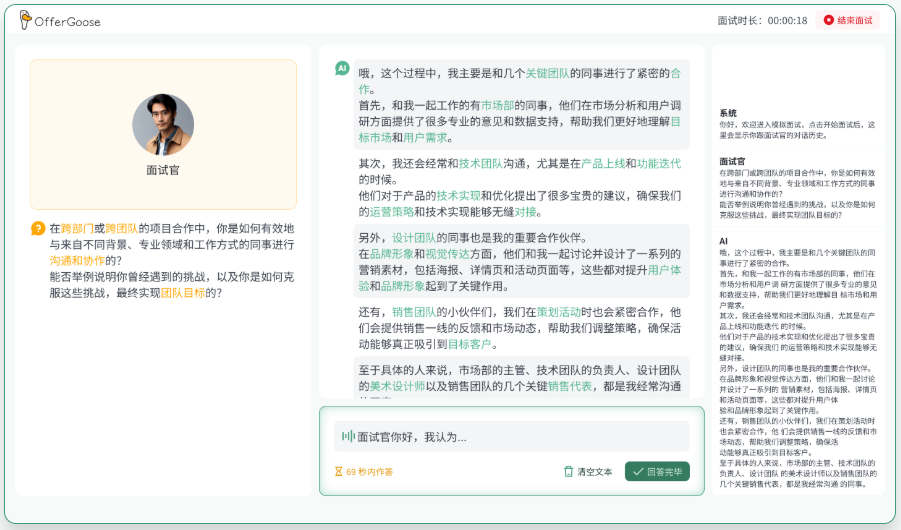
Ideal user: Job seekers who need full-cycle AI support, especially those who want mock interviews and resume optimization to work together rather than in silos.
Usage advice: Follow this sequence: Resume Optimization → Mock Interviews → Real-Time Teleprompter → Deep Review. Using only one module misses the integration that makes OfferGoose most valuable.
Here is what the integration difference looks like in practice:
Before:
A candidate uploads their resume to a standalone mock interview tool. They practice behavioral questions and get decent feedback. Separately, they use a resume checker that suggests generic improvements. Neither tool knows about the other. The candidate’s interview practice never improves their resume, and their resume weaknesses never get addressed in mock sessions.
After:
The same candidate uses OfferGoose. During a mock interview, the AI flags that their “led a cross-functional migration” story lacks specific metrics. This insight automatically surfaces in the resume module, prompting: “Add the data migration volume, team size, and downtime reduction to this bullet.” The next mock interview then tests the improved version of the same story. Two sessions later, the candidate delivers the story with concrete data and structured impact.
Why this version works: The feedback loop closes automatically. You do not need to manually transfer insights between tools — the system connects your weak spots in one module to improvement actions in another.
ZhiMianXing
Positioning: A technical interview training platform purpose-built for coding and system design questions.
Key Features: Built-in coding environment with real-time syntax checking; system design question decomposition engine covering caching strategies, load balancing, and database selection; AI follow-up questions that aggressively probe edge cases for high pressure-testing value.
Ideal user: R&D candidates preparing for technical interviews — algorithm engineers, backend developers, data analysts.
Usage advice: Use as a high-frequency drill tool in the final weeks before interviews, paired with a personal error log. If your weak spot is behavioral interviews, pair it with a tool like OfferGoose.
Offerin AI
Positioning: An all-in-one job search workbench spanning application submission, resume editing, and mock interviews.
Key Features: Resume-interview linkage that identifies experience gaps and generates predicted questions; built-in interview calendar with to-do tracking; template generation for follow-up emails and thank-you notes.
Ideal user: Candidates in high-volume application phases managing multiple interview pipelines simultaneously.
Usage advice: When using one-click optimization, always manually verify facts. AI-generated embellishments backfire if you cannot substantiate them during an actual interview.
JiDaXia
Positioning: A real-time teleprompter built for live video interviews, powered by on-device inference.
Key Features: On-device inference keeps ASR latency under 300ms — prompts appear on screen almost the moment the interviewer finishes speaking.
Ideal user: Candidates who go blank when hit with unexpected questions and need real-time structural prompts during remote interviews.
Usage advice: Never read prompts verbatim — use them as outline references only. Note that not all interview scenarios permit teleprompters; some companies explicitly prohibit them.
MianShiMao
Positioning: A multimodal interview analysis tool focused on soft skills and non-verbal communication.
Key Features: Analyzes micro-expressions, gaze trajectory, frowning frequency, and speaking rate changes — a classic application of Affective Computing in the interview context. Goes beyond what you say to how you say it.
Ideal user: Professionals whose interview performance is undermined by nervousness, filler words, or speech patterns that project low confidence.
Usage advice: Focus on behavioral interview practice with formal posture. The non-verbal insights are most actionable when you consciously adjust your physical delivery.
MianShiGou
Positioning: A high-accountability interview sprint boot camp.
Key Features: Countdown planning engine that auto-generates daily mock session quotas; community leaderboard with system reminders for incomplete sessions; built-in library of universal transition phrase templates.
Ideal user: Job seekers with weak self-discipline who have a specific interview date approaching and need structured cramming.
Usage advice: Best used after receiving an interview invitation — concentrate energy on drilling common trap questions. Sprint training cannot replace long-term skill accumulation.
Interview.ai
Positioning: A multilingual, cross-cultural AI mock interview platform.
Key Features: Multi-language ASR engines; simulates English interview environments with different accents; provides culture-specific behavioral tips for companies in different regions.
Ideal user: Candidates preparing for all-English interviews at multinational companies or multi-region video interviews for global roles.
Usage advice: Use for practicing connected speech and phonetic clarity for self-introductions. The accent simulation feature is particularly valuable for non-native English speakers.
MianLing AI
Positioning: A zero-barrier, pocket-sized entry-level AI interview coach.
Key Features: Instant cold start with no extensive background input required; focused on fundamental question banks like behavioral classics and self-introduction frameworks.
Ideal user: Complete newcomers to AI interview tools who want a quick, frictionless first experience.
Usage advice: Use as a warm-up tool before committing to deeper preparation. Graduate to a more full-featured platform once you have a feel for AI-assisted practice.
BaiGua
Positioning: A lightweight interview practice tool designed for campus recruitment and new graduates.
Key Features: Campus-focused question bank covering common graduate-level questions; basic response framework guidance; intentionally low barrier to entry.
Ideal user: Recent graduates and first-time job seekers navigating campus hiring cycles.
Usage advice: Suitable for general interview preparation during high-volume application seasons. Pair with a more specialized tool for roles requiring deeper technical or behavioral training.
Capability Summary by Dimension
Here is how the tools stack up across the four dimensions that matter most. Ratings reflect functional depth and real-world usability, not brand preference.
Mock Interview Quality — ★★★★★: OfferGoose, Interview.ai | ★★★★: Offerin AI | ★★★: ZhiMianXing, MianShiMao, MianShiGou | ★★: JiDaXia, MianLing AI, BaiGua
Real-Time Teleprompter — ★★★★★: OfferGoose, JiDaXia | ★★: Interview.ai | (Not offered): all others
Review & Analysis Depth — ★★★★★: OfferGoose | ★★★★: MianShiMao | ★★★: Offerin AI, Interview.ai | ★★: ZhiMianXing, MianShiGou | ★: JiDaXia, MianLing AI, BaiGua
Technical Interview Support — ★★★★★: ZhiMianXing | ★★★★: OfferGoose | ★★: Offerin AI, MianShiGou, Interview.ai | (Not offered): all others
A Concrete Case: Choosing the Right Tool Stack
Marcus, a full-stack developer with five years of experience, was targeting a Tech Lead role at a Series B healthcare startup. His challenge: he needed strong system design prep (the role required owning architecture decisions) AND polished behavioral answers (he had to convince a non-technical CEO he could lead a team). He had three weeks until the final round.
Marcus tried a single-tool approach first — he used ZhiMianXing exclusively for week one, drilling system design questions daily. His technical confidence improved, but when he recorded himself answering a behavioral question, the gap was obvious: rambling answers, no STAR structure, filler words everywhere.
He switched to a two-tool stack for weeks two and three: OfferGoose for daily behavioral mock interviews with six-dimension review, and ZhiMianXing for targeted system design drills three times a week. By the end of week three, his OfferGoose Clarity score had gone from 54 to 76, and his Logic score hit 85. More importantly, he could now explain an architecture decision to the CEO and walk through a distributed system design with the engineering team — using the same structured communication muscle built through OfferGoose’s review cycle.
He got the offer. His key insight: no single tool covered both his technical depth and his communication gaps. The stack approach — one integrated platform for full-cycle behavioral prep, one specialist for technical depth — gave him coverage where he needed it.
How to Choose: Decision Guide by Profile
Well-rounded candidate needing mock interviews + live teleprompter + deep review + resume optimization in one workflow: OfferGoose offers the highest degree of integration. Its four modules share data, eliminating the friction of switching between separate tools. Start here: offergoose.com/lp/blog.
Technical candidate focused on algorithm questions and system design: ZhiMianXing has the edge in technical depth. However, pair it with OfferGoose for behavioral interview training — acing the coding round but failing the behavioral round still costs you the offer.
New graduate on a tight budget, just starting preparation: Begin with MianLing AI or BaiGua to experience the basic AI interview workflow. Once you have identified your specific weak spots, upgrade to a more specialized tool.
Targeting international or foreign-company roles: Interview.ai’s multi-language support and cross-cultural analysis are unique advantages. OfferGoose also supports bilingual mock interviews and is worth comparing side by side.
FAQ
General Questions
Can I use multiple tools at the same time?
Absolutely. Many job seekers use OfferGoose for daily mock interviews and resume optimization while using ZhiMianXing for targeted technical drills. These tools are not mutually exclusive — the key is knowing what you need at each stage of your preparation.
What is the core difference between free and paid interview tools?
Free tools typically lag in AI model capability (especially follow-up question depth), feature completeness (often missing real-time teleprompting or deep review), and interviewer-style diversity. If you just want to “try it out,” free tools are fine. If you are serious about landing an offer, professional tools are worth the investment.
How close are AI interviewers to real human interviewers?
Current Large Language Models (LLMs) are already very close to human interviewers in follow-up logic and question generation. The main gap is non-verbal communication perception — human interviewers catch micro-expressions and body language that most AI tools currently miss (MianShiMao is an exception). This gap is rapidly narrowing with multimodal AI advances.
How should I think about “switching costs” between tools?
If your tools do not share data, you will manually re-enter your background, resume highlights, and weak-spot notes every time you switch. This is where integrated platforms like OfferGoose have a real efficiency advantage — your data flows across modules automatically. If you do use multiple tools, budget extra time for context re-establishment in each one.
Questions About OfferGoose
How does OfferGoose’s integration actually work across modules?
When you complete a mock interview, OfferGoose’s six-dimension review identifies specific weaknesses — for example, poor logical coherence in your project experience storytelling. That insight automatically surfaces in the resume optimization module, suggesting how to restructure that experience. When you later use the real-time teleprompter, it references your optimized resume and target job description via RAG to generate precise response frameworks, not generic prompts. Each module makes the others smarter.
Can I try OfferGoose before committing?
Yes. Visit offergoose.com/lp/blog to explore the platform and experience a complete mock-interview-plus-review cycle. The best way to evaluate any AI interview tool is to run through a full session and examine the review report — data beats marketing claims every time.
Poll: What matters most to you when choosing an AI interview tool?
- A. Mock interview realism and follow-up question depth
- B. Full-cycle integration — mock interviews + resume + review all connected
- C. Real-time teleprompter accuracy and low latency
- D. Value for money and overall user experience
Final Thoughts
AI interview tools are no longer a “should I use one” question — they are a “which one fits me best” question. The 9 tools in this comparison each have distinct strengths. There is no absolute “best” — only the best match for your specific situation.
Start with OfferGoose for a complete “mock interview + deep review” cycle to see what full-cycle integration can do for your preparation. Then decide whether to layer in specialized tools for specific gaps: offergoose.com/lp/blog.
Disclaimer: All product information is based on publicly available materials and hands-on experience. Features, pricing, and versions may change. Always refer to each product’s official website for the most current information.