
Technical Interview Prep With AI: A Full-Stack Training System for Algorithms, System Design, and Behavioral Rounds
@[TOC]

Technical interviews are the strangest beast in the hiring world. You need to nail three things simultaneously: raw coding ability, structured verbal communication, and interview psychology. Plenty of engineers grind 500 LeetCode problems and then fail the first round on “Tell me about the hardest bug you ever tracked down.”
This article follows the real training log of a backend engineer — let’s call him Chen — as he builds a complete AI mock interview training system across all three technical interview modules over two weeks.
The Three Mountains of Technical Interviews
A standard technical interview loop typically has three modules, each testing a fundamentally different skill:
| Module | What It Tests | Common Pitfall | What to Train |
|---|---|---|---|
| Algorithms | Logical reasoning, coding fluency, time complexity analysis | Coding silently, zero verbal explanation | Thinking out loud through the entire process |
| System Design | Architectural thinking, trade-off analysis, business understanding | Chasing the “perfect” solution | Demonstrating structured trade-off reasoning |
| Behavioral | Collaboration, leadership, problem-solving | Answering with technical jargon | STAR-structured storytelling with business impact |
Here’s the core problem: these three modules demand completely different “speaking modes.” Behavioral answers target HR or hiring managers. System design answers target architects and senior engineers. Algorithm walkthroughs show the interviewer your thought process in real time. You need to train three separate communication systems.
Recommended First: Use OfferGoose to Identify Your Weakest Module
Before committing two weeks to structured training, run one full-length technical mock interview on OfferGoose to see which module is dragging you down. The dimensional report will show exactly where to invest your time.
👉 Start your free technical mock interview at offergoose.com/lp/blog
The Candidate: Chen, Backend Engineer, 3 Years of Experience
Chen works primarily in Java backend development. His project experience spans microservice migrations, database migrations, and high-concurrency optimization. His target: a senior backend engineer role at a mid-to-large internet company.
The job description he was targeting called for hands-on experience with microservices architecture, database selection (SQL vs. NoSQL), caching strategy, and load balancing. The tech stack: Java / Spring Boot + MySQL + Redis + Kafka.
Before starting his training, Chen used OfferGoose’s resume-to-JD matching feature to analyze the gap between his resume and the target role. Three critical weaknesses surfaced: system design explanations were fuzzy, project impact lacked quantification, and English technical terminology was imprecise.
Here is Chen’s complete two-week AI mock interview training log.
Week 1: Module-by-Module Drills
Algorithm Verbalization Training (Days 1–2)
Most engineers believe algorithm rounds are won by writing code fast. In reality, interviewers evaluate your chain-of-thought reasoning before they even look at your code.
Here is how Chen trained:
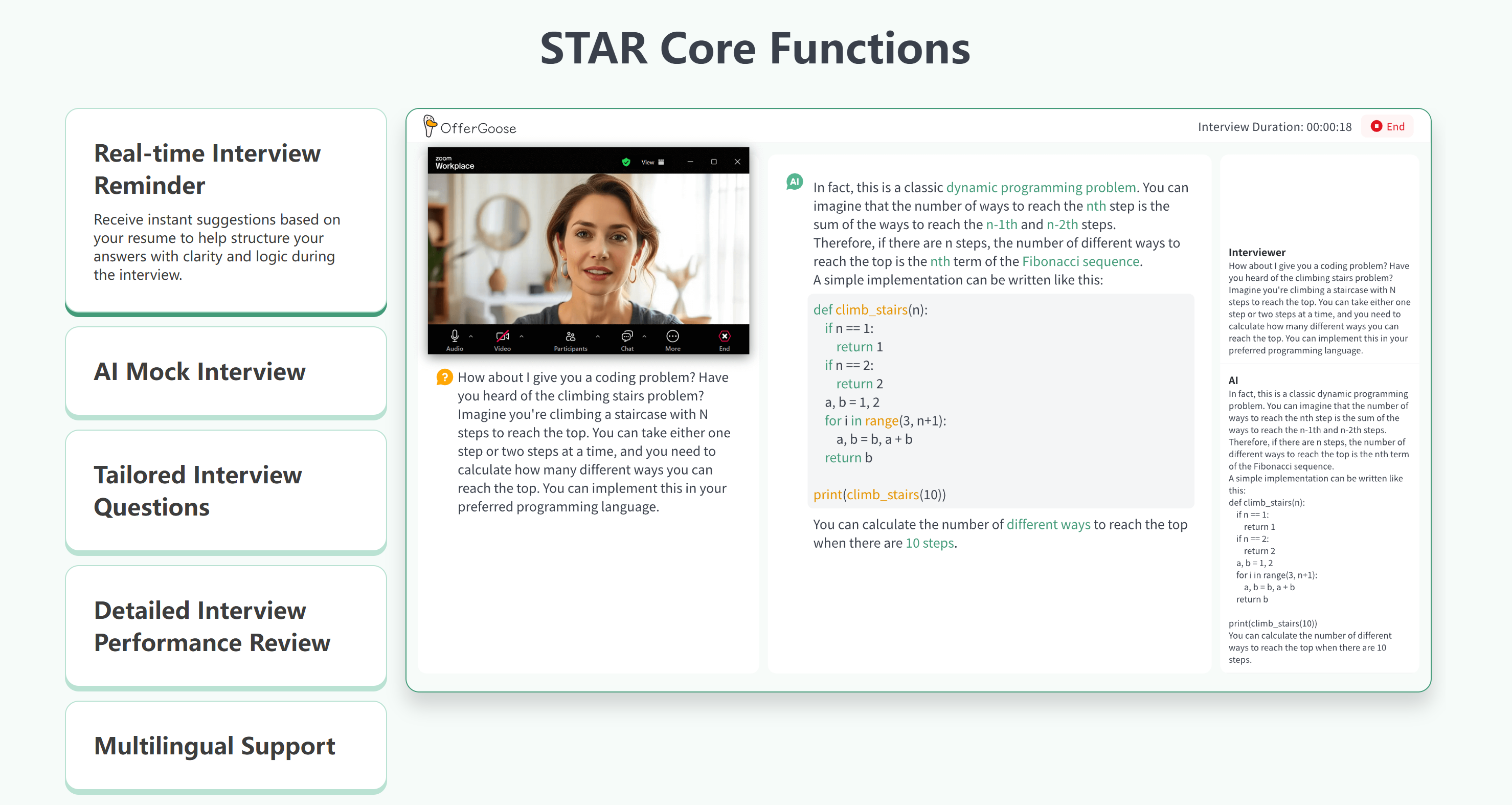
- Opened OfferGoose’s algorithm interview mode (interviewer style: “technical follow-up type”)
- The AI interviewer presented a problem
- Chen verbalized his entire approach before touching code — not typing, not writing, just speaking:
- What is the brute-force solution? What’s the time complexity?
- Where is the optimization leverage? Why does it reduce complexity?
- Which edge cases need handling?
- Then he coded with inline comments as he spoke
- The AI interviewer followed up: “If data volume scales 100×, does your approach still hold? What if memory is constrained?”
After 10 problems practiced this way, Chen noticed a major shift: he had broken the “head-down, silent coding” habit and replaced it with a “think aloud first” instinct. That is exactly what interviewers want to see.
System Design Training (Days 3–4)
System design is the anchor round of technical interviews — the one that separates senior from junior candidates.
Chen’s training protocol:
- The AI presented a design prompt (e.g., “Design a flash-sale system”)
- Chen decomposed it using a MECE (Mutually Exclusive, Collectively Exhaustive) structure:
- Functional requirements: What does the buyer side need? The merchant side? The platform side?
- Non-functional requirements: Expected concurrency, latency budget, consistency requirements?
- Core challenges: Concurrent inventory deduction safety? Traffic spike mitigation?
- Design discussion: Why pre-deduct inventory in Redis rather than operating directly on MySQL?
- The AI interviewer pushed further: “What if flash-sale traffic grows another 10×? What if you need strong consistency?”
Key insight gained: system design has no single “correct” answer. The interviewer is evaluating your analytical framework and trade-off decision-making, not whether you guessed the architecture diagram they had in mind.
Behavioral Interview Training (Days 5–7)
This was Chen’s most difficult module. He was fluent in engineer-to-engineer communication, but behavioral interviews demand stories about business impact and team dynamics — not technical implementation details.
Training focus areas:
- Rewrote every project experience using STAR-C (STAR + Commercial Impact)
- Critically, translated technical actions into business outcomes — “Optimized database queries” became “Reduced core API response time from 800ms to 120ms, which directly lowered homepage bounce rate by 3.2%”
- Practiced “down-leveling” technical language for non-technical interviewers — avoiding jargon the listener wouldn’t understand
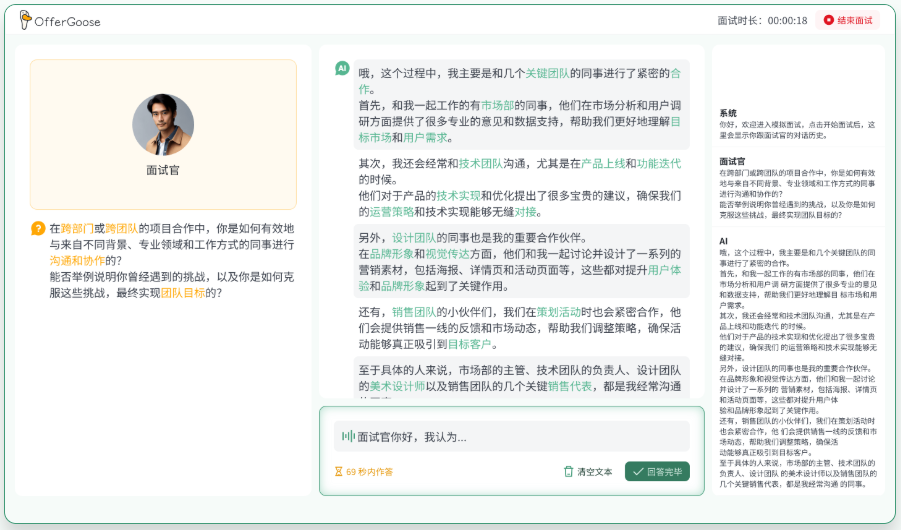
A critical technique: OfferGoose lets you select interviewer type. Chen cycled through three personas: HR interviewer (non-technical), technical peer interviewer (fellow engineer), and executive interviewer (strategic/business focus). Each persona asked about the same project experience from a completely different angle, forcing Chen to flex his communication style accordingly.
Week 2: Full Simulations and Gap Closing
Full-Length Simulations (Days 8–11)
Chen ran a complete 60-minute technical interview: 10 minutes of resume deep-dive + 20 minutes of algorithm + 15 minutes of system design + 15 minutes of behavioral.
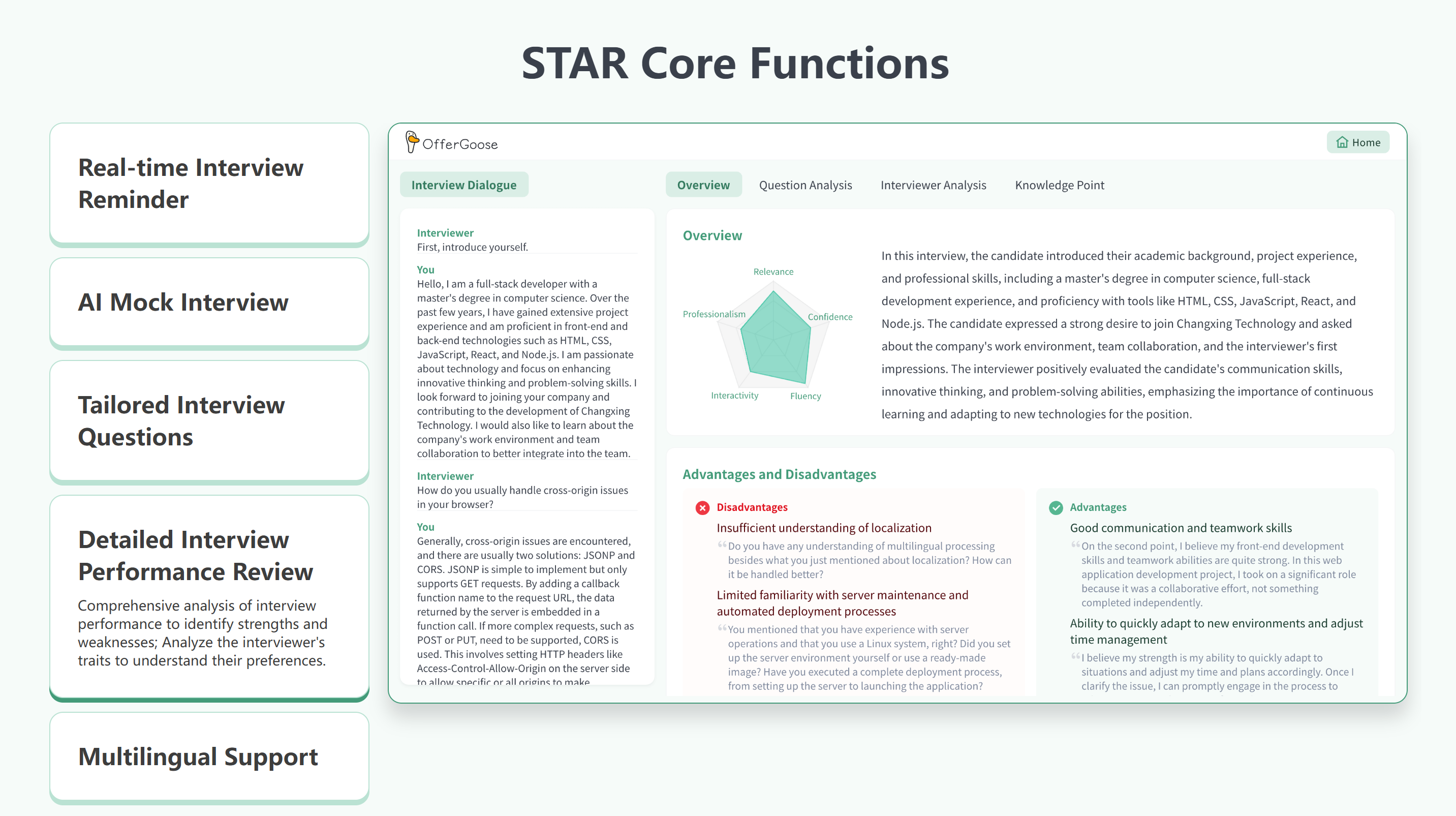
The first full-simulation review revealed a blind spot: his algorithm performance was strong (90+), but behavioral dragged his overall profile down (65). The review report flagged that his behavioral answers lacked emotional texture and interpersonal detail — he narrated everything in a flat, “rational” tone, but interviewers want to hear “How did you handle a conflict with the product manager?” and “How did you persuade a reluctant teammate to get on board?”
This discovery shifted the rest of his training focus almost entirely to behavioral, specifically “conflict resolution” and “cross-functional collaboration” stories.
High-Pressure Sprint (Days 12–14)
For the final three days, Chen ran three high-pressure simulations — interviewer style set to “rigorous interrogation mode.” Vague answers were cut off mid-sentence. Unclear reasoning triggered relentless follow-ups.
These were the most uncomfortable three days of training. They were also where the fastest progress happened. Chen learned to respond to a sharp “Are you sure about that?” with calm composure: “Let me double-check — from angle X, my approach holds, but if we introduce factor Y, I’d need to adjust to Z.”
That ability — staying unshaken when interrupted, staying clear when pushed — is something you never develop in friendly practice mode.
Chen’s Real-World Results
After two weeks of structured AI mock interview training, Chen walked into three real interviews. He received two offers.
The most unexpected piece of feedback came from one hiring manager: “Your system design thinking is really clear, and you can explain technical decisions in a way non-technical stakeholders would understand. That’s rare for someone with three years of experience.”
That was the single biggest lift AI mock interviews gave him — not technical skill (that came from years on the job), but structured communication skill.
Three Technical Interview Techniques That Work
Technique 1: Talk While You Code — Don’t Code Then Talk
Don’t write silently for five minutes and then look up and say, “Done.” The interviewer’s nightmare is a candidate who disappears into their own head. Verbalize every step as you go. OfferGoose’s technical interviewer mode is designed around this expectation — it evaluates your process, not just the final code.
Technique 2: Use “Requirements → Architecture → Trade-offs” for Every System Design Question
Requirements definition (What) → Architecture design (How) → Alternatives and trade-offs (Why not). Never start sketching architecture before the requirements are clear. Interviewers penalize premature solutioning heavily.
Technique 3: Lead With Business Value, Then Dive Into Technical Detail
“I designed a recommendation engine using a retrieval-augmented generation pipeline” lands differently from “I built a recommendation system that automatically surfaced relevant content based on user behavior, increasing click-through rate by 18%.” Lead with what the thing actually achieved in business terms. Then explain how it worked. Non-technical interviewers check out the moment jargon starts; technical interviewers will follow along either way — but they’ll respect the business framing.
Before:
“We migrated our monolithic application to a microservices architecture. I decomposed the order service, inventory service, and payment service into separate Spring Boot applications with REST APIs. We used Kafka for async communication between services.”
After:
“Our monolith had a single point of failure that took down the entire checkout flow whenever order volume spiked. I led the decomposition into three services — orders, inventory, payments — starting with inventory because it was the bottleneck. Post-migration, checkout availability went from 97.8% to 99.95%, and we could scale inventory independently during flash sales. The key decision was using Kafka for async inter-service messaging rather than synchronous REST calls, which would have recreated the same coupling problem at the network level.”
Candidate context: This is Chen, a backend engineer with 3 years of Java experience, targeting a senior backend role at a mid-to-large internet company. The specific action he took was leading the decomposition of a monolithic checkout system into three microservices, prioritizing the inventory service because it was the bottleneck. The quantified result: checkout availability improved from 97.8% to 99.95%, and inventory could scale independently during flash sales — a business-critical improvement that made his candidacy far more compelling.
Why this version works: It opens with the business problem, names the specific bottleneck, explains the sequencing decision (inventory first), quantifies the outcome, and closes with an explicit architecture trade-off. It shows the interviewer not just what you built, but how you think.
FAQ
General Questions
Do I need to prepare for English technical interviews?
If you’re targeting multinational companies or roles with global teams, yes — English technical communication is essential. OfferGoose supports bilingual (English + another language) mock interviews so you can practice technical terminology in both languages. Terms like load balancing, caching strategy, eventual consistency, and microservices should roll off your tongue naturally during the interview, not feel like translations you’re reaching for.
How is AI algorithm interview practice different from just doing LeetCode?
LeetCode is one-directional: you write code, the online judge says pass or fail. AI mock interviews are bidirectional: you explain your reasoning, the AI probes with follow-ups. The latter is far closer to the conversational dynamic of a real technical interview, where your thought process matters as much as your final solution.
Are AI mock interviews suitable for self-taught engineers without a CS degree?
Extremely suitable. Self-taught engineers are most likely to get tripped up on foundational principles and system design questions — the areas where a formal CS curriculum fills gaps that bootcamps and self-study often skip. AI mock interviews surface those knowledge gaps systematically, giving you a targeted study roadmap instead of vague “learn more CS fundamentals” advice.
Questions About OfferGoose
Does OfferGoose support language-specific technical interviews?
Yes. OfferGoose’s technical interview modes support multiple programming languages and frameworks. You can configure sessions for Java/Spring Boot, Python/Django, Go, Node.js, and other common stacks, with role-specific question generation based on your target job description.
Can I practice system design interviews on OfferGoose at different difficulty levels?
Yes. OfferGoose lets you set the system design difficulty from junior (design a URL shortener) to senior/staff (design a distributed message queue, design a real-time analytics pipeline). The AI adjusts the depth of expected trade-off analysis and the rigor of follow-up questions accordingly.
🗳️ Poll: Which part of technical interviews do you find hardest?
- ⬜ A. Explaining algorithm thought process out loud while coding
- ⬜ B. System design questions feel too open-ended — don’t know where to start
- ⬜ C. Behavioral answers come out too technical; non-technical interviewers look lost
- ⬜ D. Handling follow-up questions when I hit the edge of my knowledge
The Bottom Line
A technical interview is not a skills exam. It’s a structured communication event. Your technical ability is the entry ticket — but the offer decision often hinges on whether you can communicate that ability clearly, structurally, and persuasively.
AI mock interviews are the best sandbox environment technical candidates have. Run one properly configured session, get your dimensional breakdown, identify your weakest module, and build a training plan around it. Two weeks of deliberate practice with real feedback beats three months of solo LeetCode grinding.