
5 AI Mock Interview Mistakes 90% of Candidates Make (And How to Fix Every One)
@[TOC]

“I ran 20 AI mock interview sessions. Still didn’t pass the real thing.”
A reader sent us this message last week. When we dug into what those 20 sessions actually looked like, the gap between “doing mock interviews” and “doing them right” was bigger than the gap between zero practice and 20 sessions.
AI mock interviews are fast becoming a standard tool in every job seeker’s kit. But there’s a hidden trap: the difference between using the tool and using it correctly can mean wasting half your training hours — or worse, building the wrong habits.
Here are the five most common mistakes, why each one sabotages your progress, and exactly how to fix them.
Recommended First: Use OfferGoose to Get a Multi-Dimensional Baseline Report
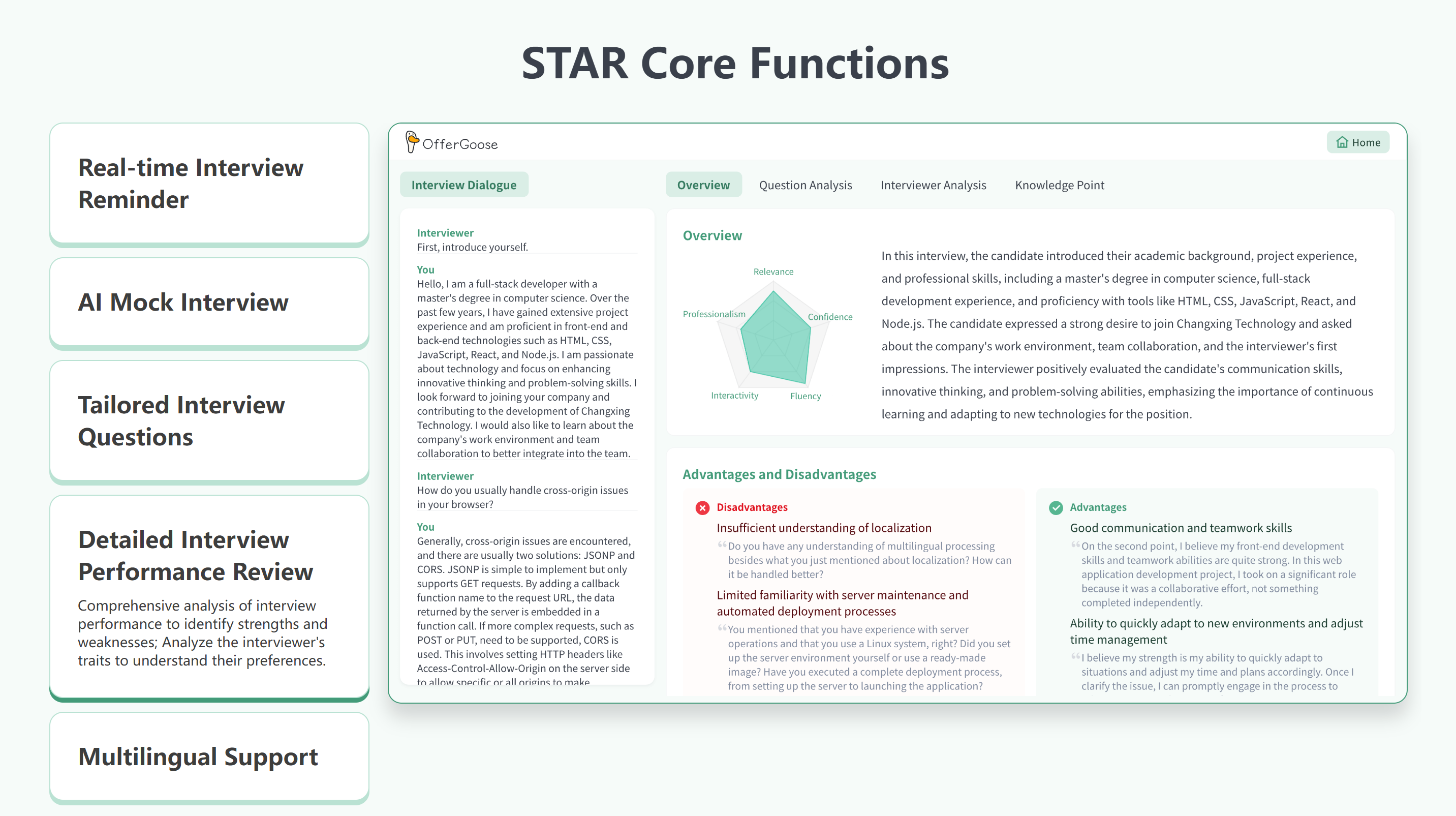
Before you read about what not to do, run one properly configured mock interview so you have a real baseline. OfferGoose gives you a dimension-by-dimension breakdown — logic, clarity, relevance, professionalism, confidence — so you can see where you actually stand.
👉 Start your free mock interview at offergoose.com/lp/blog
Mistake 1: Treating AI Mock Interviews Like Flashcard Drills
What It Looks Like
Open the AI mock interview tool → pick random questions → answer each one → glance at the score → pick more questions → repeat. The same way you’d grind LeetCode problems.
Why It Doesn’t Work
Interviewing and flashcard drilling engage completely different cognitive pathways.
Cognitive load theory tells us that under pressure, the human brain can only juggle a limited amount of information at once. Flashcard practice trains the path “retrieve fact → output fact.” Real interviewing demands “interpret the question → pull a relevant experience from memory → structure it using STAR → deliver it conversationally.” Those are two fundamentally different cognitive pipelines.
Running 100 questions where you only practiced “retrieve → output” means that the moment an interviewer rephrases the question slightly, your pipeline breaks.
How to Fix It
Stop counting questions. Start counting mastery.
Pick 10 core STAR stories that cover the standard dimensions — leadership, conflict resolution, failure and learning, innovation, cross-team collaboration. Practice each story at least five times. The goal isn’t memorization. The goal is being able to expand or compress the same story from any follow-up angle, on demand.
In OfferGoose, run the same story through 3–5 rounds of AI follow-ups. Let the AI probe different angles — “What would you do differently?” “How did your manager react?” “What was the hardest part?” — so you build the mental agility to pivot within the same narrative.
Mistake 2: Obsessing Over the Total Score, Ignoring the Dimension Breakdown
What It Looks Like
Mock interview ends → glance at total score: “82. Not bad.” → close the report.
Why It Doesn’t Work
A total score is a heavily compressed signal that hides your actual weak spots. You might score 90 on logic but 58 on delivery clarity. The total says “you’re doing fine.” The interviewer, sitting across from you, experiences your fragmented delivery and checks out mentally before you ever get to your logical arguments.
The real value of an NLP-based AI evaluation system is in the dimensional breakdown:
- High relevance score? You’re zeroing in on what was actually asked.
- Low logic score? Your argument chain has gaps.
- High variance in professionalism? You’re sharp on some domains and shaky on others.
How to Fix It
After every session, identify your single weakest dimension. Make it the only thing you focus on improving in the next session. If “clarity” was your lowest score, spend the next mock deliberately slowing down and finishing each sentence before starting the next. Once that dimension rises across three consecutive sessions, shift focus to the next weakest.
Mistake 3: Only Practicing With the “Friendly” AI Interviewer
What It Looks Like
Every session uses “standard mode” or “supportive” interviewer settings. The AI gives you hints when you stall, waits patiently while you gather your thoughts, and never interrupts.
Why It Doesn’t Work
Real interviewers are not this polite. You’re likely to encounter:
- Stress interviewers: dead silence, frequent interruptions, drilling into details until you admit you don’t know
- Cold, unreadable interviewers: expressionless, responding with a flat “okay” that makes you second-guess everything you just said
- Topic-jumpers: abruptly switching to an unrelated subject to test your mental agility
If friendly mode is all you’ve practiced, your first encounter with a stone-faced interviewer triggers a primacy effect cascade: “Oh no, they hate me,” followed by a confidence collapse you never trained to recover from.
How to Fix It
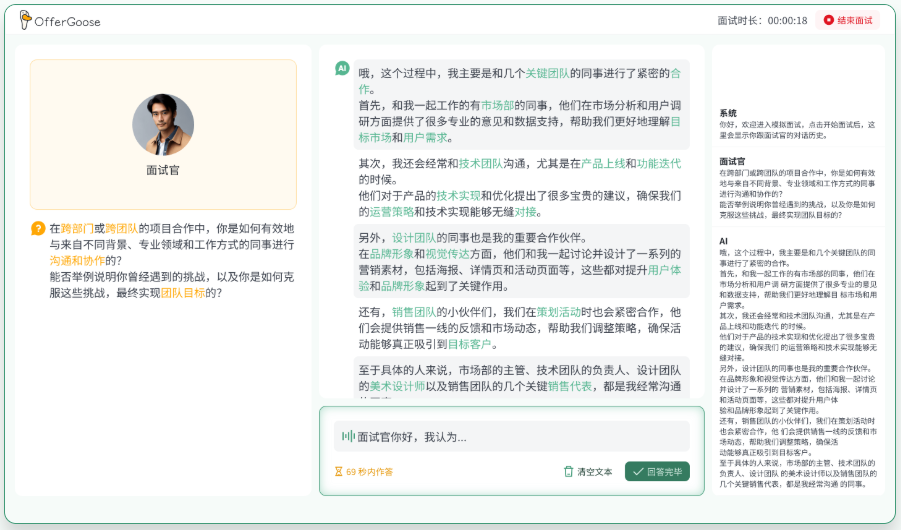
In the middle and late stages of your training, deliberately cycle through harder interviewer modes. OfferGoose supports multiple interviewer styles — from standard HR to technical griller to executive pressure mode. Aim to spend roughly 40% of your total training volume in high-difficulty modes so that you develop composure under fire.
Mistake 4: Memorizing the AI’s Sample Answers Word-for-Word
What It Looks Like
The AI produces a polished, well-structured model answer. You think: “That’s perfect.” You memorize it. Next time a similar question comes up, you recite it.
Why It Doesn’t Work
Interviewers can detect recitation far more reliably than most candidates realize. Memorized answers and spontaneous speech differ on three dimensions:
- Monotone delivery: Recited passages lack the natural pitch variation of improvised speech
- Zero conversational texture: No natural pauses, no back-and-forth rhythm, no mid-sentence adjustments
- Follow-up collapse: The instant the interviewer asks about a detail your memorized script didn’t cover, you freeze
Even TTS research confirms that human ears easily distinguish synthetic, rhythmically flat speech from natural conversation. An interviewer listening to you recite operates on the same principle.
How to Fix It
Use AI model answers for structure extraction, not content memorization. Study how the answer is organized: What’s the opening hook? What logical connectors hold the middle together? How does the closing land? Then take that same structure and rebuild it around your own real experience — your actual project, your actual numbers, your actual decisions.
Mistake 5: Skipping Deep Review After Each Session
What It Looks Like
Mock interview ends → glance at score → skim one or two lines of AI feedback → close the tab → start the next session.
Why It Doesn’t Work
This is the most expensive mistake on the list — and the easiest to overlook. The value of a mock interview is roughly 70% in the review and 30% in the session itself.
Building a competency evidence chain requires iteration. Each mock session is a data point. But if you never analyze the data, you’re a data warehouse, not a learning system. The feedback sits there unused while you repeat the same errors in session after session.
How to Fix It
Create a simple training log. After every session, record exactly three things:
- Best answer of the session (and why — great structure? strong example? clean delivery?)
- Worst answer of the session (and why — went off-topic? weak evidence? logic collapsed under pressure?)
- Single improvement target for next session (only one — focus is what drives progress)
OfferGoose’s deep review feature auto-generates structured improvement suggestions broken down by logic, clarity, professionalism, and confidence. Log these insights and build your personal improvement map over time.
Before/After: A Real Example From an Operations Candidate
A candidate preparing for a senior operations role at an e-commerce company went through this exact transformation:
Before:
“I was in charge of optimizing warehouse fulfillment. We had some delays during peak seasons. I worked with the logistics team to improve things and we saw better numbers afterward.”
After:
“During last year’s Singles’ Day peak, our warehouse SLA compliance dropped to 82% — meaning nearly one in five orders missed the promised delivery window. I mapped the bottleneck to a picking-route inefficiency: pickers were walking an average of 3.2 km per shift, nearly 40% of which was non-value-added travel. I redesigned the zone-based picking algorithm to cluster same-zone orders, cutting average walking distance to 1.9 km. SLA compliance recovered to 96.4% within three days, and we processed 22% more daily orders with the same headcount.”
Why this version works: It replaces a vague “I was in charge of” framing with a specific crisis, a clear diagnostic step, a concrete intervention, and a quantified before-and-after result. The interviewer gets the full decision-making narrative, not just a task list.
Beyond the answer quality, the candidate also changed how they trained:
- Switched from 15 sessions of random “standard mode” practice to a structured three-phase plan: question-type drills → full simulations → stress testing
- Built 10 STAR-C stories with quantified commercial impact for each
- Maintained a review log after every session
- Attacked weak dimensions one at a time instead of hoping for overall improvement
Result: In the real interview, when the hiring manager threw three consecutive follow-ups at the same project story, the candidate pivoted smoothly to different angles of the same experience each time. They got the offer.
FAQ
General Questions
How long should each mock interview session be?
Set it to 30–40 minutes — the standard length of a single-round interview — plus 15–20 minutes for review afterward. A complete “practice + review” cycle should take about one hour. Longer than that and attention fatigue sets in, making the review less valuable.
Are AI mock interviews suitable for introverts?
Not only suitable — they may be the single best interview training tool for introverted candidates. AI doesn’t judge. It doesn’t create awkward social pressure. You can make mistakes freely and iterate without embarrassment. Many introverted job seekers report a significant drop in real-interview anxiety after 30+ AI mock sessions, simply because the act of speaking structured answers has become habitual rather than novel.
Questions About OfferGoose
How does OfferGoose’s AI interviewer compare to a real human interviewer?
OfferGoose is built on an LLM fine-tuned specifically for interview evaluation, with embedded assessment frameworks for behavioral interviews, technical rounds, and cross-cultural interview scenarios. The distinction isn’t “can it chat?” — any AI can chat. It’s that OfferGoose evaluates you using the same structured criteria real interviewers apply: STAR completeness, evidence quality, logical coherence, and commercial thinking. General-purpose AI chatbots lack these standardized scoring rubrics entirely.
Can I switch interviewer styles mid-training?
Yes. OfferGoose lets you select from multiple interviewer personas — standard HR, technical deep-dive, high-pressure interrupter, executive-level — and switch between them session by session. This is one of the core advantages over practicing with a single human partner who only has one style.
🗳️ Poll: Which mistake do you catch yourself making most often?
- ⬜ A. Flashcard-style practice — chasing volume over depth
- ⬜ B. Checking only the total score, never the dimension breakdown
- ⬜ C. Sticking to friendly mode, avoiding pressure simulations
- ⬜ D. Skipping the review and jumping straight to the next session
Final Word
AI mock interviews are table stakes for job seekers in 2026, but a great tool with bad methods is still a waste of time. Most candidates hit at least three of the five mistakes above.
Fixing them doesn’t require more hours — it requires a different approach to the hours you’re already spending. Configure the right interviewer style. Get the dimensional breakdown, not just the score. Build a training log. Run one properly structured session and compare it to your previous “grind 10 questions and move on” session — the difference in learning per minute is dramatic.