
AI Mock Interviews: The Complete 5-Phase Training System From Beginner to Offer-Ready
@[TOC]

Most people think AI mock interviews work like this: open an app, pick a few questions, talk at the screen, call it a day. They run 15 sessions, walk into a real interview, and still freeze when the interviewer throws an unexpected follow-up.
The problem isn’t the tool. It’s treating AI mock interviews as casual practice instead of systematic training.
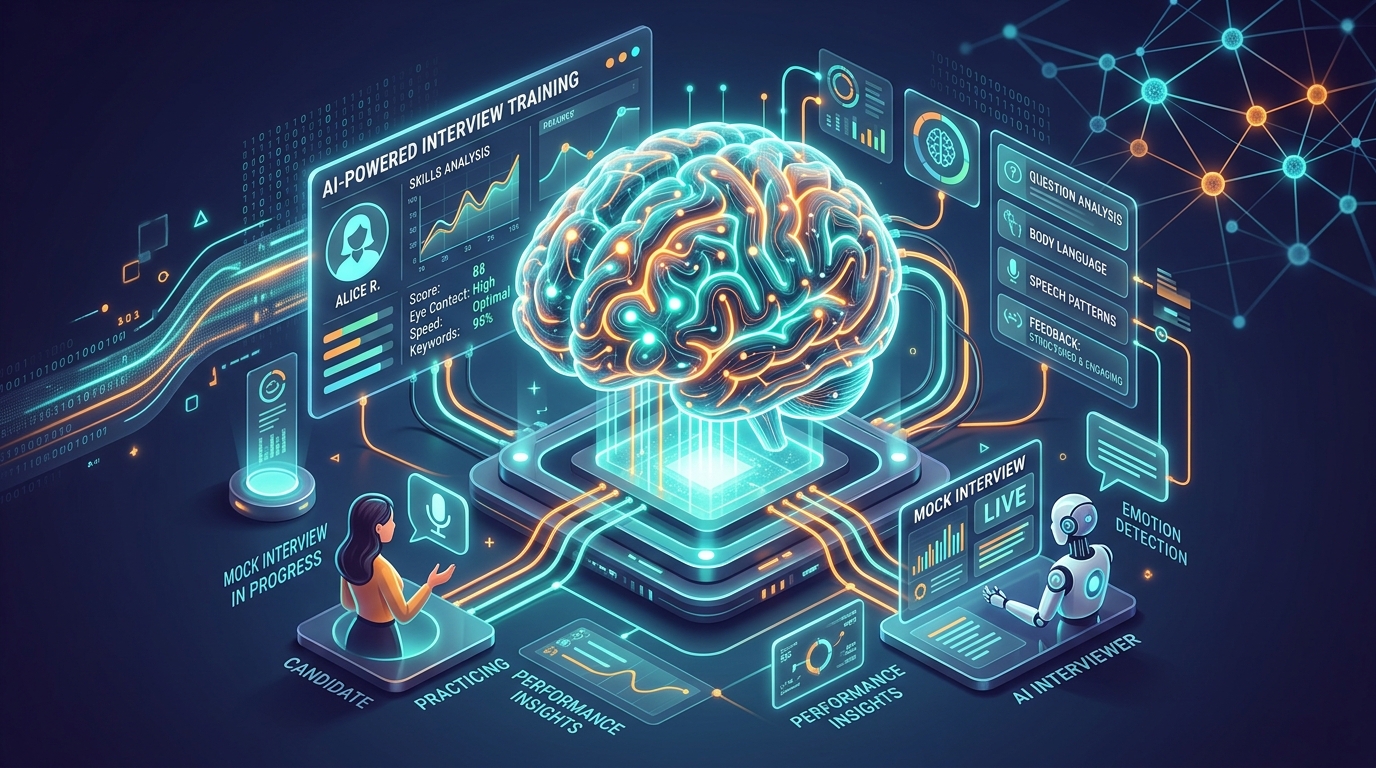
An LLM-powered AI mock interview platform is fundamentally a dynamic training system with prompt engineering capabilities at its core. Use it deliberately and it becomes your rehearsal sandbox. Use it casually and it’s just a time sink.
This article walks through a complete “train → review → optimize” loop, showing you exactly how to structure AI mock interview practice so every session actually moves the needle.
AI Mock Interviews vs. Human Mock Interviews: Know the Boundaries
A lot of people ask: “Can AI completely replace practicing with a real person?” The answer is no — but they complement each other powerfully. The key is understanding where each excels.
Where AI Mock Interviews Win
AI mock interviews bring three capabilities that even the best human practice partner can’t match:
Infinite patience. An AI interviewer never gets tired, never rushes because it has another call in 10 minutes, and never checks out mentally. You can drill the same question 50 times and it will still give you equally detailed feedback on attempt #50.
Standardized multi-dimensional evaluation. Human feedback tends to be fuzzy: “You sounded okay” or “Your delivery felt a bit off.” An NLP-based AI system can break down your performance into precise metrics — words per minute, filler-word density, logical structure completeness, keyword coverage, and more.
Configurable difficulty gradients. You can start with a warm, encouraging interviewer style and gradually crank up the intensity. Want a stone-cold interviewer who interrupts you mid-sentence? A rapid-fire technical griller? An executive who only cares about business impact? Affective computing techniques let AI models simulate these distinct interviewer personas on demand.
Where Human Mock Interviews Still Matter
Human mock interviews bring irreplaceable value in a few areas:
- Non-verbal feedback: Micro-expressions, body language shifts, subtle tone changes — AI isn’t great at simulating these yet (though multimodal models are closing the gap)
- Unspoken cultural norms: Certain industries and companies have implicit expectations that a human mentor familiar with that world can flag
- Psychological realism: Practicing with a real person creates a nervous-system response closer to the real thing
The optimal strategy: AI for volume and fundamentals, humans for validation (2–3 sessions right before the real interview).
Recommended First: Use OfferGoose to Run a Free Diagnostic Mock Interview
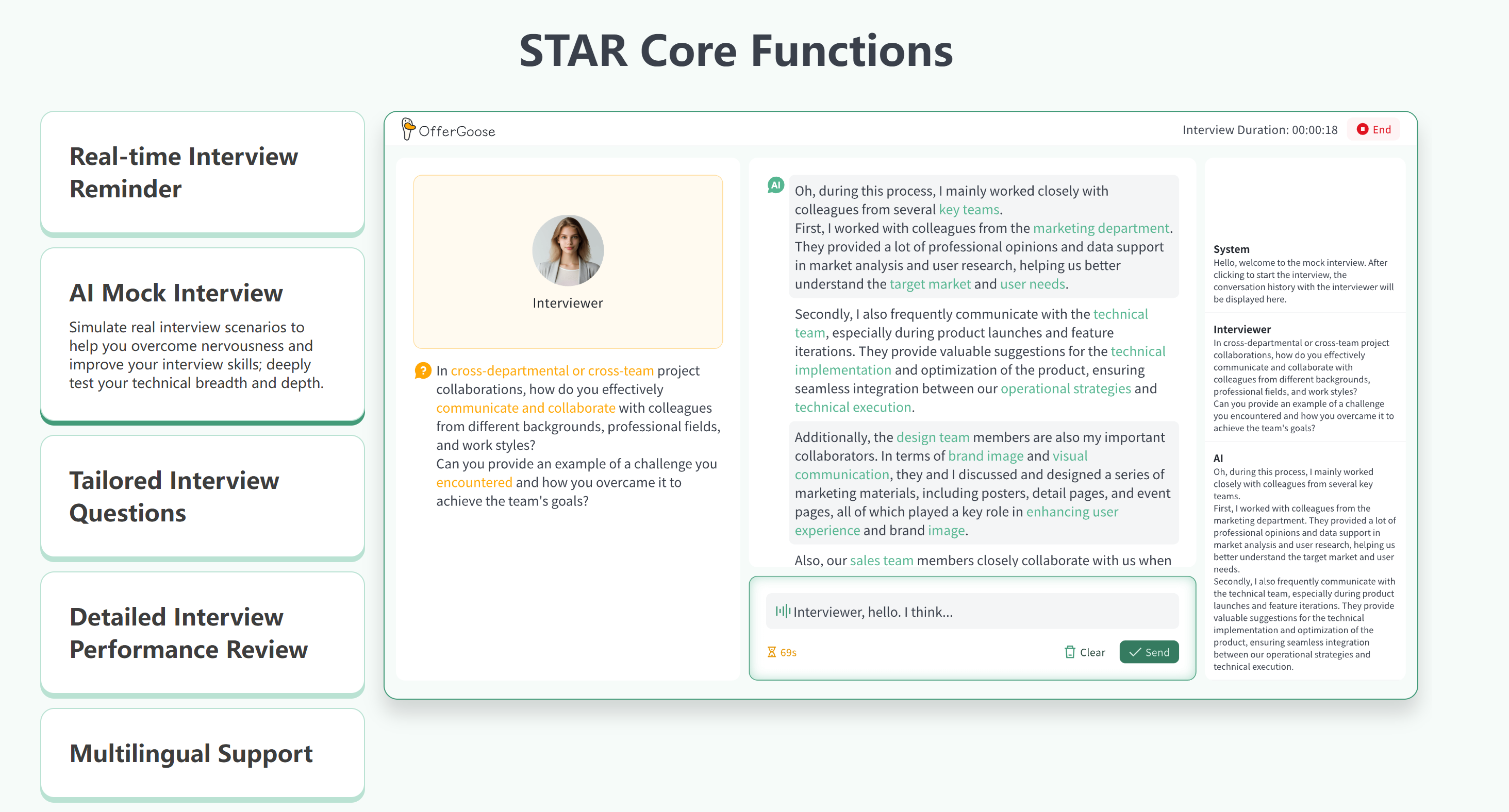
Before diving into structured training, get a baseline. OfferGoose’s free mock interview gives you a multi-dimensional skills radar — logic, relevance, clarity, professionalism, confidence — so you know exactly which areas to target before you invest time in practice.
👉 Start your free diagnostic mock interview at offergoose.com/lp/blog
The Five-Phase AI Mock Interview Training System
Phase 1: Question-Type Drills (Days 1–3)
Before running full-length simulations, break your practice down by question category. Different interview question types demand fundamentally different thinking and speaking patterns.
Behavioral interview questions are the highest-ROI category to prep first. Questions like “Tell me about a time you resolved a conflict” or “Describe a failure and what you learned” follow a predictable structure. The standard framework is STAR (Situation–Task–Action–Result). A more advanced version, STAR-C, adds “Commercial Impact” to quantify business value.
Train with a stopwatch: each STAR story should land between 90 seconds and 2 minutes. Anything longer and the interviewer’s attention drifts. Have the AI time you and flag when you run long.
Technical concept questions are not about reciting definitions. Use this structure: “Definition → Real-world use case → Your hands-on experience → Comparison of alternative approaches.” For example, if asked about the difference between Redis and a relational database, don’t stop at “one is in-memory, one is on disk.” Extend into how you made caching strategy decisions in a real project and what trade-offs you considered.
System design questions benefit from a MECE (Mutually Exclusive, Collectively Exhaustive) decomposition approach. Clarify requirements first (functional + non-functional), then break down system components, and finally discuss trade-offs explicitly.
Phase 2: Full-Length Simulations (Days 4–7)
Now integrate all question types into complete interview sessions.
Key configuration settings:
- Duration: Set it to 1.2× the real interview length. If real interviews run 45 minutes, train at 55 — leave room for mistakes and retries.
- Interviewer style: Rotate daily. Monday: standard HR type. Tuesday: technical deep-dive type. Wednesday: high-pressure interrupter.
- Role matching: Upload your target job description so the AI generates role-specific questions instead of generic ones.
Aim for 2–3 sessions per day with at least one hour between sessions for review.
Phase 3: Structured Review (After Every Session)
Review matters more than the mock itself. OfferGoose’s deep review breaks down your performance across six dimensions:
- Logic: Does your answer follow a clear causal chain?
- Relevance: Did you actually answer what was asked?
- Clarity: Is your language concise and direct, or are you circling the point?
- Professionalism: Are technical terms used accurately? Any knowledge gaps exposed?
- Interaction quality: Do you demonstrate active thinking and follow-up questions?
- Confidence: What do pace, pauses, and filler-word density reveal about your nerves?
After each review, write down the three biggest improvements to target next session. Review them before your next mock.
Phase 4: Targeted Weakness Repair (Days 8–12)
After a week of training, your weak spots should be painfully clear.
If behavioral is weak: Go back to your STAR drafts. Check whether every Result is quantified and every Action is a decision, not a task-list item. A common failure mode: Actions that read like job duties (“I was responsible for X,” “I participated in Y”) instead of decisions (“I chose A/B testing over gut-feel prioritization because the data showed…”).
If technical is weak: Don’t grind LeetCode mindlessly. Do “interview-style” practice. For every algorithm problem, verbalize your thought process out loud before writing a single line of code — chain-of-thought reasoning is exactly what interviewers want to see. Start with the brute-force approach, then walk through optimization, and finish with time complexity (Big-O) analysis.
If delivery is the issue: Slow down deliberately. Under pressure, many people speak faster and faster until their thoughts outrun their words. Practice at 0.8× your natural pace. The breathing room that creates makes you sound more composed.
Phase 5: Stress Testing and Real-World Validation (Days 13–15)
The final phase is about making practice harder than reality.
- Set the AI interviewer to “rigorous follow-up mode” — every answer gets 3–4 edge-case probes
- Practice in suboptimal conditions: tired (post-10 PM), slightly distracted, on an unstable connection
- The goal is to build psychological resilience so that real interview conditions feel easy by comparison
A Complete Training Log: Product Manager Candidate, 30 Sessions
Here is a real training log from a candidate preparing for a product manager role at a mid-sized SaaS company. She had 2 years of experience but consistently struggled to communicate project impact during interviews.
| Training Phase | Sessions | Interviewer Style | Key Issue | Targeted Fix |
|---|---|---|---|---|
| Days 1–3 | 6 | Standard HR | Project descriptions too vague, no numbers | Added specific metrics to every project story |
| Days 4–7 | 9 | Technical deep-dive | Froze when asked about metric definitions (DAU, retention, conversion) | Studied and practiced explaining core SaaS metrics |
| Days 8–12 | 10 | High-pressure interrupter | Lost train of thought after being cut off | Drilled “3-sentence core message” technique for rapid recovery |
| Days 13–15 | 5 | Mixed full-simulation | Overall performance stabilized | Fine-tuned the 60-second self-introduction |
After 30 sessions, she went from speaking at an erratic pace littered with filler words to delivering a complete project narrative in under two minutes with clear STAR structure and quantified impact.
The breakthrough wasn’t volume — it was that every single session had a specific, named improvement target.
Three Mistakes That Undo Most Candidates
Mistake 1: Only practicing the topics you already know well
It’s tempting to pick familiar questions and avoid weak spots. That’s like going to the gym and only training biceps — you look busy, but you’re dodging the real work. Deliberately expose your gaps. Let the AI drill into the topics that make you uncomfortable.
Mistake 2: Treating the AI score as an absolute verdict
AI scoring is a multi-dimensional reference point, not a final judgment. Sometimes a “low logic score” just means you used industry-specific terminology the model flagged as unfamiliar. Cross-reference the numeric score with the qualitative feedback — don’t optimize for the number alone.
Mistake 3: Memorizing the AI’s sample answers
AI-generated model answers are structural templates, not scripts to memorize. Interviewers can spot recitation from a mile away — monotone delivery, zero natural pauses, and a complete collapse the moment a follow-up question goes off-script. Extract the structure from the model answer, then rebuild it around your own real experience.
Before:
“In my last role, I was responsible for user growth. We ran several campaigns and saw good results. I collaborated with the marketing team and used data to guide decisions.”
After:
“I owned user acquisition for our SMB segment. We were stuck at a 2.3% trial-to-paid conversion rate. I hypothesized that our onboarding flow was asking for too much setup before users saw value — so I redesigned the first-run experience to deliver a working dashboard in under 90 seconds. Conversion ticked up to 4.1% over six weeks, which meant roughly 140 additional paying accounts per month.”
Why this version works: It replaces fuzzy responsibility statements with a specific problem, a clear hypothesis, a concrete action, and a quantified result — the exact structure interviewers are listening for.
FAQ
General Questions
Should I always use the camera during AI mock interviews?
Yes, if the tool supports it. Non-verbal communication carries significant weight in interview evaluations. If your AI platform offers video analysis (like OfferGoose’s multimodal assessment), turn it on to get feedback on eye contact, facial expressions, and posture. Audio-only practice is still useful but captures less of what a real interviewer would notice.
How do I know when I’m actually ready?
A simple self-test: pick any of your core STAR stories. Can you deliver it fluently in under two minutes without notes, and then handle three or more follow-up questions on the spot? When every major story in your arsenal passes that bar, you’re ready to walk into a real interview.
Questions About OfferGoose
How is OfferGoose different from using a free AI chatbot for mock interviews?
OfferGoose is a purpose-built LLM fine-tuned specifically for interview scenarios, with embedded evaluation frameworks for behavioral interviews, technical rounds, system design, and cross-cultural (including multinational company) interviews. It doesn’t just chat — it evaluates you using the same assessment logic real interviewers apply. General-purpose AI chatbots lack structured interview scoring rubrics and domain-specific knowledge bases.
What interview types does OfferGoose cover?
OfferGoose supports behavioral interviews (STAR/STAR-C evaluation), technical interviews (algorithms, system design, domain-specific deep dives), HR screening rounds, case interviews, and executive-level interviews. It also offers bilingual (English + other languages) mock sessions for candidates targeting multinational roles.
🗳️ Poll: What’s your biggest challenge with AI mock interviews?
- ⬜ A. Speaking to a screen feels unnatural — missing the in-person pressure
- ⬜ B. Not sure how to extract maximum value from the AI feedback
- ⬜ C. AI follow-up questions feel too shallow compared to real interviewers
- ⬜ D. I’ve done a lot of sessions but don’t see clear improvement
The Bottom Line
AI mock interviews aren’t magic. They won’t transform a hesitant speaker into a keynote presenter overnight. What they are is an extraordinarily efficient feedback system — one that lets you move from “you don’t know what you don’t know” to “you know what you know” in the shortest time and at the lowest cost possible.
OfferGoose’s AI mock interview platform supports multi-industry, multi-language, multi-interviewer-style training with structured evaluation across all major interview formats. Start with one free diagnostic session, get your first skills radar, and build a personal training plan from there.