
Summer Interview Prep Checklist: 10 Skills Every Student Should Verify Before the Semester Starts
Summer Interview Prep Checklist: 10 Skills Every Student Should Verify Before the Semester Starts

Less than six weeks until school starts—are you really ready?
“I think I’m pretty prepared.” This is the most dangerous sentence spoken before fall recruiting begins. The biggest enemy of interview preparation isn’t laziness—it’s not knowing where you’re weak.
You may have drilled plenty of questions, read countless interview guides, even practiced with friends a few times. But if you sat across from a real interviewer right now and completed a full interview—what would your actual performance look like? What hidden weaknesses would surface? What should you focus on for the remaining summer weeks?
Most students can’t answer these questions. And the reason is simple: you’ve never done a systematic interview competency diagnostic.
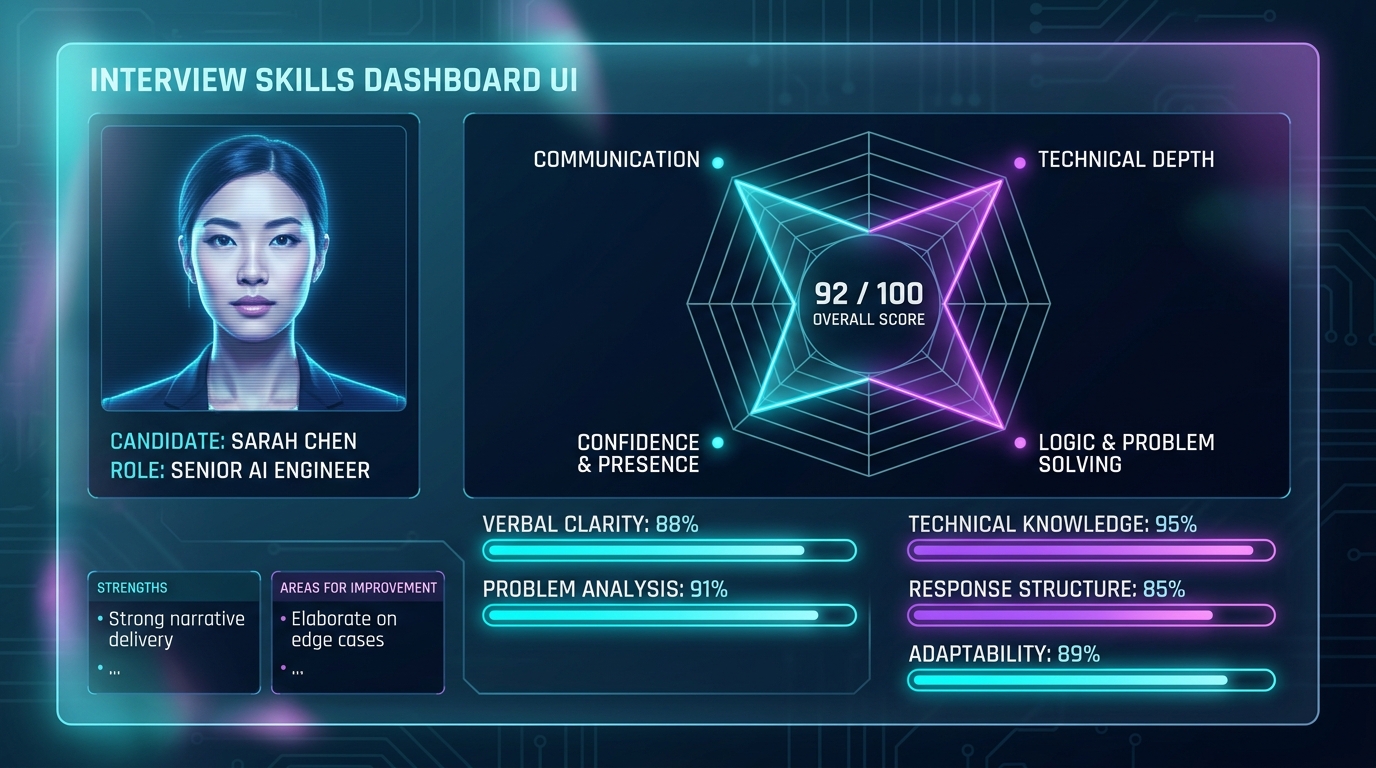
This article provides a structured 10-item checklist, each with clear passing criteria and an AI-assisted verification method. Run through all 10 items using OfferGoose’s AI mock interviews, and in about 30 minutes you’ll have a clear “interview skills health report”—showing you exactly where to invest your remaining summer effort.
Recommended First: Use OfferGoose to Run Your Complete Skills Diagnostic
OfferGoose’s AI mock interview supports different modes for each checklist item—from behavioral interviews to technical deep-dives to English practice. After each session, the automated review report scores your performance across multiple dimensions, giving you a data-driven “interview readiness report” you can act on.
The 10-item interview skills checklist
Item 1: Self-introduction (duration and structure)
Passing standard: Deliver a fluent, unprompted 1.5-2 minute self-introduction covering four layers: who I am → my core strengths → key experiences → why I fit this role.
Common failures: Too long (3+ minutes, interviewer tunes out) or too short (under 1 minute, seems empty); no structure (rambles randomly); no role relevance (generic intro with no “why you” signal).
AI check: Run OfferGoose in basic interview mode, self-introduction only. The review report analyzes duration, fluency, and content structure. Focus on “logical completeness” and “role relevance” scores.
Item 2: STAR-structured project experience delivery
Passing standard: For every project on your resume, clearly articulate the STAR (Situation-Task-Action-Result) framework in 2-3 minutes: project context and goal (S+T), your specific actions and methods (A), quantified results and impact (R).
AI check: Use OfferGoose’s “project deep-dive” mode. The review report evaluates STAR completeness across all four elements—many students are surprised to find their “Action” and “Result” scores far below “Situation.”
Item 3: Technical fundamentals—immediate response ability
Passing standard: For core technical knowledge in your target role, begin organizing a logical response within 10 seconds of the question, with no awkward silences exceeding 5 seconds.
AI check: Run a “technical fundamentals” simulation without restricting the question scope. The review report tracks your average response latency and professional depth scores.
Item 4: Behavioral interview structured responses
Passing standard: For high-frequency topics—leadership, team conflict, failure experience, pressure handling, cross-functional collaboration—deliver a complete STAR-structured response within 1-2 minutes for each.
AI check: OfferGoose’s behavioral interview mode covers all high-frequency topics sequentially. Each response is scored on STAR dimensions, helping you identify your weakest topic areas through competency evidence chain analysis.
Item 5: Adaptability under follow-up pressure
Passing standard: When the interviewer challenges or presses deeper on your answer, adjust your thinking and deliver a logical response within 5-10 seconds—without “mind blank” or self-negating reactions.
AI check: OfferGoose’s AI interviewer naturally generates follow-ups based on your responses. The review report measures the gap between “initial response quality” and “follow-up response quality”—this gap is your adaptability deficit.
Item 6: English interview fundamentals (if applicable)
Passing standard: Complete a 15-minute basic English interview (self-introduction + 3-4 common questions) with clear logic and accurate key information, even if grammar isn’t perfect.
AI check: Run an English AI mock interview. Automatic Speech Recognition (ASR) transcribes your responses, and the review report flags grammar errors, unnatural phrasing, and content completeness issues.
Item 7: Industry and role knowledge
Passing standard: Clearly answer “why this industry/company/role” with specific understanding of industry trends, company business, and role requirements—not vague “I’m interested in this field.”
AI check: Set the AI interviewer to “role knowledge” mode. Questions progress from industry understanding → company knowledge → role fit. The review report evaluates information density in your answers—generic claims are explicitly flagged.
Item 8: Reverse-questions quality
Passing standard: In the “do you have any questions for us?” segment, ask 2-3 questions that demonstrate depth of thinking and genuine interest—not “what are the benefits like?” or “how did I do today?”
AI check: AI mock interviews include the reverse-questioning segment. The review report evaluates your questions on depth, role relevance, and independent thinking.
Item 9: Overall communication style
Passing standard: Confident but not arrogant, professional but not stiff; moderate pace, stable volume, minimal filler words (“um,” “like,” “you know”).
AI check: OfferGoose’s review analyzes pace stability, filler word frequency, and fluency. While it can’t assess eye contact or body language, affective computing analysis flags uncertainty signals in your delivery.
Item 10: Interview stamina and energy management
Passing standard: Maintain consistent output quality across a 45-60 minute complete interview—no significant drop between the first and last 15 minutes.
AI check: Run a 45-minute full simulation. The review report provides segmented analysis—if “start score” and “end score” differ by more than 15%, your interview stamina needs work.
How to use this checklist
Step 1 (today): Check all 10 items. For any you’re unsure about, run the corresponding OfferGoose AI mock interview mode. Don’t judge by feeling—judge by data.
Step 2 (this week): Identify your 3 weakest items. These are your priority targets for the remainder of summer. Don’t try to fix all 10 at once—focus on the highest-leverage gaps.
Step 3 (remaining summer): Use daily AI mock interviews to train your weak spots. Recheck all 10 items weekly, tracking your progress data.
Step 4 (final week): Run a complete 10-item recheck. If any items still fall below standard, sprint on those in the final week.
AI mock interview configuration quick reference
| Item | Recommended Mode | Duration | Key Metrics |
|---|---|---|---|
| Self-introduction | Basic Interview | 5-10 min | Logical completeness, role relevance |
| STAR project delivery | Project Deep-Dive | 10-15 min | STAR element completeness |
| Technical response | Technical Fundamentals | 15-20 min | Response latency, professional depth |
| Behavioral interview | Behavioral Mode | 15-20 min | STAR completeness, case persuasiveness |
| Follow-up adaptability | Deep Follow-Up | 15-20 min | Response stability, logical consistency |
| English interview | English Mode | 15-20 min | Grammar accuracy, naturalness |
| Role knowledge | Comprehensive | 10-15 min | Information density, understanding depth |
| Reverse questions | Full Interview | 5 min | Question quality score |
| Communication style | Full Interview | Auto-analyzed | Pace, filler words, fluency |
| Energy management | Extended Interview | 45 min | Segmented performance variance |
Summary: know where you’re weak so you can become strong
“Knowing what you don’t know” is the hardest and most important step in interview preparation. This checklist’s value isn’t “telling you what to prepare”—you mostly know that already. Its value is showing you which things you thought were ready that actually aren’t.
Powered by Natural Language Processing (NLP) and Large Language Models (LLMs), AI mock interviews deliver evaluation objectivity and analytical granularity beyond what human interviewers can provide. Spend 30 minutes running this checklist against OfferGoose’s AI mock interviews—you won’t just get a score, you’ll get a clear, actionable “summer interview skills improvement roadmap.”
Try OfferGoose’s AI mock interview feature to complete your 10-item interview skills diagnostic.
FAQ
General Questions
Do I really need to meet the standard on all 10 items?
If your target role clearly doesn’t require a certain skill—e.g., you’re certain there won’t be English interviews—you can skip that item. But it’s better to over-prepare by one item than under-prepare. Interview surprises usually come from areas you assumed “won’t be tested.”
What if I fail every item?
Completely normal. This checklist’s standard is “fall-recruiting-ready,” not “beginner level.” If most items aren’t passing, it means your previous approach was too inefficient—now is the perfect time to switch to a high-efficiency training method. Prioritize the first four items (self-introduction, STAR project delivery, technical response, behavioral interview)—these typically create the biggest differentiation.
Questions About OfferGoose
Is checking all 10 items weekly too frequent?
After your first full diagnostic, you don’t need to recheck all 10 weekly. Focus weekly rechecks on your “priority targets” (3 weakest items), and recheck others every 2-3 weeks. But always record the data from every recheck to track trends.
Can AI really assess my communication style objectively?
OfferGoose’s communication style assessment is based on quantifiable metrics—pace stability, filler word frequency, pause patterns, response duration distribution—not subjective judgment. Improvements in these objective metrics typically correlate directly with improvements in overall delivery quality.