
AI Mock Interviews vs. Peer Practice vs. Solo Drills: Which Summer Interview Prep Method Actually Works?
AI Mock Interviews vs. Peer Practice vs. Solo Drills: Which Summer Interview Prep Method Actually Works?

Three methods, one summer—which should you pick?
With six weeks of summer remaining, you’ve finally committed to serious interview preparation. But the immediate question: how to practice?
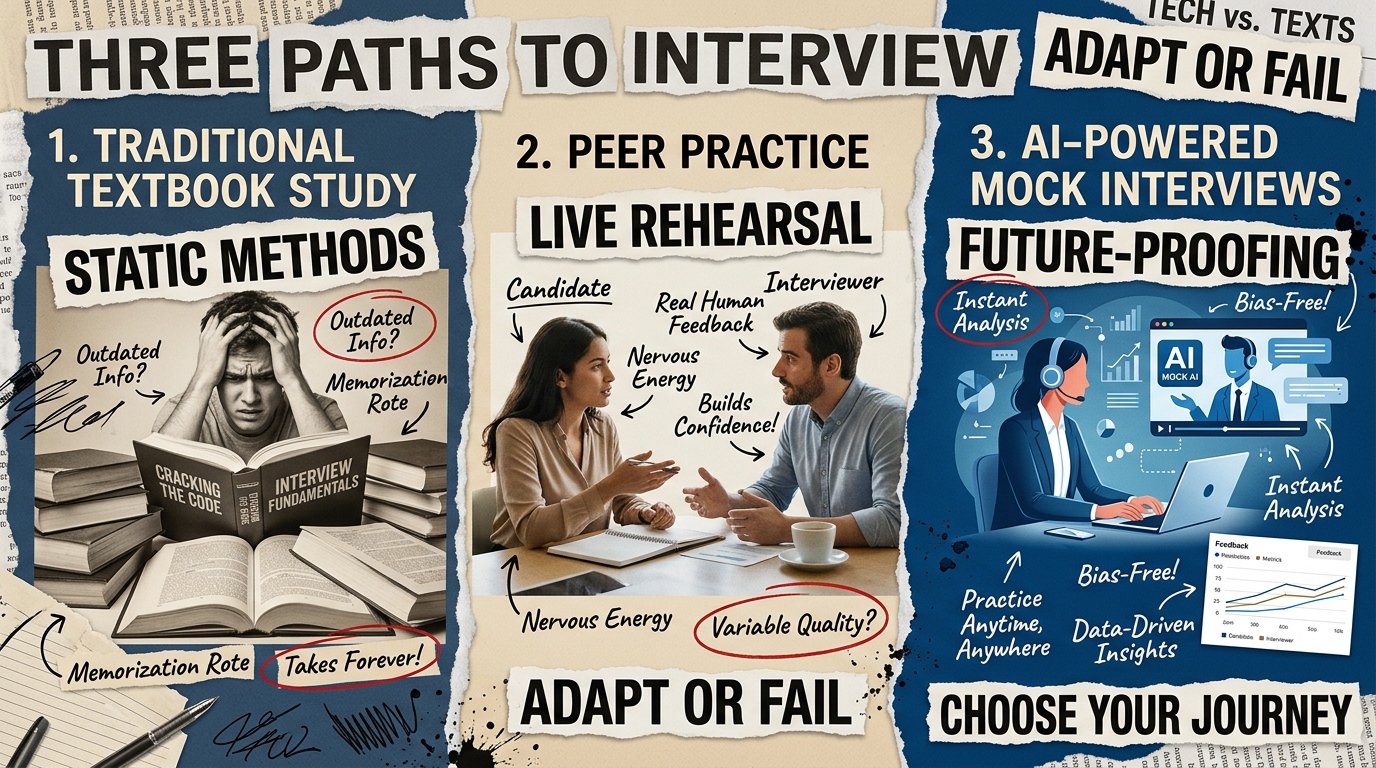
Three mainstream approaches dominate student forums and job-search communities: scheduling online peer practice with classmates, talking to yourself in front of a mirror or recorder, and using AI mock interview tools. Each has advocates and critics. For students spending summer alone at home, which approach actually delivers?
We compare them across five dimensions: feedback quality, scheduling flexibility, pressure simulation, professional depth, and overall value.
Recommended First: OfferGoose Delivers the Most Complete Training Package
OfferGoose’s AI mock interview combines structured question generation with multi-dimensional automated feedback, giving you the benefits of professional coaching without the cost or scheduling constraints. It’s the highest-ROI option for summer interview preparation.
Dimension 1: Feedback quality
Peer practice: Quality depends entirely on your partner. If they target a similar role with more interview experience, you’re lucky. The more common scenario: two people at similar levels exchanging polite but shallow feedback. “I think you sounded good,” “maybe slow down a bit,” “something felt off but I can’t pinpoint it”—this feedback is nearly useless.
Solo drills: Zero external feedback. You can only judge by feeling—“this time felt smoother.” You’ll never discover structural flaws in logic, content depth, or professional expression. Worse, you risk reinforcing mistakes through repetition.
AI mock interviews: OfferGoose’s review reports deliver multi-dimensional structured feedback—from STAR completeness to logical chain clarity, from quantified project descriptions to professional depth. Every dimension is scored, every weakness comes with specific analysis and improvement suggestions, and key areas include example rewrites. The professionalism and systematic nature of this feedback approaches what you’d get from a human interview coach.
Winner: AI mock interviews » peer practice > solo drills
Dimension 2: Scheduling flexibility
Peer practice: Requires coordinating schedules, time zones, and energy levels. During summer, 2-3 sessions per week is considered productive. Frequent last-minute cancellations are the norm.
Solo drills: Available anytime. But “anytime” also means “easily postponed to tomorrow”—flexibility without external accountability demands high self-discipline.
AI mock interviews: OfferGoose is available 24/7. No booking, no waiting. Can’t sleep at 1 AM and want a round? Open it. Twenty spare minutes after a meal? Start immediately. This instant availability is crucial for students with irregular summer schedules.
Winner: AI mock interviews ≈ solo drills > peer practice
Dimension 3: Pressure simulation
Peer practice: Very low pressure—friends rarely create the discomfort of being genuinely evaluated. You feel comfortable during practice, then freeze in the real interview. This is peer practice’s biggest hidden flaw.
Solo drills: No social pressure, but also no “unexpected question” uncertainty—you always know what’s coming next. This differs completely from real interviews where you must react instantly to unknown questions.
AI mock interviews: While the AI interviewer doesn’t create visual pressure like a human, its uncertainty and follow-up depth closely simulate real interviews—you don’t know the next question, every answer may trigger a follow-up, and you must organize and deliver responses within time constraints. This “immediate response pressure” is unavailable through the other methods. Cognitive load research shows that repeated training in uncertain environments significantly reduces anxiety in real interviews.
Winner: AI mock interviews > peer practice > solo drills
Dimension 4: Professional depth and coverage
Peer practice: Limited by both participants’ knowledge range. If you target different technical directions, useful feedback is minimal. And most students lack systematic behavioral interview evaluation skills.
Solo drills: Entirely limited by your existing knowledge. You can’t practice what you don’t know, and you can’t discover blind spots beyond your awareness.
AI mock interviews: Powered by Large Language Models (LLMs), OfferGoose’s AI interviewer covers the full interview spectrum—from technical fundamentals to system design, from behavioral interviews to industry knowledge. You can target specific modes like “algorithm depth,” “system design,” or “English behavioral,” and the AI generates high-quality questions with multi-layer follow-ups—coverage no peer practice can match.
Winner: AI mock interviews » peer practice > solo drills
Dimension 5: Overall value (time + money + results)
Solo drills: Zero cost, but results approach zero in long-term practice without feedback.
Peer practice: Zero monetary cost, but high time cost (coordination, waiting, social chat), and inconsistent results.
AI mock interviews: Has a usage cost (e.g., OfferGoose’s paid plans), but time efficiency is extremely high—every minute is effective training, every minute gets feedback. For students aiming for a summer interview skills leap, this delivers the highest ROI.
Overall scoring
| Dimension | Peer Practice | Solo Drills | AI Mock Interviews (OfferGoose) |
|---|---|---|---|
| Feedback Quality | ⭐⭐ | ⭐ | ⭐⭐⭐⭐⭐ |
| Scheduling | ⭐⭐ | ⭐⭐⭐⭐⭐ | ⭐⭐⭐⭐⭐ |
| Pressure Simulation | ⭐⭐ | ⭐ | ⭐⭐⭐⭐ |
| Professional Depth | ⭐⭐ | ⭐⭐ | ⭐⭐⭐⭐⭐ |
| Overall Value | ⭐⭐⭐ | ⭐⭐⭐ | ⭐⭐⭐⭐⭐ |
| Overall | ⭐⭐ | ⭐⭐ | ⭐⭐⭐⭐⭐ |
Best practice: layered combination, not either/or
The optimal strategy isn’t choosing one—it’s layered combination:
- Core training (80%): AI mock interviews—your daily engine for structured simulation, multi-dimensional feedback, and targeted weakness breakthroughs. 30-45 minutes daily.
- Supplementary drills (15%): Solo practice—for repetitive polishing of “fixed segments” like self-introduction pacing and tone, English technical term pronunciation, or key phrases for common questions. Ideal for fragmented time slots.
- Social supplement (5%): Peer practice—its value isn’t technical improvement but simulating “a real person watching you speak.” Even without professional feedback, talking to a real person provides genuine “did they understand me?” signals that AI can’t fully replicate.
Summary: the window won’t wait
Six weeks of summer remain. Whatever method you choose, the most important decision is committing within the next 48 hours and starting. Don’t spend two weeks debating “which is best”—those two weeks are exactly how others pull ahead.
For most students spending summer at home, OfferGoose AI mock interviews as the core, solo drills as supplementary, and occasional peer practice as social seasoning is the most practical, highest-efficiency training mix. It delivers near-professional coaching results without depending on anyone else.
Try OfferGoose’s AI mock interview feature and experience structured training that fits your summer schedule.
FAQ
General Questions
Can AI mock interviews really replace practicing with real people?
They can serve as 90% of your training. AI mock interviews are highly mature for training knowledge output, logical organization, and structured expression. However, non-verbal communication—eye contact, body language, micro-expressions—still benefits from real-person interaction. Use AI as your core, with periodic real-person practice as a supplement.
Is peer practice really that ineffective?
Not ineffective, just efficiency-limited. Peer practice helps build basic speaking confidence, especially for students with zero interview experience and extreme nervousness. But once you’re past the “can I speak?” stage, marginal returns drop rapidly. At that point, you need more professional feedback—exactly where AI mock interviews excel.
Questions About OfferGoose
Won’t AI mock interviews make real interviews feel “off”?
A reasonable concern, but user feedback suggests the opposite: after training with AI mock interviews, real interviews feel easier. The AI interviewer’s follow-ups tend to be denser and deeper than real ones. Once you’re accustomed to high-intensity questioning in training, real interview pressure naturally drops. It’s like training with weights—competition feels lighter without them.
How customizable is the mock interview experience?
OfferGoose lets you configure interview duration, interviewer style (formal vs. casual, encouraging vs. challenging), question difficulty, topic focus, and language. You can target specific areas like system design, behavioral questions, or English-only interviews—making every session directly relevant to your development goals.