
Cognitive Load in Interviews: Why Mock Practice Is Your Best Stress Reducer
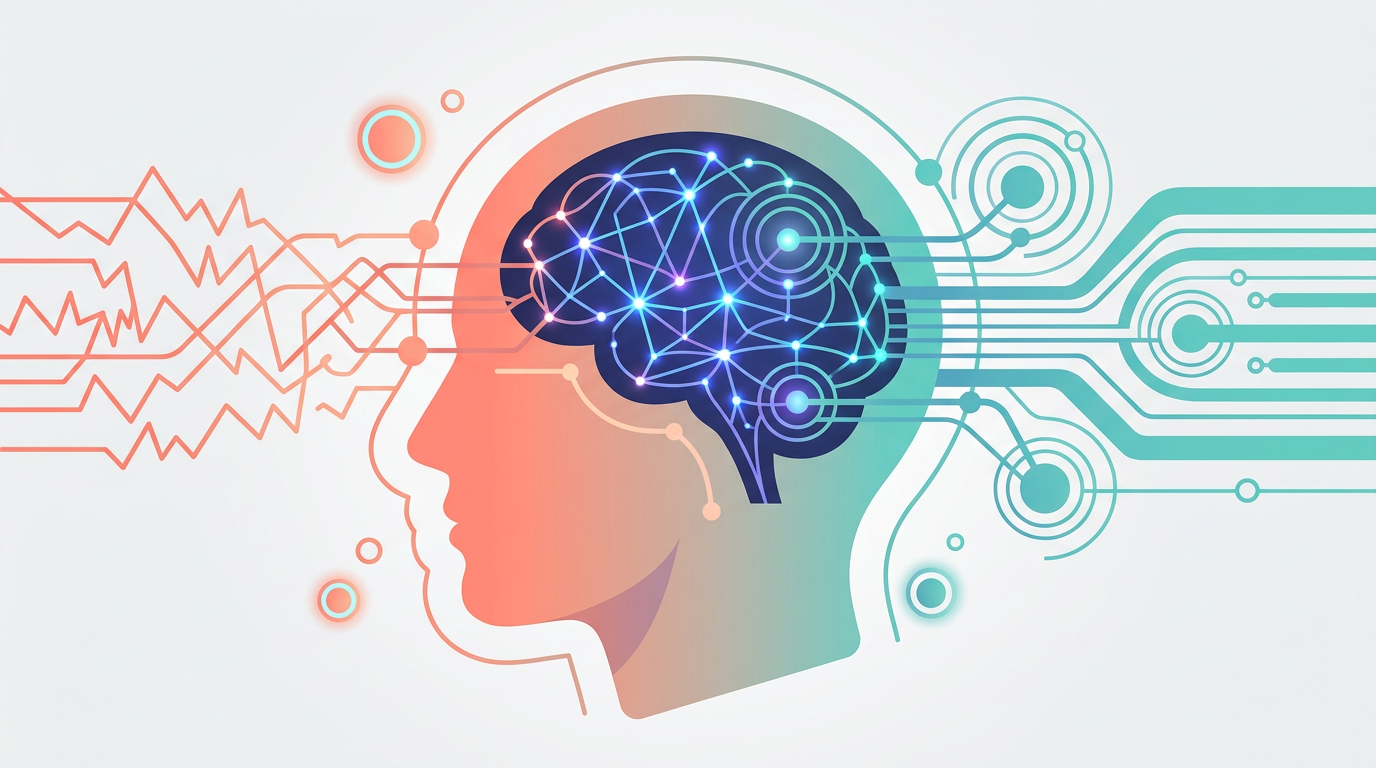
Cognitive Load in Interviews: Why Mock Practice Is Your Best Stress Reducer

“You Were Just Too Nervous” — The Most Useless Interview Feedback
“You did well otherwise, you were just too nervous.”
This is one of the most common — and least helpful — pieces of interview feedback. It is like a doctor telling you “you seem unhealthy” — it names the problem without explaining the cause or providing a solution.
What makes it worse is the attribution trap: once you label interview nervousness as a personality flaw, you are stuck. You cannot change your personality. But the cognitive science perspective is completely different: interview anxiety is not a character trait — it is a cognitive resource management problem. You do not blank out, speed up, or lose logical coherence because you are “naturally nervous.” You experience these things because your finite cognitive resources are being divided among too many simultaneous tasks.
This is good news. Because cognitive resource allocation can be trained and optimized. And the essence of mock interviewing — whether powered by an LLM or a human — is training your brain to manage cognitive load more efficiently under interview conditions.
Recommended First: Use OfferGoose to Automate Your Interview Cognition
OfferGoose’s AI mock interview system is designed to move your interview responses from conscious effort to automatic execution. Through repeated practice with structured feedback, the STAR-C framework, common question patterns, and delivery mechanics become automated — freeing cognitive resources for the things that actually matter: connecting with the interviewer, reading the room, and delivering memorable, differentiated responses.
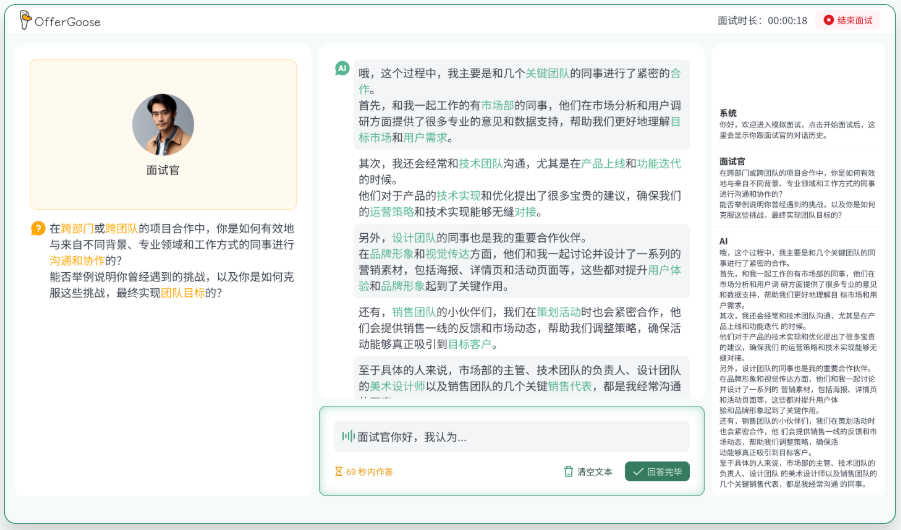
Your Brain Runs 5 Processes Simultaneously During an Interview
When sitting across from an interviewer (or on a video call), your brain simultaneously runs these five processes:
1. Comprehension
- Task: Parse the question’s semantics, identify keywords, understand the real intent
- Cognitive load: Medium
- Failure mode: “Could you repeat that?” (you heard it — your brain just didn’t have time to process)
2. Retrieval
- Task: Pull relevant knowledge, experience, and examples from memory
- Cognitive load: Medium-high
- Failure mode: “I worked on a project… wait, let me think…”
3. Organization
- Task: Structure retrieved fragments into a coherent response (STAR-C framework)
- Cognitive load: High
- Failure mode: “Um… so… basically…” (information is there, but not organized)
4. Production
- Task: Convert organized content into fluent speech while controlling pace, volume, and wording
- Cognitive load: Medium
- Failure mode: Rate spikes, filler word explosion, mid-sentence course corrections
5. Monitoring
- Task: Observe interviewer reactions, monitor your own performance, manage anxiety
- Cognitive load: High
- Failure mode: Over-monitoring interrupts response flow (“Wait, did I say that wrong?”)
The combined load of these five tasks easily exceeds working memory capacity. When total load surpasses capacity, the brain downgrades — prioritizing basic functions (comprehension) and sacrificing higher functions (structured organization, fluent production). This is the neuroscientific explanation for “going blank.”
Three Cognitive Overload Patterns
| Pattern | Manifestation | Root cause |
|---|---|---|
| Retrieval collapse | Know the answer but can’t recall it | Retrieval resources hijacked by monitoring |
| Organization collapse | Stream of consciousness, no logic | Organization squeezed by retrieval + monitoring |
| Production collapse | Rate spikes, filler explosion | Production degrades to “survival mode” under low resources |
What most people call “being too nervous” is actually one or more of these three patterns.
Why “Just Relax” Fails — And What Actually Works
When you tell yourself “don’t be nervous,” your brain does the opposite of relaxing: it shifts attention from answering questions to monitoring nervousness. This does not free cognitive resources — it adds to the monitoring load, making you more nervous.
The effective strategy is not reducing load — you cannot make the interview easier or less important. The strategy is cognitive automation: lowering the resource cost of specific tasks through practice.
When a skill moves from conscious processing to automatic processing, its cognitive resource consumption drops by 70-90%. This is why experienced drivers can hold conversations while driving — driving has become automatic. Why senior engineers can explain their thinking while coding — syntax and basic logic are automatic. And why novices fall apart in interviews — all tasks are still in conscious processing mode.
The scientific essence of mock interviewing is moving the “organization” and “production” tasks from conscious processing toward automatic processing.
Three Levels of Automation Through Mock Interviews
Level 1: STAR-C Becomes Muscle Memory
After 8-12 mock interview sessions, STAR-C shifts from “I need to remember to use STAR” to “question heard → STAR auto-launches.” Neuroscientifically, the relevant neural pathways transfer from the prefrontal cortex (conscious thought) to the basal ganglia (automatic execution). When organization (process 3) becomes automated, freed resources can go to retrieval (better examples), monitoring (better interaction), or simply making your delivery more natural.
Level 2: Pattern Matching for Common Questions
Through repeated practice with high-frequency behavioral question types — conflict, failure, leadership, influence — your brain stops “searching from scratch” and starts “pattern matching.” This dramatically reduces retrieval (process 2) cognitive load. OfferGoose’s RAG system generates variant questions based on your resume — same evaluation dimension, different surface form — accelerating pattern-matching ability.
Level 3: Production Fluency
ASR analysis reveals a consistent pattern: after 10+ mock interview sessions, filler word density drops 40-60% and speech rate variability narrows by 50%. This is not because candidates “became better speakers” — it is because organization automation eliminated the need to constantly switch between “thinking” and “speaking.”
The Monitoring Liberation
When organization, retrieval, and production loads decrease, the most critical liberation happens in monitoring. You no longer need to spend attention on “am I using STAR?” or “am I speaking smoothly?” — those are automatic. The freed resources go to monitoring what actually matters: interviewer reactions, conversation rhythm, timing.
This is the fundamental gap between interview experts and novices — not intelligence, not experience, but cognitive resource allocation efficiency.
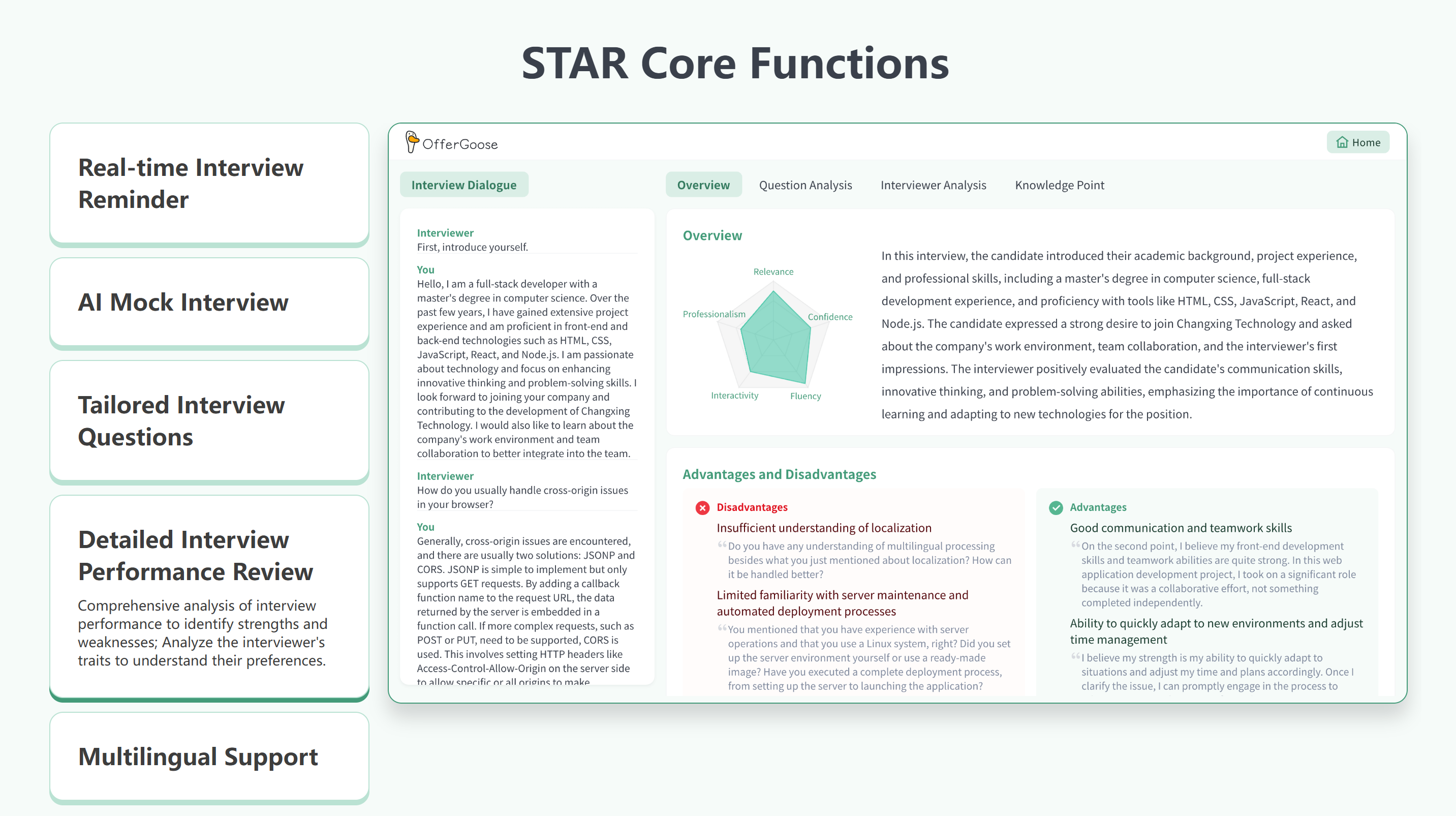
Interview Flow State: Cognitive Load Management at Its Peak
Flow state — complete immersion where self-consciousness dissolves and action merges with awareness — is achievable in interviews. Interview flow is not “zero nervousness” — optimal arousal level is actually a prerequisite.
Interview flow characteristics:
- You comprehend questions clearly without needing repetition
- Responses flow naturally without consciously “recalling” frameworks
- You perceive interviewer engagement and adjust in real time
- You do not interrupt yourself mid-response to evaluate “how am I doing?”
The enemy of flow is excessive self-monitoring — the metacognitive voice that evaluates every sentence in real time. Each appearance of this voice draws from your finite cognitive pool. Interview novices are drowned by it; interview experts have learned — through extensive mock practice — to turn down its volume.
The ultimate goal of mock interviews is not to make your answers better. It is to make you stop needing to evaluate your answers while delivering them. When “doing” and “evaluating” stop running simultaneously, you approach interview flow.
Three Anxiety Types and Their Cognitive Strategies
Type 1: Preparation Anxiety
“I’m worried they’ll ask something I didn’t prepare for.” Root cause: Retrieval load too high because knowledge is not structurally organized. Strategy: Build a knowledge organization framework, not a question bank. STAR-C maps any question — freeing you from needing to have prepared that specific question.
Type 2: Social Evaluation Anxiety
“I keep wondering what the interviewer thinks of me.” Root cause: Monitoring load too high, driven by primacy effect anxiety. Strategy: Convert “evaluation monitoring” to “signal monitoring.” The interviewer’s micro-expressions are not necessarily judgments — they may be processing your answer. Train yourself to attend to informational cues (“they seem interested in the technical detail”) rather than evaluative cues (“do they think I’m doing poorly?”).
Type 3: Expression Block Anxiety
“I know the answer but can’t say it.” Root cause: Production load too high, often coupled with insufficient organization automation. Strategy: This is the most directly responsive type to mock interviews. Repeated voice-mode practice with OfferGoose builds the organization-to-production pipeline from manual to automatic. ASR delivery metrics provide objective data on invisible progress.
FAQ
General Questions
What if I’m relaxed during mock interviews but still nervous in real ones?
Your automation training has not yet generalized across context change. Solution: add environmental fidelity to mock practice — same attire, same device, same posture. Environmental cues can trigger automated responses through conditioning.
Is cognitive load always bad?
No. Zero cognitive load means the task is trivially easy — zero growth. The optimal state is manageable challenge within your capacity. This is the zone of proximal development — exactly where mock interviews should position you.
Questions About OfferGoose
How does OfferGoose specifically reduce cognitive load during practice?
OfferGoose reduces cognitive load through three mechanisms: first, by providing a zero-judgment AI environment, it eliminates the social evaluation component of monitoring load. Second, its structured STAR-C detection automates the organization task over repeated sessions. Third, its real-time interview assistant acts as an external working memory during live interviews — offloading retrieval and organization so you can focus on delivery and connection.
How many sessions before I notice cognitive automation effects?
Most users report noticeable reduction in “mental effort during responses” after 5-8 sessions. The objective markers — reduced filler density, stabilized speech rate, improved STAR-C completion under pressure — typically appear by session 10-12.