
The Introvert's Interview Survival Guide: How Mock Interviews Help You Overcome Social Anxiety

The Introvert’s Interview Survival Guide: How Mock Interviews Help You Overcome Social Anxiety

“It’s Not That I Can’t Do the Job — I Just Can’t Say It”
Su’s pre-interview routine was always the same: anxiety starting three days before, insomnia the night before, sweaty palms thirty minutes before, mental blank five minutes before. She could feel her knowledge and experience were all there — locked in a vault she could not open.
After each interview, walking out of the building, every locked-away answer came flooding back — clear logic, precise wording, even better examples she should have used. But it was always too late.
“Interviewing is a live performance game,” she said. “They judge what you show, not what you actually have but couldn’t show. And interviewers don’t care about the difference.”
She is right. This creates an unfair gap for introverts. But that gap is closable. Research in affective computing and behavioral science shows that social anxiety response patterns — racing heart, narrowed thinking, degraded verbal organization — can be effectively managed through gradual exposure therapy and deliberate practice. AI mock interviews provide exactly that: a zero-social-pressure training environment.
Recommended First: Use OfferGoose for Zero-Pressure Interview Training
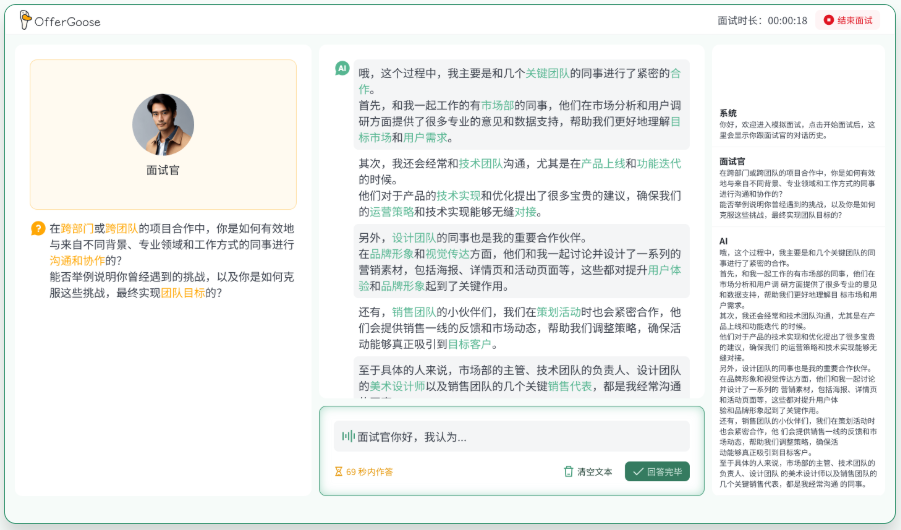
OfferGoose’s AI mock interview creates a completely judgment-free practice space — no interviewer expressions to read, no awkward silences to fear, no real-time anxiety about “did I say something wrong.” You can practice the same question repeatedly until the act of verbal expression itself becomes automatic. When basic delivery stops consuming cognitive resources, you free up bandwidth for what actually matters: content quality and authentic connection.
The Three Core Challenges Introverts Face in Interviews
Challenge 1: Cognitive Resources Hijacked by Anxiety
When introverts enter high-stakes social situations, the amygdala over-activates, triggering fight-or-flight responses. Significant cognitive load gets diverted to “anxiety management” — monitoring your own expressions, worrying about the interviewer’s judgments, interpreting silences — leaving insufficient resources for actually answering questions. This is not an intelligence or ability problem — it is a cognitive resource allocation problem.
Challenge 2: The Think-Speak Gap Reads as Hesitation
Introverts process information through “internalize first, output second” — they need to fully construct a response mentally before speaking. This think-speak time gap gets misinterpreted by interviewers as hesitation or uncertainty. NLP pause analysis confirms: introverts pause more at response beginnings (thinking phase), while extroverts pause more mid-response (organizing phase). Interviewers and AI evaluation systems tolerate mid-response pauses far more than beginning pauses.
Challenge 3: Non-Verbal Signal Spiral
Nervous introverts display signals — averted gaze, softer voice, leaning back, reduced smiling — that trigger the interviewer’s primacy effect, forming an impression of low confidence. When you sense this judgment, your anxiety intensifies, creating a downward spiral.
Why Introverts Can Actually Outperform Extroverts
Introversion is not a defect — it is a different information processing mode with natural interview advantages:
Depth of thinking: Introverts show stronger prefrontal cortex activity during default-mode processing, enabling more detailed analysis. In system design or case interviews requiring demonstrated thinking depth, introverts often deliver higher quality responses.
Precision: Introverts default to “quality over quantity” expression. They may say less, but what they say typically reflects more thorough processing — a hidden advantage in behavioral interviews, once you learn to structure that precision.
Listening ability: Strong interview performance includes three phases: understand the question → confirm understanding → organize response. Introverts often excel at the first two — they listen more carefully before rushing to answer.
Three-Phase Gradual Exposure Training
Phase 1: Zero-Pressure AI Environment (Sessions 1-8)
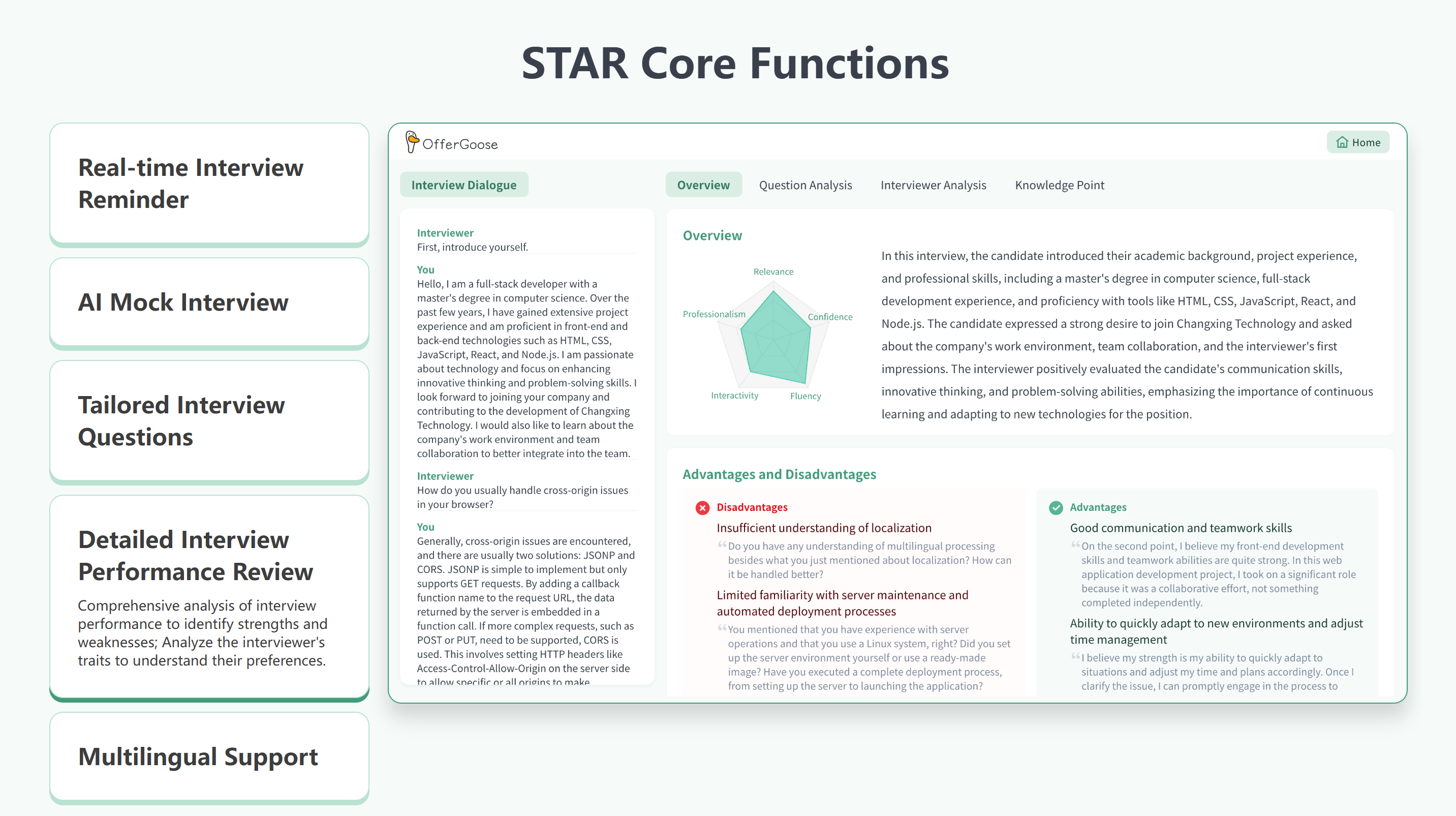
Practice basic “hear → organize → output” flow without any social evaluation. Build STAR-C muscle memory. Use AI debrief reports to discover expression issues you were not aware of. Value: automate basic delivery so it stops consuming cognitive resources.
Phase 2: Incremental Pressure (Sessions 9-15)
Switch to high-pressure interviewer mode. Reduce thinking time limits. Use voice mode for real-time delivery pressure. Goal: not to eliminate nervousness, but to remain functional while nervous.
Phase 3: Bridge to Human Practice (Sessions 16-20 + peer practice)
After AI has built sufficient foundation, add human practice. Use OfferGoose as a “warm-up” before peer sessions — lowering the psychological barrier to social expression mode.
FAQ
General Questions
How do I handle “lack of presence” feedback?
Presence is decomposable: speech rate stability + volume confidence + eye contact + response structural completeness. You do not need to become a “high-presence person” — you just need to reach acceptable thresholds on these four measurable dimensions. OfferGoose’s debrief provides precise scores for each.
Does pre-interview anxiety insomnia have a solution?
Mock interviews themselves are the most effective desensitization therapy. After 20 sessions covering diverse difficult questions and pressure follow-ups, the unknown factor of real interviews drops dramatically. Known challenges do not trigger the same anxiety level.
Questions About OfferGoose
Is OfferGoose suitable for introverts specifically?
Yes. The system’s zero-judgment AI environment is ideal for gradual exposure training. You control the pace — start with supportive interviewer mode, text input, and generous time limits, then progressively increase pressure as your comfort grows.
Can OfferGoose help with non-verbal communication?
The ASR analysis captures delivery metrics — rate stability, pause patterns, filler density — that correlate with perceived confidence. While it cannot analyze facial expressions, it provides objective data on the vocal dimensions that most affect interviewer impressions of confidence.