
How AI Mock Interviews Work: The Technology Behind Realistic Interview Simulation

How AI Mock Interviews Work: The Technology Behind Realistic Interview Simulation

The Technology Most Users Never See
Over 60% of major employers now use at least one AI tool in their hiring process. But the more interesting revolution is happening on the candidate side: AI mock interviews are rapidly going from a “secret weapon” for tech candidates to a standard tool across all industries.
Yet most users have no idea what is happening under the hood. They see a chat window or an avatar and assume it is “ChatGPT dressed up as an interviewer.” That misunderstanding creates a hidden disadvantage: you cannot use a tool well if you do not understand what it actually measures and how.
A modern AI mock interview system integrates multiple technology stacks: large language models for dynamic question generation, retrieval-augmented generation for personalization, automatic speech recognition for delivery analysis, chain-of-thought reasoning for follow-up depth, and affective computing for non-verbal signal detection. Understanding how these pieces fit together helps you get more from every practice session.
Recommended First: Use OfferGoose for Technology-Backed Interview Practice
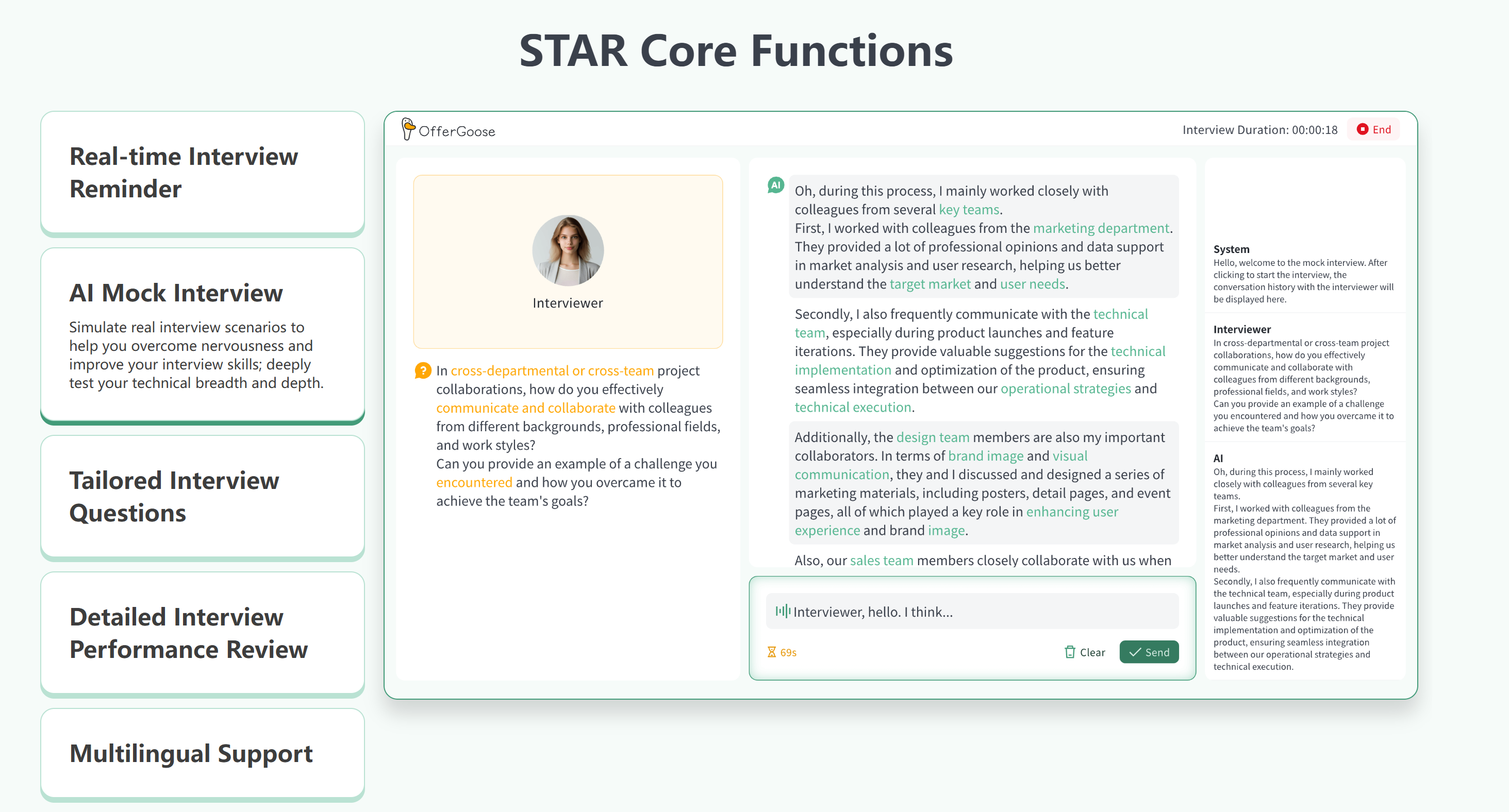
OfferGoose is built on this multi-stack architecture. When you upload your resume and target job description, the RAG engine extracts personalized “information anchors” — specific projects, skills, and experience points — and builds question chains that probe deeper with each follow-up. After the session, six-dimensional analysis covers logic structure, clarity, data usage, professional depth, interaction quality, and confidence. This is not a chatbot role-playing — it is a purpose-built interview training system.
Layer 1: Question Generation — Not Random, But Dynamic
First-generation interview practice tools pulled questions from a fixed bank. You answered one, moved to the next. No follow-up. No adaptation based on your response. That is functionally identical to reading interview experiences.
Transformer-based LLMs changed this entirely. The system does not “pull” questions — it generates them based on your resume, the target job, and your previous answers. More importantly, it constructs follow-up chains:
- Question 1 (breadth): “Tell me about your role in project X.”
- Question 2 (depth): Based on the technology you mentioned — “You chose Redis for caching. Why Redis over a local cache solution?”
- Question 3 (boundary): Challenging your decision — “If your data volume grew 10x, where would your caching strategy break?”
- Question 4 (business): Lifting to value — “What measurable business outcome did this caching optimization produce?”
This chain-of-thought questioning pattern mirrors what senior interviewers actually do: progressively probe the edges of your competence through layered follow-ups.
RAG is the underappreciated technology here. Without it, an LLM can only ask “How did you do user growth?” — a generic question. With RAG, OfferGoose retrieves your specific project details from your resume, matches them against the JD’s growth requirements, and asks: “In your e-commerce user growth project, you mentioned a 15% conversion improvement through A/B testing — how did you design the experiment groups? How did you select the control group?”
Layer 2: Speech Recognition — AI Reads More Than Your Words
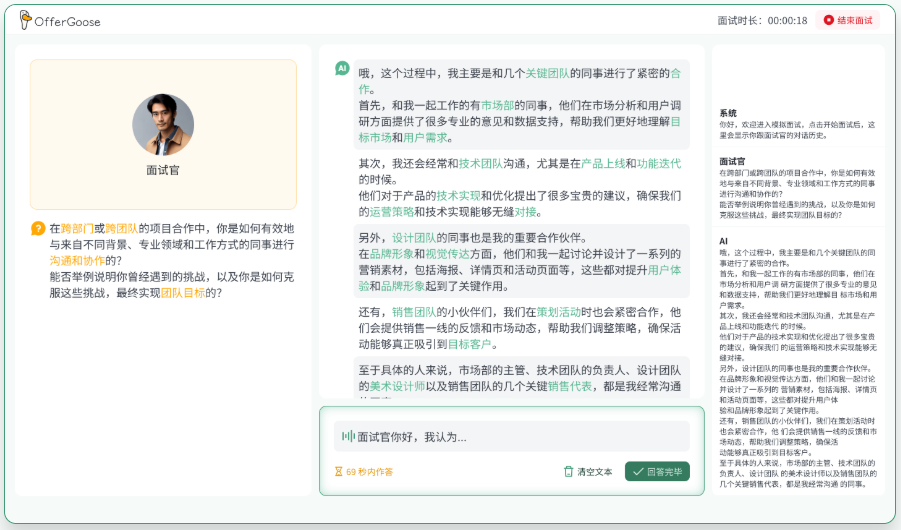
ASR in mock interviews does far more than transcribe speech to text. Modern ASR engines collect:
- Speech rate curves: Changes in speed across different question types. A sudden acceleration on salary expectation questions often signals discomfort.
- Pause analysis: Pause location matters more than pause duration. A pause between STAR framework segments is normal cognitive organization. A long pause mid-sentence on a simple statement signals uncertainty.
- Filler word density: The distribution pattern of “um,” “uh,” and similar fillers. Experienced interviewers notice this subconsciously.
When these signals combine with NLP text analysis, you get a dual-channel evaluation: the text channel assesses logic and content quality; the speech channel assesses delivery fluency and confidence signals.
Layer 3: Evaluation — Not a Single Score, But Six Dimensions
A single overall score tells you almost nothing. Useful evaluation decomposes performance into specific, actionable dimensions:
| Dimension | What AI evaluates | Practical value for you |
|---|---|---|
| Logic structure | Clear framework (STAR), causal links between points | Identifies “beginning-middle-end” vs. “stream of consciousness” |
| Content relevance | On-topic vs. drifting, question comprehension | Reveals your “answering a different question” patterns |
| Quantitative expression | Concrete data, verifiable results | Pinpoints where you use vague language |
| Professional depth | Accurate terminology, depth appropriate to role level | Distinguishes “heard of it” from “understands it” |
| Interaction quality | Confirmation of understanding, counter-question awareness | Evaluates you as a conversation partner |
| Delivery fluency | ASR-based rate, pauses, filler analysis | Provides objective fluency metrics |
Why ChatGPT Interview Practice Is Not the Same Thing
Many candidates think they are doing “AI mock interviews” by prompting a general chatbot to “act as an interviewer.” This approach has three fatal limitations:
First, no follow-up chain. The chatbot asks Question 2 without any connection to your Answer 1. Real interviews do not work this way.
Second, no personalization. The chatbot does not know your resume, your target role, or your industry. It generates questions from a generic “product manager interview” label — functionally identical to reading a generic interview guide.
Third, no multi-dimensional evaluation. At best, you get “your answer was good, consider adding more detail” — which is not feedback, it is filler.
FAQ
General Questions
How accurate is AI mock interview evaluation compared to a human interviewer?
AI evaluation is highly reliable on codable dimensions like logic structure, content relevance, and quantitative expression. The gap exists in nuanced non-verbal judgments (“this person has leadership potential”) and highly contextual assessments. However, AI evaluation has a key advantage: it is unaffected by primacy effect and mood fluctuations, providing more consistent and reproducible feedback.
Will practicing with AI make my answers sound templated?
Only if you use it to memorize answers instead of building frameworks. The goal is not to produce the same answer every time — it is to internalize a response structure that makes any question mappable. High-level performance comes from internalization, not memorization.
Questions About OfferGoose
What kind of follow-up logic does OfferGoose use?
OfferGoose uses chain-of-thought reasoning to identify “fuzzy points” in your answers — areas where you were vague about your personal contribution, avoided quantifying results, or skipped the business impact — and generates targeted follow-ups that simulate how a senior interviewer would probe those gaps.
Is OfferGoose suitable for technical interviews?
Yes. OfferGoose includes specialized modules for system design framework guidance, algorithm expression practice, and technical concept articulation — all evaluated across the same multi-dimensional framework.
👉 Try OfferGoose and experience technology-backed AI mock interviews